Tag Archives: travel

Senior Timeshares: Beware the Hard Sell

I should have been suspicious from the start. Because the older I get — and I just turned 68 — the more I recognize that when I react rather than respond, or am impulsive rather than intentional, allowing my body to move more quickly than my brain, the situation rarely ends well.

The story begins last March. When I reserved a hotel room for a women’s conference in Des Moines, Iowa, this coming February, the booking agent asked at the end of the call if I could stay on the line to hear a marketing offer. Because the property where I had booked a room is part of a major hotel chain, my reward would be 500 points in the organization’s honors program. “Sure,” I told the agent, “I’m game.”

Apparently, I had joined the program for repeat customers back when I traveled to professional conferences once or twice a year. On my own time, I prefer to stay at AirBnB or VRBO short-term rentals because the properties are homey and private, provide a kitchen that helps save on meal costs and tend to be situated among the locals. In short, I feel less like a pampered tourist.

A VRBO in North Carolina that my sister rented for three of us last April for a family wedding.

But pampering is precisely what this hotel chain — and all of the hotel-affiliated timeshare programs — aims to do. The marketing pitch was an enticing offer to spend a few discount-rate nights at a swanky property in Las Vegas or Florida or, my choice, New York City in exchange for a two-hour meeting about the company’s “exclusive timeshare brand.”

The pitchman on the phone asked about my travel habits, employment history and marital status. (Red flag!) Then he offered a reasonably priced deal for three days and two nights at a hotel in midtown Manhattan, but he emphasized repeatedly (another red flag) that I had to pay the $285.75 charge on the spot — that day! I also had to promise that both my husband and I would be on time for the 8:30 a.m. timeshare meeting the morning after we arrived. Otherwise, our hotel room would revert to full price, about double the promotional rate.

Some weeks later, we forked over an extra 65 bucks to convert the trip to a slightly longer four days and three nights at a property in downtown Chicago, a scenic train ride away from our home in the Twin Cities. The tactics of the hard sell at the morning meeting (“don’t be late,” the desk clerk warned when she checked us in at the hotel) harkened back to the original phone call. Not duplicitous but canny, and well rehearsed.

Buy now, pay later

From the get-go, the whole tone and tenor put me on edge, employing sales techniques I had never experienced, even on a car lot. Once we arrived at a modern, amenities-laden property a 15-minute walk from where we were staying, I had to answer a list of the identical questions the telephone salesman had asked me weeks before (marital and employment status being key).

Hotel representatives also wanted to know our top “dream vacation” spots to get away. My choice of Canada and the Netherlands may have been a clue that we weren’t their highest budget catch.


Once the Keurig machine had brewed our coffee and we’d collected mini containers of yogurt and cellophane-wrapped pound cake (the promised breakfast), the meeting began, led by a jovial salesman named Pete.

  • Dressed in business casual (a jacket and necktie would show up later on the man who tried to close the sale), he ushered us into a brightly lit office with partial walls and no door, lending an air of immediacy and vibrancy given the noisy activity in the hallway.
  • The persistent beat of the piped-in Muzak, loud enough that I sometimes couldn’t hear what Pete was saying, seemed designed to distract us. When I asked if he could turn the music down, he said the volume kept others from overhearing Social Security and credit card numbers when deals were getting done.
  • Within minutes of sitting down, Pete asked us what type of properties we usually like to stay in. I explained our preference for short-term rentals — they accommodate my early-bird and my husband’s night-owl tendencies — and specifically mentioned Airbnb. Later, when Pete was showing us a typical timeshare suite on an upper floor of the hotel, he told us that he once discovered a video camera in the shower of an Airbnb and (“thank goodness!”) removed it before his wife used the bathroom.
  • Noting that a key card is required for entrance to the elevators, Pete stressed the safety of the hotel chain’s timeshares — a selling point for the graying target market — and said only other timeshare members would be on the floor of any property we rented. Like a gated suburban community, we’d be tucked in among our own.

Throughout the exciting, emotional, enticing presentation (and it was all three), Pete flipped through digital photos of hotel-chain properties, from resorts and cruises to “glamping” sites at national parks, on a horizontal monitor embedded beneath his glass-topped desk. He said we could join the timeshare program for $80,000 — more than 20 percent of which would be due that day.

Florida beach: Photo by Michael Monahan on Unsplash

“We can’t access that kind of money on the spot,” I told him. “It would have helped to know this coming into the meeting.” He assured us the company could provide a credit card on which to finance the $17,000 down payment; we would sign a contract for the rest, plus the annual HOA fee of $2,100.

My head was spinning. “Could you give us your last name and mobile number,” I asked, “so we can talk things over this afternoon?” Pete said he carried no business cards — an odd practice for a salesman — and stressed again the act-now nature of the offer. Just like the telephone sales pitch that had gotten us to Chicago in the first place, the deal had to be done immediately. On the spot.

Nearly 90 minutes into the two-hour presentation, I learned that our assigned timeshare location would be in Florida, with options to use other company properties around the world. I had already explained to Pete that I wouldn’t spend money in a state where my transgender cousin could be charged with a felony for using a women’s bathroom and where the ACLU describes the year-old abortion ban as “near total,” with “no real exceptions for rape or incest.”

He said no other property was available that day — these being act-now, one-time offers. Then he brought in a “closer,” a trim man in a tailored suit, who consulted his iPad and said he happened to have a different Florida property for only $53,000, a considerable savings from the original quote of $80,000.

But it was Florida again, which we neither wanted nor requested. I walked out, leaving my husband to extricate himself while I waited on the sidewalk, red flags flying everywhere I turned.

Exit strategy

A timeshare sounds like a great idea, a cooperative ownership agreement with like-minded people for a property you have toured and approved. Or, so I thought, based on the arrangement my late father’s law firm had at a ski resort in Colorado.

In this case, the hotel chain wasn’t selling us a property per se. We were purchasing points for the right to stay a certain number of nights per year at any company property — 30 nights, based on our $80,000 purchase price — but we’d still be attached to this place in Florida, sight unseen.

Red flags by J.S. B. on Flickr. Creative Commons (CC) 2.0

My husband and I hadn’t realized that timeshare agreements can be notoriously hard to get out of. I learned that after a Google search led me to warning articles from AARP, a source I trust because they target scams that target seniors. A few days later, searching for the replay of a WNBA game on YouTube, I was stopped cold by an ad from Wesley Financial Group about “timeshare lies.” Apparently, my browsing history had led them to me.

Dubbing itself “the most proven and reviewed timeshare exit company” — CEO Chuck McDowell used to be a timeshare salesman — Wesley employed an attractive young actress to ask whether any of these sales tactics had been used in our timeshare pitch:

1. “Your maintenance fees will never go up.” Yes, Pete had told us that. On average, said the Wesley spokeswoman, they go up 4 percent a year.

2. “This is a financial investment.” We’d heard that, too. But real estate investments pay off based on supply and demand, “and the supply [of timeshares] is always high because of the massive marketing machine that is the timeshare industry,” the Wesley woman said.

3. “Your obligations will die when you pass away.” Actually, Pete had suggested the opposite, saying we could transfer the Florida property and the timeshare points to our two grown sons once we became too infirm to travel. Regardless, according to Wesley Financial Group, “most agreements are in perpetuity.”

After sitting through the mandatory meeting in Chicago, I recognized that a hotel- or resort-based timeshare — offered by Marriott, Disney, Wyndham, Hilton and others — could be ideal for people who travel more often than I do, who want luxurious accommodations where they are separated and safe, and who don’t let political leanings or social issues dictate their destinations.

That isn’t me. In hindsight, I am grateful to have walked away a little wiser and a whole lot less naive, and didn’t fork over $80,000 to remind myself of who I really am.
Travel as a Practice for Retirement

A version of this story appeared on June 10, 2025, in Next Avenue, a national publication for older adults published online by Twin Cities PBS.

When I left full-time work in September 2022, two months after turning 65, people naturally asked me how I liked retirement. Once I’d barked out my disdain for the R-word — chin lifted, spine stiffening — they learned not to inquire again.

In fact, the anxiety masked as rigidity was less about them than me: Retirement is a daunting prospect for us Baby Boomers who link our identity and sense of self with work.

I still don’t call myself “retired,” even though I work only a quarter-time job and a handful of contract gigs. But that’s about to change. I’ve given notice at my job, and my first grandchild is on the way, along with some shared responsibility for infant care.

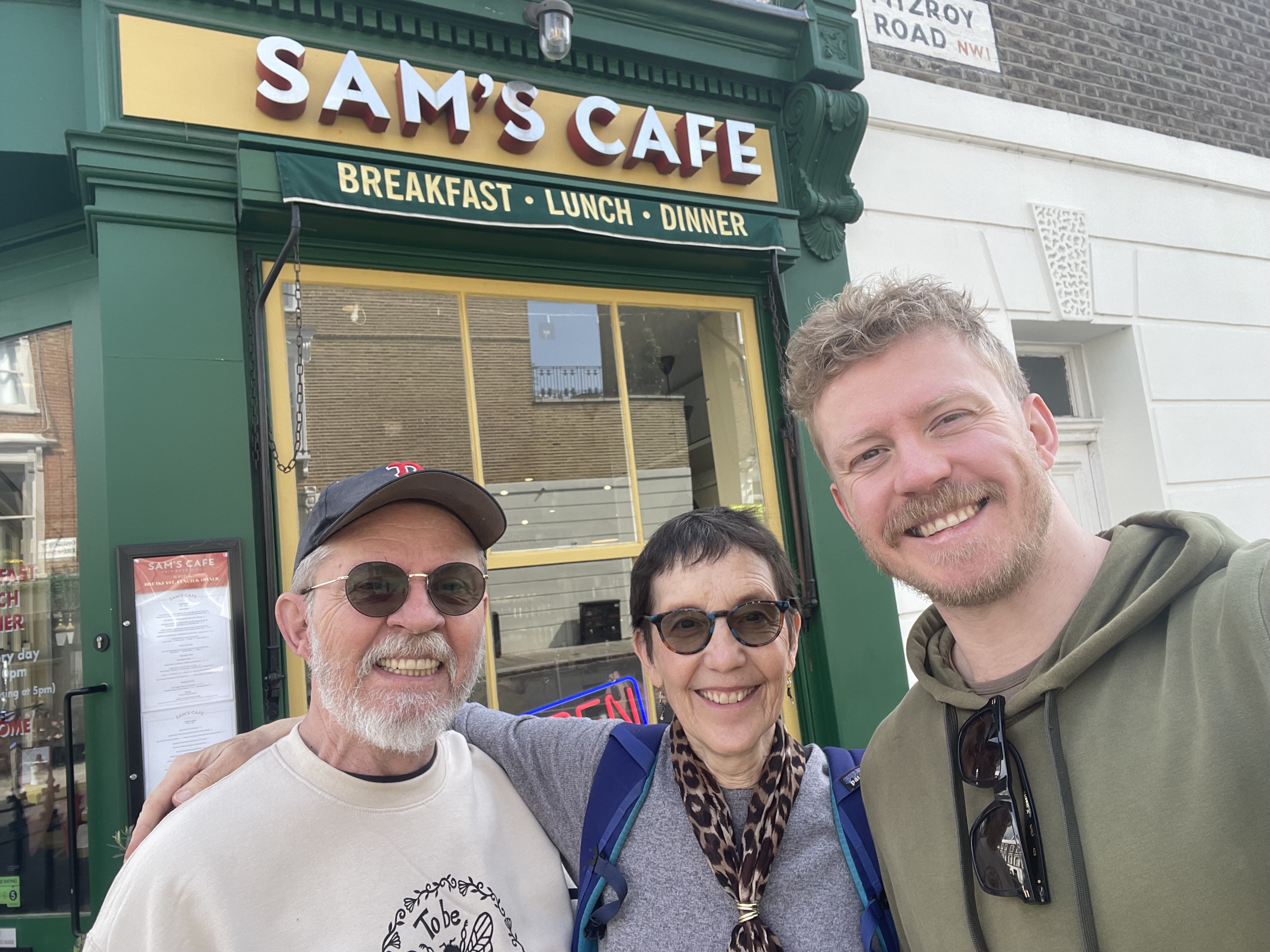
Husband, David Studer, and our older son, Sam Studer, who is at London Film School

Since my husband and I had planned an overseas excursion this past April to visit our older son, who is studying at London Film School, I decided to approach the trip — only my second time in Europe — as practice for the less structured, more selfless life that is awaiting me.

Here’s what I learned.

Lesson 1: Lose Track of Time

We go-getter careerists live and breathe by our agendas. This holds true for me even 32 months after leaving full-time work. My quarter-time job, my freelance assignments, even fitness classes and coffee dates with friends: All fill my calendar at least a month or two out from where I stand today.

The decision to avoid sticking to a rigid schedule in London, aside from ticketed events and planned outings with our son, was an exercise in letting go — both a relief and a discipline all its own. As we planned the trip, I insisted on only one “anchor activity” a day, forcing a spontaneity I rarely allow myself to experience.

My favorite times were early mornings, while my husband was still asleep. With no deadlines to hit or dogs to be walked, I wrote in my journal. Sent postcards back home to friends. Read the library book I had downloaded on my iPad.

I refused to check work emails, relying on the out-of-office message that told people I was away, and tried to sit with the discomfort of being unproductive. The clock dictates my day, and it took effort to silence the pragmatic voice that drives me, even on weekends: “It’s 10 a.m., and you’ve accomplished nothing.”

So what? No one was monitoring my output or keeping score on how deeply I dug into London’s vast cultural scene. Free to let the days and evenings take their course, I felt how nourishing a less hectic life can be. No coincidence, I slept longer and more deeply in a stranger’s British flat than I ever do at home in my own bed.

Lesson 2: Get Out in the World

As luxurious as it was to hang out some mornings, I also had days when I left my night-owl husband sleeping at the Airbnb and struck out on my own. March and April are London’s least rainy months, and a stretch of sunny weather made it a joy to start the day walking the streets or seeing the view atop an iconic, red double-decker bus.

Pro-tip: Google Maps and the Transit app were my best sources of navigation, but I also felt more comfortable being out alone in the daytime once I’d been in town long enough to learn my way around.

One of my fears about full-on retirement is losing regular contact with younger colleagues and allowing my world to shrink. It’s become tempting as I age to stay home with a good book and a homecooked meal, or to settle in with my pets and watch Netflix or women’s basketball and tell myself that is enough. Or that it’s safer.

So, following the lead of a widowed friend who goes alone to movies and concerts and routinely travels on his own, I spent the better part of one morning at the Tate Britain — one bus ride away — browsing the museum store, strolling through galleries and relaxing outside the cafeteria with my book. Yes, I was alone, but I was also among people.

Given my career in journalism and communications, I can easily strike up conversations with strangers, even in a city with thick English accents. The trip showed me how to carry my professional skills into retirement, when I no longer can wrap myself in the security blanket of a title and role, with a ready answer to the question: What do you do?

Lesson 3: Dress to Please Yourself

During my decades as a business reporter and later a marketing-and-communications director, I dressed up every day. Looked and acted the part of a career woman. I enjoyed shopping and the creativity of assembling a wardrobe — mixing and matching outfits, coordinating earrings, scarves and shoes — but toward the end of my career, especially after COVID, “dressing for success” felt like donning a costume. It wasn’t me!

In London, I had no one to dress for but myself. My comfort, the weather and how far I would likely walk that day dictated what I wore. That meant:

  • Comfortable shoes with heel support and a roomy toe box for the 17,062 steps I averaged during my nine days abroad.
  • Little to no eye makeup, even for “Carmen” at the Royal Opera House, because it could smudge in the wind and cold.
  • Refreshing my short razor haircut the day before we left, so I could fluff it with my fingers after wearing a hat for warmth or sun protection.
  • Ditching the more fashionable purse for a sturdy backpack, both to free my arms while walking and to discourage bag snatchers.

Now that I operate from a home office, I rarely dress up anymore. “Athletic casual” is how my younger son defines my style. Retirement allows that freedom — to quit comparing myself with younger women and dress for the age and body type I am today. And for movement, the best antidote to low energy and stiff joints.

Lesson 4: Keep Learning

My gradual glidepath to retirement these past two and a half years has given me time to adjust, both financially and emotionally. Of course, I worry: Will we have enough money? Who will I be without work? Will volunteering and family life fulfill the sense of purpose that a career has given me for decades?

A trip to London is not exactly high adventure for a white American with English roots. Still, I find it fitting that a foreign country became my place to try out a different way to live. Retirement is a bold undertaking, a journey toward a different land. My passport — my practice in the coming months — will be to remember and refresh these lessons learned.

Evolving Reflections on ‘Home’

My husband and I raised our two sons in Northfield, Minnesota — a progressive, two-college town where I always felt safe, where we rarely locked the side door off the driveway at night, where our kids rode their bikes freely around town. Back when we sold our family home in 2013, I wanted to write an ode to the place where I had lived for 20 years, the longest stretch of my lifetime.

That house was home, full of two decades’ worth of meaning and memories, family and friends, a center of activity for sleepovers and potlucks, where boisterous boys and loving dogs (rest in peace, Skip and Lucy) were a dominant, delightful presence.

The small-town house in Northfield, Minnesota, where our two sons grew up: 20 years of memories. Photo by Amy Gage

No one else in the family seemed to share my nostalgia for the white Dutch Colonial with a three-season front porch, a black roof and red trim, built in 1900 within eyesight of Old Main at St. Olaf College. It “looked appropriate” to see two little girls dash out the front door, my younger son said after he showed the house to his girlfriend during a trip back to town. That was all he would concede.

Eventually, I moved on, too, giving my heart to the smaller, 1906-era empty-nest house my husband and I have now in St. Paul, with a quaint wraparound porch that I fell for on sight. My shifting allegiances make me wonder: Is it the house itself that makes a home? Much as I love the expanded, updated kitchen in my current place and the egress window in the basement that fills my workout room with natural light, are those amenities what have bonded me to this place? Or could I comfortably, given time, call any place home?

Our city house today: walking distance to a library, four bus lines and two colleges, and a short bike ride to the Saint Paul Grand Round. Photo by David Studer

I’ve always reveled in the creative expression of home, the furniture and wall hangings and house plants that reflect my moods and tastes. These days, I am grateful not only for the safety and security I feel at home but for the privilege of being able to afford a house at all.

I root where I am planted. Whether it’s an upper duplex in northeast Minneapolis, a rental house on the edge of Indian Mounds Park in St. Paul or the first house that my husband and I purchased, and subsequently detached from when two teenagers burned a cross on the front lawn of a Black family down the street: Home is structure for me, a physical location, a place where I can put my stamp and comfortably be myself.

I had breakfast recently with a friend who had returned from a summer in Finland, her home country. She talked about the relatives she visited, described a mass transit system that allowed her and her wife to get along without a car, spoke fondly of the concerts they attended and the greater sense of ease in a society less gun crazy and politically polarized than ours.

“So, where is home,” I asked her.

“Home is where your people are,” she said.

My people, literally defined — the family I was raised in — are either dead or have moved away. My three surviving siblings are scattered around the country (the brother who died in 1988 lived just blocks from where I am now). At 67, I have few older relatives left in Minnesota. My mother, father and stepmother died in fairly quick succession, and all during autumn, in 2015, 2017 and 2018. In fact, my only extended family in a state where people are known for staying put is one sister-in-law in Minneapolis, an uncle who spends half the year in Florida, a first cousin in a far southern suburb and another first cousin about two hours north, a DFLer who keeps up the good fight in what is now solid red Trump country.

After seeing my older son off to London for graduate school in August, I feel lucky to have my younger son and his partner just a 10-minute bike ride away.

I describe my closest friends as “intentional family” — the folks who are no blood relation but with whom I share a history, the ones who hung with me through the messes and mistakes of young adulthood. After a 40-year career, I rarely go anywhere in St. Paul or Minneapolis without running into some colleague or connection. I worked with my next-door neighbor at St. Catherine University, shared a cubicle with the neighbor behind me for seven years in a newsroom and knew the woman who lives kitty-corner from my house at Minnesota Public Radio, when I was an editor on its magazine.

So, yes, as my friend says, people constitute “home.” My friendly neighborhood — with its walkability to mass transit, college campuses, and both fun and functional shopping — also enhances my sense of community. I thrive on the convenience of urban living, especially at an age when I feel less inclined to drive and more inclined to do good for the planet.

My parents divorced when I was 14. My childhood home was sold and my foundation ripped away at too tender an age for an awkward, uncertain girl. Perhaps that accounts for my love of home now, my reluctance to travel much with my long-retired husband. As my own career winds down, I have a growing desire just to stay home. To cook and tackle projects. To read and chat with neighbors.

To redefine my purpose and until then, to be still.

When my husband presses me about why I won’t travel more, I hardly know how to begin explaining. Our six-year age difference and our differing parental roles, which made sense when the kids were young, have now become a chasm in our respective wants and needs. As a largely on-site parent, he worked at home; even when he earned a part-time paycheck, he was the one in town while I commuted to my family-wage job.

He loved being Mr. Mom, “but there were no breaks or paid vacations.” And even though I did enjoy raises and paid time off and validations for a job well done, I also spent years leaving home five days a week, including on mornings when I longed to stay back with the little boy in the footie pajamas who held his arms out as I headed to the car.

Being at home now is sustaining; it slows me down, allowing a reset from 40 years of pushing into the wind. There is much of the world I haven’t seen, large swaths of this country I’ve yet to cover. I dream about taking a train somewhere all by myself.

But for today, the simple pleasures of tucking in with a dog and a good book, learning how to cook tofu or repotting plants in my backyard while listening to a podcast are as much adventure as I want or need. Give it time, I tell my husband. This, too, shall pass.