Tag Archives: Retirement

Should You Keep Social Media After Retirement?

One aspect of retirement that I never considered was how it would affect my profile on social media.

Nearly a year after leaving the last of my two part-time jobs, now working a contract gig that averages only 20 hours a month, I’m not sure I see the point in continuing to create and curate an online profile. At least not on a professionally oriented site like LinkedIn.

This is no small decision for a careerist who’s held public-facing positions.

I’ve been active on Facebook for years (true to my Boomer demographic) and a more occasional presence on LinkedIn and Twitter, pre–Elon Musk. Nine years ago — at the urging of young adults at work — I began toe-dipping into Instagram, which I had written off as a visual playground for photos of food, pets and sunsets.

Now that I no longer have professional contacts to impress, or any particular public image to maintain, is keeping up with social media still worth my time? To answer that question, I’ve come up with a set of criteria to evaluate whether I will retain any of these platforms at age 69, with my full-time, full-bore career four years behind me.

The following considerations will help me decide:

  • Can I be my whole self on this platform? This is important given the 21 years I spent as a communications professional for private colleges and universities, when any social media musings — even with the disclaimer that “posts are my own” — potentially reflected on the institution and once got me into deep trouble with my employer.
  • Do I enjoy and learn from other people’s content? This has become an issue for me in the progressive echo chamber that is Bluesky, where I silenced myself in declaring preferences for mayoral candidates in the Twin Cities, for example, because my views seemed more centrist and nuanced than the people I am following. Given the acerbic tone on Bluesky, I pause as I review political or policy discussions — the latest being the Democratic U.S. Senate race in Minnesota between Peggy Flanagan and Angie Craig — and ask myself: Are pissy exchanges with strangers worth this much emotional energy?
  • Does this feel like a creative outlet or an obligation? I posted a reel on Instagram the other day for the first time since late March after my weekly volunteer shift at a local food shelf. It gave me a little thrill, and I was proud of the message (“just show up”). But given that my first post on Instagram was in March 2017, and I’ve posted only 125 times since then, I am unlikely to become an influencer or even attract many followers beyond my friends and family.

Cutting the cord, deleting the accounts, wiping the slate clean just feels so . . . final. Like a concession to being old and out of touch. It’s the digital equivalent of burning journals — and eliminating a piece of my history that once felt important.

This is where the three criteria are going to help me.

News source or entertainment?

I’d never thought of Instagram as a news site until Trump’s ICE agents invaded Minnesota last January, detaining and assaulting immigrants and other people of color and killing two white citizens on the street in broad daylight. The horror, the family separations, the economic impacts of that brutality will never leave our collective consciousness.

Amid it all, as I used the newspaper and public radio and neighborhood Signal chats to follow the violence and resistance, I noticed that my older son in London, then 35, seemed to have a better handle on the goings-on than I did.

Younger people are more likely to be regular news consumers on TikTok, Instagram, Reddit and X. Democrats are also more likely than Republicans to say they get news from Instagram.

Pew Research Center, September 25, 2025

“This ICE stuff in the Cities is insane,” he wrote me on WhatsApp on January 17, 2026, a week before agents murdered Alex Pretti. “I’m seeing at least 3–4 new videos every day of something horrible. Two people have been shot, one kid permanently blinded. Shot from point blank with a pepper ball and dragged away by his collar.”

When I asked Sam about his news source, he replied instantly: Instagram. “Everyone is recording and posting everything,” he said. And then he directed me to Unicorn Riot, from which algorithms eventually led me to all kinds of local heroes and local news — on the ground, unfiltered, in real time.

Instagram is the social media site where I am learning the most from other people’s posts and reels. Where I think less about cultivating a “professional” persona and feel most free to get creative with what I want to present, as I did in the first reel I posted, during the ICE invasion.

  • My reasons for staying? Instagram checks all three of my boxes: whole self, creativity and education. News source or entertainment? I like that Instagram is both.

You’re my Bluesky . . . or not

I joined Bluesky by invitation — the only way to get on the platform initially — in September 2023. I was managing editor of Streets.mn, a community-oriented online magazine in the Twin Cities, and up until that time, Twitter had been my go-to platform to build sources and follow trends among the multimodal advocates, urban planners, city zoning experts and climate activists — the self-described “urbanists” — who were far younger than I was.

My Twitter profile, which dated back to 2008, had a photo of my dogs, a description of me as both an employee and a volunteer, and lots of posts about women’s basketball, reproductive rights and local politics. The platform felt more entrepreneurial and less polished and performative than Facebook, and I responded in kind.

Elon Musk changed that. Once the billionaire took over Twitter in October 2022, eventually rebranding it to X with a foreboding black background, the left-leaning regulars already were abandoning it. Progressives started migrating to Bluesky in February 2023, when the platform was being beta-tested as an invitation-only app and a year after Bluesky — which started as a Twitter initiative back in 2019 — had officially spun off from X.

By late 2024, when Bluesky was fully open to the public, major media like Forbes and CBS News were covering people’s exodus from Twitter. I had no interest in associating myself with Musk or the second Trump regime, but the larger reason why I quit posting to X in November 2024 (though I have maintained my account, for posterity, I suppose) was that I didn’t want my Streets.mn sources and writers to think I was out of touch.

In true social media style, I had an image to maintain, in this case as the still “with it” older woman.

Truth is, since resigning from the editorial position, I have struggled to discover who I am on Bluesky. I was there in a role, as an editor who made connections because it served my job. Now the task is to shape and share my own identity. But I don’t find the platform receptive to who I am.

My blog posts on mindful aging generate little engagement, and the one time I tried to reveal myself — describing my despair when thieves ransacked my well-tended Little Free Library — one commenter shrugged: “I thought that’s what Little Free Libraries are for.”

Conservative columnist George Will recently described a progressive politician as being “fluent in the online snark and condescension that clog social media.” Though I take issue with Will on any number of issues, I do agree with those who’ve criticized Bluesky as a “monoculture” that neither invites nor elevates dissenting views.

  • Using my own criteria, what are the reasons for staying? I can’t think of any. I rarely bother to post anymore.

The last ‘Link’ to professionalism?

I recently revised my résumé from four single-spaced pages to a single sheet that emphasizes volunteering, family and personal interests, names me as retired and focuses on the attributes (“well organized, high energy, community minded”) that I hope will land me a part-time job, at some point, at a neighborhood business.

The résumé does list my LinkedIn profile, which these days showcases my blog and freelance writing and the publication I write and edit for the Bicycle Alliance of Minnesota. So, that’s reason enough to keep the account active, even though I’ve posted only six times this year and the “impressions” for each post have been diminishing.

LinkedIn allows professionals, including the middle class, to invest in themselves in order to find the right jobs.

Democratic mega-donor and LinkedIn co-founder Reid Hoffman

LinkedIn takes hits for being inauthentic, promoting “humble bragging” and trading in “personal brand growth.” I use it as a professional bulletin board and an online space that feels safe. Because it’s meant for career-building, LinkedIn has a decorum that appeals to my understanding of what constructive dialogue and “good manners” means.

Several of my retired peers have kept their LinkedIn pages, though they rarely post. “I wanted people to know I retired,” says one, “and I don’t see any harm in keeping it. Today it told me my cousin has a new job, and I wouldn’t have known without LinkedIn. It’s interesting to see what people are up to.”

Another friend laughs that her LinkedIn page is “deep in cobwebs. I don’t even remember my password at this point.” I’ve worked in the field of information currency and communications for too long to keep a site active that I never look at or maintain.

  • Reason for staying? That’s a fourth criterion. Because for now, at least, it serves me.
How You’ll Know When It’s Time to Let Go

Ego, irritation and exhaustion are the watchwords of this story — the emotional and physical habits that work against us as we age. TLDR is the cheeky abbreviation for “too long, didn’t read” (yes, I learned that from a Millennial), so if you’re stopping here, try to guard against:

  • Self-importance (the conviction that only you know what’s best).
  • Sanctimoniousness (feeling thwarted when others counter what you believe to be right).
  • Overdoing it (because you believe you can control the outcome).

I want to tamp down these tendencies in the autumn of my life. Quitting work at age 68 may help me do that.


Image by freepik

I have talked about retirement so often in this blog that my friends and family just dismiss me: You love being busy. You’ll never quit working. The first statement is true. The second has changed, which I never anticipated during my decades as a careerist.

At the end of August, after months of hand-wringing and internal debate, I finally left the last of my part-time jobs. I embraced the word “retirement,” even as I struggle still with what it means.

Getting there has been a journey:

  • Three years ago, in September 2022, I resigned from full-time employment after I turned 65 and archly declared that no one should view me as “retired,” given the two part-time positions I’d taken on.
  • Six months later, in March 2023, I described those jobs as a “glidepath” toward retirement and interviewed two peers who were taking similar approaches.
  • A year into the gig work, in September 2023, I described how part-time professional work pulls more on your intellect and energies than a job you leave behind once the shift is over.
  • In July 2024, more than a year before official retirement, I wrote about the decision to draw Social Security at age 67. It was another step closer to the inevitable. And toward acceptance.

Finally, this past February, I gave six months’ notice and developed systems that would make the transition easier for my successor. Here’s how I reconciled my instinctive desire to keep working — despite the privilege of financial security — with the reality that it was time to move on.

The first half of life is devoted to forming a healthy ego, the second half is going inward and letting go of it.

Swiss psychiatrist and psychologist Carl Jung

Once ego takes over

My final job was as managing editor of Streets.mn, an online publication that advocates for “people-centered communities”: bike and pedestrian infrastructure, public transportation, vibrant public spaces and more abundant housing throughout Minnesota. The quarter-time position was the only paid job within the volunteer-based organization. I worked with board members who had full-time responsibilities elsewhere, with unpaid contributors who had little professional writing experience, and with copy editors who were donating their time and had varying degrees of commitment to learning the fine points of AP Style.

The work was rewarding and challenging — a big stretch for a part-time gig, with the responsibility of publishing a new piece of well-reported content every weekday. The board would warn me from time to time that donations were down and cut my hours for several months at the end of 2024. And yet I remained motivated and immensely proud of the work, getting to my computer every workday before 6 a.m. to ensure we met the 7 a.m. publication deadline.

Dedication morphed into ownership as I passed the three-year mark. I thought less about what “we” were accomplishing, together, with this reputable publication and more about how “I” had transformed it into a well-oiled machine.

My successor approaches the role differently and is contributing her own strengths. In the four weeks since I left, I have ceased to check the website every morning and note the copy-editing changes I would have made. (A friend challenged me to stop; just stop.) Time to separate, to let go and, for my own peace of mind, to abandon the notion that my way is the only and obvious answer.

Endings are a little overrated. When the ending is here, it’s here, and you just move forward.

WNBA all-star Diana Taurasi, who retired in 2025 at age 42

Restless, irritable and discontent

My insider joke, more relevant a year ago, was that I didn’t want to become the Joe Biden of Streets.mn — the oldest person in the room at board meetings, writers’ gatherings and readers’ happy hours; the leader who couldn’t accept that she was aging out.

Collaborating with younger people helps keep me mentally fresh. I’ve recognized that since I turned 60. Still, as my quit date got closer, little irritants kept popping up that I could only attribute to a generational divide:

  • A Macalester College student who wrote for us occasionally texted me after our coffee meeting to suggest I use AI editing to reduce my workload — apparently unaware of all the years of experience and mentorship it required for me to get good at this.
  • A guest on a Streets.mn podcast episode declared that “all cops suck” in Minneapolis, and the host agreed, as though it’s a verified fact. I don’t believe that to be true, nor is it my experience with police. But maybe those are the uninformed musings of an older white woman.
  • Though I often told writers that an editor’s job is “to make you look good,” I grew weary of polishing stories that lacked focus or solid reporting. I wondered whether my obsession with word choice, fact-checking and well-crafted sentences was outdated in an era when fewer people read books — or read, period — and when TikTok users see “celebrities” and “influencers” as a legitimate source of news.

A former college professor, a woman whose work was her calling, told me she knew it was time to retire when she got tired of dealing with students. Exactly.

We do best when we learn how to have both work and rest in our lives.

Women Rowing North (2019), by Mary Pipher

The body’s wisdom

I kept notes during the first month of my retirement to track how this life change feels physically and emotionally. I was sick the first few days: stomach problems, little appetite, a newfound love of naps. After consulting WebMD and freaking out at the possibilities, I came to recognize that my malady was pure exhaustion.

I am grateful every day that I enjoy such good health at 68. I can’t imagine life without biking, walking, yoga classes, physical mobility. Yes, these are the “golden years.” But how long can they last?

Two weeks ago, my cousin had to cancel our plans to meet at the Minnesota Landscape Arboretum, and I had an entire day unscheduled. I cooked and listened to podcasts, took a bath and read, baked spoonbread in two pans and shared one with a neighbor who has suffered a broken collarbone. I never allow myself this luxury of time.

“When transitions happen and identities change, one of our great challenges is to find a new sense of meaning and purpose in our lives,” writes psychologist Mary Pipher in the 2019 book Women Rowing North, which is written for the phase of life I’m entering.

This is my chance, finally, to put family first. To cultivate and honor friendships, the intentional family that has stood by me. To spend time with my first grandchild and be present for my grown sons. To retire not only from a career but from achievement and doing, from broadcasting accomplishments on LinkedIn, from filling up my calendar because it helps me feel important.

Time is fleeting. That’s a reality for everyone, but only in old age do you know it to be true.

Become a Midlife Revolutionary: Walk to Work

Minneapolis is among the 10 safest cities for pedestrians in the country, the local newspaper announced this week. Seattle was the most safe, Detroit the least among the 25 large urban areas studied.

That’s comforting news, given that I do a lot of walking in Minneapolis and its twin city, St. Paul, where I live and work. But the data ignore the more interesting sociology.

Buried in a recent U.S. Census Bureau analysis of the percentages and characteristics of people who walk or bike to work is an age-related statistic that speaks to the subtle mind shifts that start to happen in middle age.

Although walking to work is most common — no surprise — among young adults with relatively low incomes, it creeps up again among people 55 and older. People like the violin maker who lives across the street from my house and walks more than a mile to work in all weather, or like his wife, a college bookstore manager who commutes a similar distance by foot or bicycle.

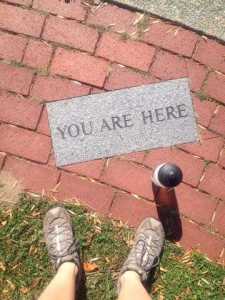
People like You Are Hereme, who a year ago traded a 40-mile commute for a walkable distance to work of 1.2 miles. Now, instead of nonstop meetings by iPhone in unpredictable weather and crawling traffic, my commute entails reading sidewalk poetry, admiring the art of urban landscaping and simply getting lost in my own thoughts.

Why walk? Why bother?

A higher percentage of people walk to work in Minneapolis (and, by extension, St. Paul) than in other cold Midwestern cities like Chicago and Milwaukee, according to the Census data. Across all 50 metro areas studied, an eco-friendly commuting method — walk, bike, bus, train — is most prevalent among people who live and work in the same city.

But the uptick in “older worker” walking interests me most — because my experience correlates exactly with the statistics. Walking has become, for me, a social statement, a political action. I walk to work because our neighborhood streets are choked with cars. I walk because I polluted the planet for years so I could enjoy both the city career and the small-town family.

I walk because the United States has become a fat and lazy nation, with obesity rates more than double what they were in 1970 and an average of 2.28 vehicles per household. “We don’t have a parking problem” in St. Paul, a City Council legislative aide told me recently. “We have a walking problem.”

And so, while it would be easy for me to talk about the more balanced perspective that middle age brings — along with the resulting confidence to slow life’s pace, to find my path — in truth I’m not sure that’s why I’m walking more. I walk because “excess” has become the U.S. brand, a hedonism we export to further justify our self-centered shopping and consumption.

I walk because I’m a child of Depression-era parents who raised my siblings and me without air-conditioning, with one TV and with the discipline to turn off lights even back when electricity was “penny cheap.”

I walk because I’m a sucker for the starfish story, and walking to work is one thing I can do, one small difference I can make, in a planet that grows more damaged by the day.

It’s not easy being green

Living an eco-life is more palatable and possible in a granola-eating, rainbow-flag–waving neighborhood with bus lines close by and a grocery store, Thai restaurant and charming retro movie theater within easy walking distance.

Still, walking to work has its challenges, especially for middle-aged women. Discomfort and inconvenience top the list:

  • Walking takes longer than driving, and that’s a pain on Monday morning when I have to be at the weekly staff meeting by 8:30 a.m.
  • It rains in Minnesota, and, of course, it snows.
  • My building has a Wudu station in the second-floor bathroom where Muslim women can wash their feet before prayer, but the closest showers for commuters who walk or cycle are at the athletics facility across campus.
  • My lunch gets squished in my backpack, which also gets heavy with a laptop and a pair of work-suitable shoes inside.
  • It’s harder to walk and wear a skirt or suit — the expected attire for a woman my age. I dress more casually than I’d like because it’s easier to stuff jeans or cotton pants in my backpack than to carry dry-clean-only clothes.
  • You have to plan. I need my car for work — at least that’s what I tell myself when I have an appointment more than a mile away. Instead, I have learned to plan outside meetings at the top of the workday, so I can drive there and back, park my car at home and then walk in. I also meet with people more often by phone.

Most important: I have a tolerant employer who has no problem with me working from home sometimes or varying my schedule. And that’s what a walk-to-work movement will require — flexibility from employers who recognize that a healthy, calm person is a more balanced, productive employee.

The sidewalk art three blocks from my house says it best: I don’t know enough about balance to tell you how to do it. / I think, though, it’s in the trying and the letting go / that the scales measuring right and wrong — quiver and stand still.

Lesson learned: “Walking the talk” is a literal action. By living my values, I may inspire someone else to do the same.