
My husband and I raised our two sons in Northfield, Minnesota — a progressive, two-college town where I always felt safe, where we rarely locked the side door off the driveway at night, where our kids rode their bikes freely around town. Back when we sold our family home in 2013, I wanted to write an ode to the place where I had lived for 20 years, the longest stretch of my lifetime.
That house was home, full of two decades’ worth of meaning and memories, family and friends, a center of activity for sleepovers and potlucks, where boisterous boys and loving dogs (rest in peace, Skip and Lucy) were a dominant, delightful presence.

No one else in the family seemed to share my nostalgia for the white Dutch Colonial with a three-season front porch, a black roof and red trim, built in 1900 within eyesight of Old Main at St. Olaf College. It “looked appropriate” to see two little girls dash out the front door, my younger son said after he showed the house to his girlfriend during a trip back to town. That was all he would concede.
Eventually, I moved on, too, giving my heart to the smaller, 1906-era empty-nest house my husband and I have now in St. Paul, with a quaint wraparound porch that I fell for on sight. My shifting allegiances make me wonder: Is it the house itself that makes a home? Much as I love the expanded, updated kitchen in my current place and the egress window in the basement that fills my workout room with natural light, are those amenities what have bonded me to this place? Or could I comfortably, given time, call any place home?
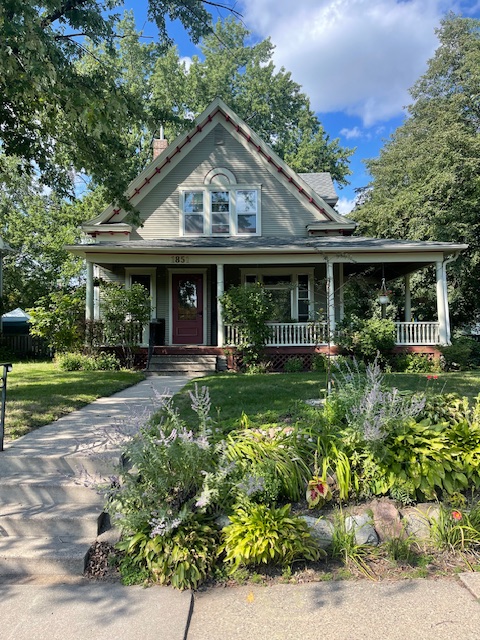
I’ve always reveled in the creative expression of home, the furniture and wall hangings and house plants that reflect my moods and tastes. These days, I am grateful not only for the safety and security I feel at home but for the privilege of being able to afford a house at all.
I root where I am planted. Whether it’s an upper duplex in northeast Minneapolis, a rental house on the edge of Indian Mounds Park in St. Paul or the first house that my husband and I purchased, and subsequently detached from when two teenagers burned a cross on the front lawn of a Black family down the street: Home is structure for me, a physical location, a place where I can put my stamp and comfortably be myself.

I had breakfast recently with a friend who had returned from a summer in Finland, her home country. She talked about the relatives she visited, described a mass transit system that allowed her and her wife to get along without a car, spoke fondly of the concerts they attended and the greater sense of ease in a society less gun crazy and politically polarized than ours.
“So, where is home,” I asked her.
“Home is where your people are,” she said.
My people, literally defined — the family I was raised in — are either dead or have moved away. My three surviving siblings are scattered around the country (the brother who died in 1988 lived just blocks from where I am now). At 67, I have few older relatives left in Minnesota. My mother, father and stepmother died in fairly quick succession, and all during autumn, in 2015, 2017 and 2018. In fact, my only extended family in a state where people are known for staying put is one sister-in-law in Minneapolis, an uncle who spends half the year in Florida, a first cousin in a far southern suburb and another first cousin about two hours north, a DFLer who keeps up the good fight in what is now solid red Trump country.
After seeing my older son off to London for graduate school in August, I feel lucky to have my younger son and his partner just a 10-minute bike ride away.
I describe my closest friends as “intentional family” — the folks who are no blood relation but with whom I share a history, the ones who hung with me through the messes and mistakes of young adulthood. After a 40-year career, I rarely go anywhere in St. Paul or Minneapolis without running into some colleague or connection. I worked with my next-door neighbor at St. Catherine University, shared a cubicle with the neighbor behind me for seven years in a newsroom and knew the woman who lives kitty-corner from my house at Minnesota Public Radio, when I was an editor on its magazine.
So, yes, as my friend says, people constitute “home.” My friendly neighborhood — with its walkability to mass transit, college campuses, and both fun and functional shopping — also enhances my sense of community. I thrive on the convenience of urban living, especially at an age when I feel less inclined to drive and more inclined to do good for the planet.
My parents divorced when I was 14. My childhood home was sold and my foundation ripped away at too tender an age for an awkward, uncertain girl. Perhaps that accounts for my love of home now, my reluctance to travel much with my long-retired husband. As my own career winds down, I have a growing desire just to stay home. To cook and tackle projects. To read and chat with neighbors.
To redefine my purpose and until then, to be still.
When my husband presses me about why I won’t travel more, I hardly know how to begin explaining. Our six-year age difference and our differing parental roles, which made sense when the kids were young, have now become a chasm in our respective wants and needs. As a largely on-site parent, he worked at home; even when he earned a part-time paycheck, he was the one in town while I commuted to my family-wage job.
He loved being Mr. Mom, “but there were no breaks or paid vacations.” And even though I did enjoy raises and paid time off and validations for a job well done, I also spent years leaving home five days a week, including on mornings when I longed to stay back with the little boy in the footie pajamas who held his arms out as I headed to the car.

Being at home now is sustaining; it slows me down, allowing a reset from 40 years of pushing into the wind. There is much of the world I haven’t seen, large swaths of this country I’ve yet to cover. I dream about taking a train somewhere all by myself.
But for today, the simple pleasures of tucking in with a dog and a good book, learning how to cook tofu or repotting plants in my backyard while listening to a podcast are as much adventure as I want or need. Give it time, I tell my husband. This, too, shall pass.


 The Middle Stages: Between Midlife and Old Age