Category Archives: Retirement

Ready or not: Here comes retirement!

It happened gradually, and it happened overnight. Over the course of two years — and then seemingly without warning — I have become ready, finally, to embrace retirement. Not to cease being physically active (ever!) or contributing as a volunteer. Not even to give up my quarter-time gig as an editor and nurturer of younger writers.

Instead, after more than 40 years of seeking identity and purpose and meaning through work, I have stopped defining myself as a careerist. As “what I do.” The question to answer now is: Who am I?

“Seasons change, people grow together and apart, life moves on. You will be OK, embrace it.”

— “Words From a Wanderer,” by Alexandra Elle

When I left full-time work in September 2022, at age 65, I would visibly stiffen whenever people asked me about “retirement.” Indeed, I defiantly declared in a blog post that my two part-time jobs qualified me as working — still in the game! —  especially since the positions utilized my skills and had professional sounding titles, which felt important to me then. I also defined retirement, in part, as the decision to draw Social Security, and I aimed to avoid that until I hit my full retirement age of 66 years and 6 months.

Fast-forward to today:

  • I left one of my two part-time gigs in early June, the one that paid better but was more chaotic and uncertain.
  • I opted to begin drawing Social Security when I turned 67, on July 4, and will receive my first check in August.
  • I have become more particular about the freelance work I will accept, turning down a potential offer that would have paid well for at least a year but had aspects that run counter to my values.

Back in February, I woke up earlier than usual on the morning I was set to give notice at my second job. As I sipped my café au lait before sunrise, I listened to a podcast about emotional intelligence in retirement. The speakers urged listeners to name their feelings and even state them aloud, like a 6-year-old: I feel sad. No, not that. I found a letter from the Social Security Administration in a neglected pile of mail, and I recognized a different feeling: I feel scared.

As well as humbled, helpless, hopeful. What comes next?

Where do aging people find community?

Twice last week, on consecutive days, I had rich conversations with women about loneliness and the meaning of friendship, about where we seek and find community now that our networks are shrinking, and our family responsibilities — whether raising children or caring for aging parents — are largely done.

One talk was with my widowed sister, who hasn’t worked in years (the workplace being a hub of socializing and people contact) and who recently moved from her familiar neighborhood. She plays Mahjong with her former neighbors and recently joined a cards group. That squares with advice in a New York Times article back in May, which cited research showing that adults on either end of the age spectrum may be vulnerable to loneliness — and can offset it by volunteering and joining groups.

My second discussion was with a longtime friend who is planning to retire early next year. I told her about the “Women in Retirement” group I had visited recently after months of finding excuses not to go. “The women all looked so old when I walked in,” I said, and then we laughed, knowing full well that the image I carry of myself in my head is not the one that looks back at me in photographs.

Starting from young adulthood, self-reported loneliness tends to decline as people approach midlife only to rise again after the age of 60.

The Loneliness Curve,” New York Times, May 21, 2024

Both conversations revolved around the gap between our own perceptions of our energy and vitality — the contributions we still hope to make in the world — and the diminishing way that people perceive us, if they think of us at all. My sister’s young adult grandkids see her as “an old lady,” she says, and rarely are in touch. My friend and I, who met 40 years ago in a newsroom, discussed the coming loss of a collegial community at work, even in a part-time job like mine.

Friendship was the topic at the “Women in Retirement” group last week, with a focus on the axiom that we have friends for a reason, friends for a season and friends for life (credit a poem by Brian A. “Drew” Chalker). My small coterie of friends for life — the handful of people who know me as myself, not within a role or professional position — are friends I made back in my 20s and 30s.

Am I still capable of forging and investing in such deep and trusting friendships, or has it become easier to blanket myself in the comfort of people I’ve known for years? Time will tell; and time, I now recognize, in one of aging’s many insights, is an ever-diminishing commodity.

How do we reconcile our shifting energies?

During the four decades when I worked full time, full-bore — setting the “gold standard” for work ethic, one of my managers used to say — I had a standard answer when people asked where I was going on vacation: “Off the clock.” I’ve lived by a calendar and to-do lists for so long that I don’t know how else to operate. The part-time job, the one or two freelance gigs I always have going, the uptick in volunteering: All add up to days that feel nearly as full as the 50-hours-a-week career.

But guess what? It’s catching up to me. At 67, I no longer can summon the energy of a 45-year-old. So: Why do I still take so much pride in staying busy? I hear my late mother posing a question that annoyed me at the time: “You’re always running, Amy. What are you running from, I wonder.” Some part is habit. Some is trying to remain relevant (as though a person my age can do that in our ageist society). Some is denial. An even bigger part is fear.

Photo by Patrick Hendry on Unsplash

Professor and historian Heather Cox Richardson recently observed that “democracy is a process, and it’s never finished.” I feel the same way about retirement. To concede that my work life — and productivity, as I’ve defined it — is behind me, to accept that family, friends and volunteering are what can bring me peace and purpose, is to take a giant leap into the unknown.

“There is always something truly restorative, really, finally comforting, in learning what is true. In coming to the end of an illusion, a false hope,” wrote Sue Miller in her 1995 novel “The Distinguished Guest,” which I just finished. If I sit still long enough, I can name the illusion, even as I wince at its futility and hubris — the conceit that I could outrun and outwit age.

How Women’s Work-Life Choices Are Evolving

The first thing I noticed was the number of women casually wearing blue jeans as they networked, introduced themselves and sipped their morning coffee, as though clothes did not define their role or status.

I had debated what to wear for my first professional women’s conference in over 25 years. Would skirts and blazers still be required? Given that I was taking mass transit to the event, could I get away with athletic shoes? Finally, on a chilly, gray Friday with intermittent showers, I opted for slacks and shoes I could walk in — practical and comfortable. Turns out, I was overdressed!

Between the ages of 36 to 43, I was a full-time newspaper columnist writing about women and work, with a focus on how a generation of middle-class women were navigating the personal and the professional in ways their homemaker mothers never had to do. “On Balance: Issues That Affect Work and Home” the column was called. So, when I heard about the annual women’s conference put on by RSP (Ready. Set. Pivot.) — a Twin Cities-based organization that “guides bold, unapologetic women to their next best thing” — I saw it as a chance to investigate how issues for career women have changed over the past 30 years.

Three conclusions or trends emerged that demonstrate the realities I have recognized in my 60s:

  • Progress can be temperamental, and transitory, but movements for social change do push us forward.
  • Age shifts our priorities, giving us space to quit dwelling on the inevitable regrets and instead channel them into more authentic ways to lead our lives today.

“Always concentrate on how far you have come, rather than how far you have left to go.”

Heidi Johnson

Trend #1: Finally! Flexibility Is Firm

Back when I was writing the column on women and work (a first for a local newspaper in the 1990s), once- or twice-a-week telecommuting was an almost revolutionary option provided by employers wanting to be seen as work-life friendly and to retain women struggling vainly to “have it all.” I was commuting a long way to the newsroom, with my husband as an at-home parent to our two sons. When a top-tier liberal arts college a mile from home offered me a job in communications, I used it to negotiate a partial work-from-home arrangement.

“Flexibility doesn’t mean working from home on Tuesdays,” a source told me at the time. “True flexibility looks different ways on different days.” And true flexibility, back then, was rare.

Years later, flexibility was among the trends that panelists cited at the RSP conference, organized by former Blue Cross Blue Shield marketing executive Wendy Wiesman, 50, who relishes the “insane freedom” that she gained when she left a prestigious job at a reputable company five years ago.

“Women are more ambitious than ever, and workplace flexibility is fueling them,” says the Women in the Workplace 2023 report by McKinsey & Company, produced annually in partnership with LeanIn.org.

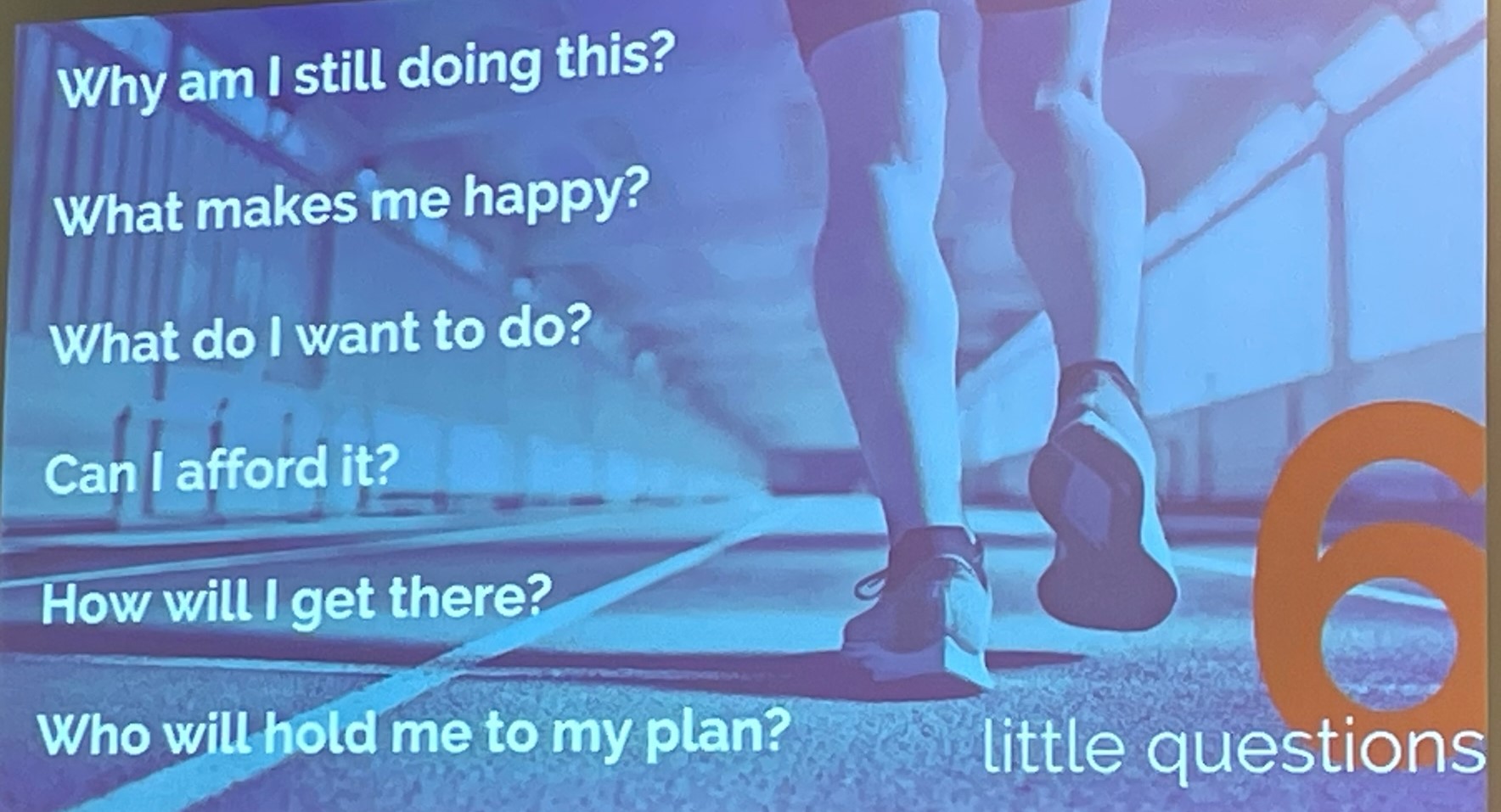
Six key questions kicked off the RSP conference in October.

Rather than being the sole exception, as I was, the women I met at the conference treated flexibility as a given rather than a favor that could be taken away. They have the confidence, or perhaps the strength in numbers, to determine how and where they want to work. COVID and a tight labor market have fueled that trend.

I talked with two women in their 40s who are running their own businesses. Diane, a human resources specialist who was often told she “wasn’t typical,” has three children and is the primary breadwinner because her husband is a teacher. Jennifer, who is married with two daughters, lost 100 pounds a decade ago and joined Toastmasters to help her present herself publicly. Now, having tired of working in financial services, she coaches professionals in public speaking.

Wiesman, founder and CEO of Ready. Set. Pivot., says those are the kinds of courageous women her company attracts, who want to design the next stage of their career and leave a secure position if it’s not working. “The DNA is of a woman who is never quite satisfied,” she says. Or, as her website puts it: “The best talent is restless.”

“What does success mean to me now? From the perspective of today, what is most important to me?”

Randi Levin, transitional life strategist

Trend #2: Self-Care Is Not Selfish

As a young business reporter, I interviewed women who wore blue suits to work. Who pulled back their long hair. Who displayed no photos of their children. It’s almost laughable now, how earnestly we tried to blend in with the corporate male establishment (and, of course, it’s the rap against the women’s movement of the 1970s, that we white women of means were merely striving to fit in rather than working to change the system for Black and brown women, too).

Often that meant working harder for less pay and recognition, on the blind faith that someday, it would pay off.

Nowadays, Black women in particular are vocal about the importance — the essentialness — of self-care amid the myriad stressors in their lives. The inaugural “Rest Up Awards,” announced by the Women’s Foundation of Minnesota in September, are granting $10,000 each to 40 nonprofit leaders throughout the state whose organizations are advancing gender and racial justice. All recipients are women of color, according to coverage in the Star Tribune.

“That whole perfectionism thing is out the door,” said the RSP conference’s keynote speaker, Natasha Bowman, a Black attorney, bestselling author and recognized expert on workplace mental health. “Women experience mental health challenges at twice the rate of men, at least. But we women don’t put ourselves on our to-do lists.”

In helping ambitious, hardworking women to design their next phase of life, Wiesman urges them to broaden their focus — and encompass their families, relationships, volunteerism and other interests in a vision of how they want to live. “I first need them not to work 80 hours a week on their day job,” she explains. “It takes a long time to shift out of that. But you have to begin to not over-achieve in that arena. Otherwise, you make no space for the pursuit.”

And you end up in your 60s, as I have, trying to explain your workaholic choices to now-grown children who still resent that you were gone so much while they were growing up.

“I did then what I knew how to do. Now that I know better, I do better.”

Maya Angelou

Trend #3: We Get to Be Who We Really Are

In addition to all the jeans and easy laughter at the women’s conference, I noticed that I had never heard “shit” and “fuck” spoken so often or openly at a professional gathering. My age-related aversion to swearing aside, I took it as a brazen symbol of Generation X women’s comfort with themselves. They’re not looking to anyone else to define what is acceptable. “I’m challenging the universe to think differently about talented women,” said Wiesman during her introductory remarks at the event.

Leadership coach Susan Davis-Ali, Ph.D., author of the book How to Become Successful Without Becoming a Man, spoke during a panel discussion about the “great corporate job” she had 15 years ago before leaving to launch her own work and pursue her own path. “Transformation means to change,” she says, including “behavior and attitudes.”

“Getting personal will create risk,” another panelist said. The mostly middle-aged, mostly white women in attendance — exactly the audience for my long-ago business column — heard about negotiating for what they’re worth (“men ask for significantly more money”), about defining what they are offering the market (“generalists aren’t getting noticed; find your sweet spot”) and about speaking with more authority (less “I think” or “I feel”; “own your expertise”).

Men’s restrooms were repurposed at the RSP conference.

When a panelist asked how many of us were old enough to have been expected to “be in the office from 9 to 5 with pantyhose on,” I was among the few women who raised my hand. Later, during a breakout session, I spoke up on behalf of my Boomer generation: the ones who blazed a trail but failed to notice that some women weren’t on the path, who overinvested in work as our sole means of self-worth and self-expression.

Wiesman’s generation obviously has learned from our mistakes. “Since the pandemic, women are centering more on their lives and themselves,” she told me. “They’re focusing on themselves first and not the system.”

As a woman of retirement age who still enjoys work, I’d say it’s time to start emulating the women coming up behind us, the ones who declare (as Wiesman’s RSP website says): “This is what I want, this is what I need, this is what I’m good at, this is what I love.” And then get out there and show the world that aging women still have a hell of a lot to offer.

Can’t find a roadmap for retirement? Write your own!

‘Are you fully retired then?” The question, at a recent gathering of neighbors, came from a former colleague at the institution where I resigned a year ago from my decades-long career. I gave my chipper, by now well-rehearsed answer: “No, no, I actually have two part-time jobs, and as I like to tell people: 1+1=3!

The upbeat response conceals a reality that I had not anticipated when I left full-time employment in fall 2022, three months after turning 65. Although it has been gratifying and intellectually stimulating to take on two jobs that allow me to remain visible and professionally active — in the game — in fact, there’s no such thing as a part-time career. As managing editor of a community blog and as executive director of a small, struggling nonprofit, I often feel as busy as I was before for a fraction of the pay and benefits.

Neither of these is a job where you hang up your apron and forget about work till your next shift. The demands, the brainstorming, the ebb and flow of creative energy are always with me, as are the texts and emails.

I addressed the dilemma of trying to sandwich professional roles into part-time gigs in a blog post back in March, when I was midway through my so-called glidepath year. Since then, the issues have only magnified: Who restores the printer connection when there’s no IT department to call? Who pays for professional development? Why must I rationalize being reimbursed for envelopes, stamps and other office supplies with a new board member of the nonprofit?

Now that a full year has passed, I am evaluating again what retirement really means and why I have resisted the concept so strongly.

For me, this first year of part-time professional work has proved to be more complex and confusing than the binary choice that society offers of work or retirement, with no options in between. I have yet to find a road map for the life I have been crafting, and so — like Dorothy on the Yellow Brick Road — I am looking for mentors to point the way:

  • When might I be ready to cease defining myself as a careerist?
  • How accepting am I, really, of growing old?
  • What other, nonpaid activities do I want to pursue?
  • Can I concede the disappointments of what I never did accomplish in my career?

And the scariest question, impossible to answer: Will my savings and investments outlive me?

“What gradually increases during our late teens and begins to decline after age 60? Our self-esteem . . .  when we no longer have the status associated with our careers.”

—     Bev Bachel, Retirement Wisdom blog

Part-time professional positions have been a convenient, and cost-effective, way for me to delay examining the inevitable — that my career, and the influence that went with it, are on the wane; that I am aging out of the workforce; and that it’s time to start looking for other ways I can contribute and find meaning.

Meanwhile, increasingly, I just feel outdated, one of those benchwarmers who yearns for how things used to be. When I hear a Gallup social scientist assert that “requiring people to work in the office can lead to lower levels of engagement, higher burnout and a lot of resentment,” I have to wonder whether my way of working is passé.

I miss going to an office, which on the face of it has nothing to do with part-time work, except my two gigs station me at home. I miss dressing in something other than jeans and yoga pants. I miss walking to work and wrapping my head around my day, schmoozing with colleagues, using the walk back home to decompress.

For the last eight years of my full-time career, I had the great good fortune to work walking distance from my house, which made commuting a pleasure, a value added to my mental health. I understand if people who adapted to the Zoom life during COVID or endured congested commutes now resent that employers are demanding face time — but as an older worker, I miss the sociability of the office. I liked the stimulation of younger colleagues and new ideas.

Consider:

  • It took months for me to lose interest in Twitter (OK, X), despite watching a parade of people I respect abandon the platform as it grew more biased and businesslike. I tried Mastodon, but it literally felt too dark and clubbish — and I told myself I didn’t need another social media mouth to feed (in addition to the three email accounts for my two part-time jobs). I finally listened when a young man offered to invite me to Bluesky, which the new platform requires. I poked around and developed a profile, describing myself as “learning as I go.” But the entire process would have been less fraught if I worked in an office with younger colleagues, rather than in a spare bedroom with a dog at my feet.
  • When our young podcast editor suggested recently that we use more video at Streets.mn, I tried to sound enthusiastic but inside I was churning. By today’s standards, do I overvalue the written word? And when might the Millennials who employ me decide that the skills and perspective of a 66-year-old Baby Boomer are no longer relevant to what they need?

“One of the privileges of age is the right to live your life the way you want to, and to truthfully state your preferences.”

—     “Ask Amy” column, by Amy Dickinson, Star Tribune, September 21, 2023

Therein lies the trap of part-time professional work, the gigs that require decision-making and creative solutions, the jobs that spin your brain and sap your strength even after the day is done:

  • I’m a contract worker who bills by the hour, with monthly billing sheets tied to specific outcomes. No one has yet told me that “think time” is among them, the way it used to be when I was employed full time.
  • So, when no one is compensating you to advance your knowledge — to attend noontime seminars or weeklong conferences, to read up on current trends — do you do it on your own time at the expense of volunteerism, relationships, exercise and other self-care?

If I were younger, the answer would be an unequivocal, energetic “yes.” More of my career would be in front of me. But with retirement drawing closer — and the privilege of being able to afford to do it — I am called to examine whether professional work is worth it anymore.

One secret to happiness at this ill-defined stage of post–full-time career — my so-called glide path — is to stay as current as you can without denying your age and the validity of your experience. But for me it’s also recognizing what the career has cost, especially as a woman who broke new ground, in loss of family time, in stress, in misplaced self-importance.

As the curtain rises on my final act, I am pondering who I am becoming, and whether hanging up that apron at the end of a shift might soon be more rewarding than a fancy title on LinkedIn.