Category Archives: Life Purpose

You Can’t Know a Place Until You’ve Been There

Leading up to my vacation in mid-April — where my modest goals were to unplug, hike, read and relax — I loved watching people’s faces when I told them where I was going.

“Paducah.”

Is that in Kentucky?

“Yes, Mitch McConnell territory.”

So, what draws you there?

In truth, it was a friend recommending the arts scene and the National Quilt Museum that got me thinking about Paducah (and trying to talk my husband into it). He and I had debated about Memphis, Santa Fe and Asheville, North Carolina, but what we really wanted was a manageable, low-key place in which we could escape city traffic and return to our small-town roots — but still have some interesting things to do. If that meant two deep-blue Minnesota liberals would venture into solid red Kentucky, so be it.

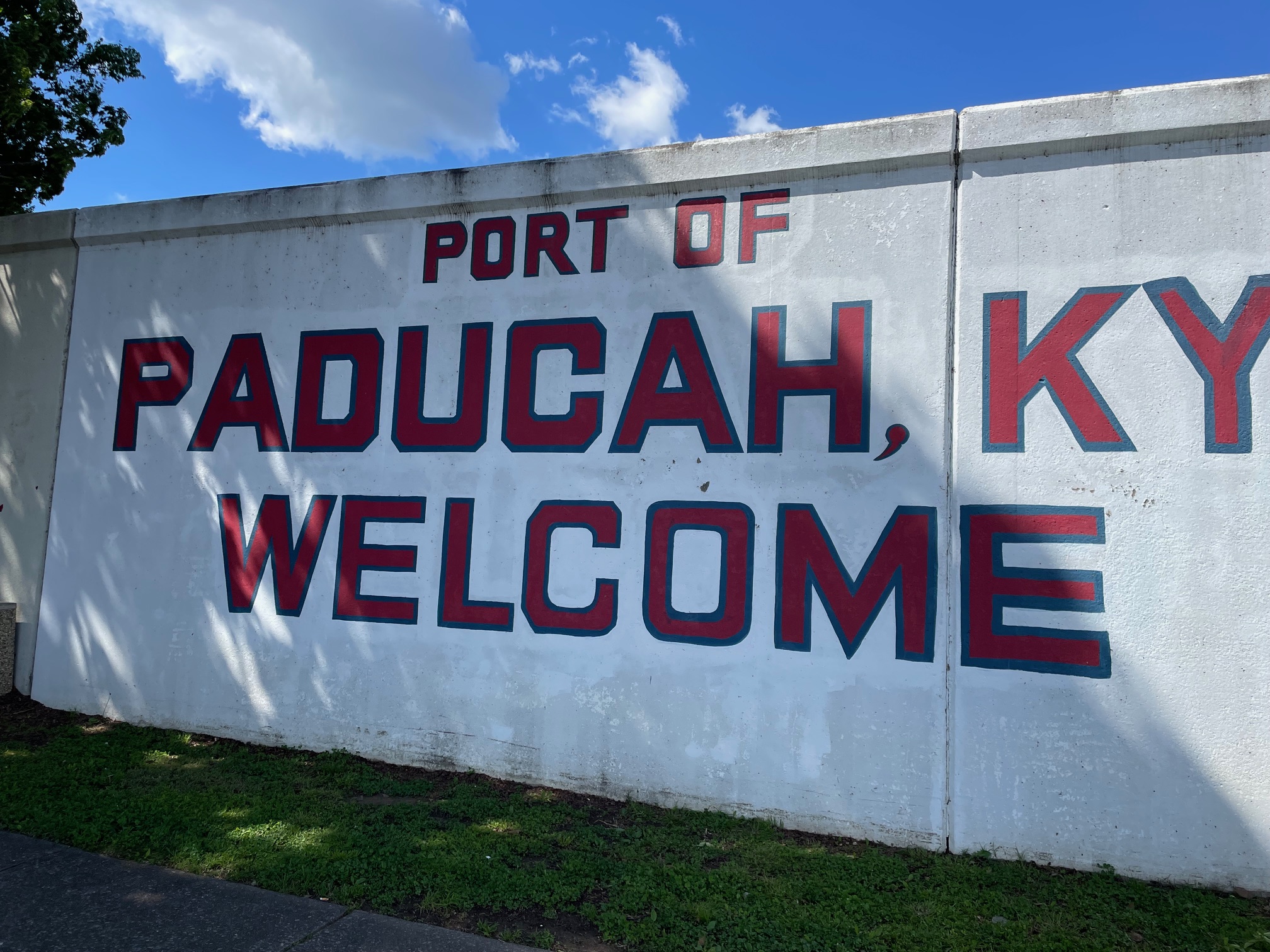
Paducah, Kentucky, sits at the confluence of the Ohio and Tennessee rivers, and had a catastrophic flood in 1937.

Paducah, the smallest of the nine UNESCO Creative Cities in the United States, seemed to fit what we were looking for. UNESCO is the United Nations Educational, Scientific and Cultural Organization, and it cites Paducah (along with Santa Fe) as a notable City of Crafts and Folk Art. We found that to be true, during a five-day visit that included:

The population of McCracken County, for which Paducah is the county seat, is 67,400. But to find this array of culture in a town of 27,000 — cafés and restaurants, locally owned art shops, bars with bands and solo artists, a river history museum, a downtown movie theater screening Civil War — was astonishing on the southern edge of the Midwest.

And that’s my point. Had we simply driven through downtown, where the Republican Party headquarters sits squarely in a business district pushing to make a post-COVID comeback, I’d have confirmed my stereotypes about Kentucky (which still calls itself a commonwealth) and kept going. But we got out of the car and stayed a few days — meeting locals, walking the streets, riding bikes, renting a 130-year-old brick “shotgun house” in a weedy, working-class part of town a fair distance from the Holiday Inn where the quilters stay.

We frequented an “all are welcome here” coffeehouse, Etcetera, one of the few eating establishments that didn’t shut down on Sunday in this heavily Christian town. (The closest Unitarian church, which I would have liked to attend, was 97 miles away in Clarksville, Tennessee.) Etcetera attracts colorfully tattooed young people and has a resident cat who sleeps in a heated little house on the patio. The backyard neighbor keeps two lovingly restored Studebakers in his garage, and I was only too happy to hang out and read while he chatted up my husband about classic cars.

In short, we found our people: the retired schoolteacher outside the Republican headquarters who directed us to Kirchoff’s, the best bakery downtown, with the bonus of a women’s clothing section in the adjoining coffeeshop; the helpful owner and bike mechanic at BikeWorld near the 135-acre Bob Noble Park (also close to the 55-acre Stuart Nelson Park, once the segregated recreation spot for Blacks and now host to the annual Emancipation Celebration every August 8); the young couple restoring the shotgun house next to our AirBnB, who’d wait to blast their music until we left.

We met other folks with whom we were more careful, like the proprietor of a cramped antique shop who piped up when I saw a campaign sign from 1980 in which Ronald Reagan commanded that we “make America great again.”

“I didn’t know that all started with him,” I told my husband. “I thought ‘It’s Morning in America’ was Reagan’s theme.” The proprietor, standing tall, proclaimed Reagan to be a great president. She showed no interest in our viewpoints, likely detecting our disdain, and said her daughter is a Democrat “only because they give her money.” We smiled and moved on to the Four Rivers Corvette Club showcase across the street.

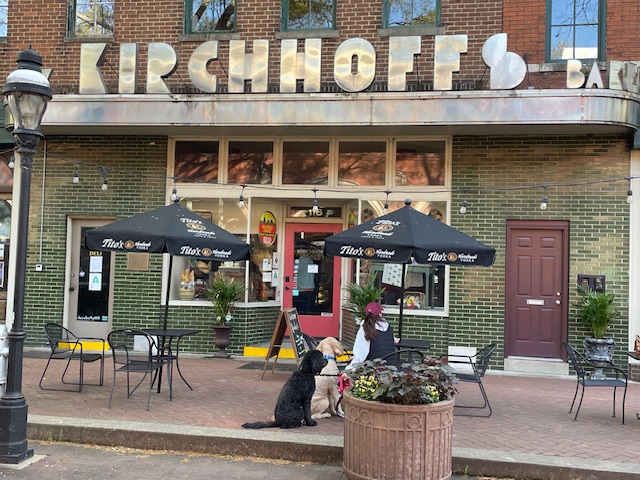
Dogs have to wait at Kirchoff’s Bakery & Deli, too, where a line stretches out the door on Saturday mornings.

On those blissful early mornings when I sat with my journal and a fresh cup of coffee, I pondered how Paducah felt different from my heart-of-the-city home in St. Paul, Minnesota:

  • No recycling containers, anywhere. We even asked a cop.
  • No apparent mass transit system, though I did see one bus stop.
  • No food co-op; and granted, Paducah is small, but Northfield, Grand Marais and St. Peter, Minnesota, all have them.
  • No bookstore downtown and likely no zoning laws. Parking lots take up a lot of precious space.
  • No consistent infrastructure for walking or bicycling. Sidewalks in our neighborhood were in disrepair, and some just ended mid-block. The only painted bike lanes I found were out by BikeWorld.
  • No recovery meetings for women, though the sunburned men wearing bill caps and work boots welcomed me warmly to their meeting. The sayings and the steps were all comfortably familiar — “just spoken with more of a twang,” I told them with a laugh.

Those men’s generosity, their acceptance, helped me avoid a head space where I crossed my arms and complained about what Paducah isn’t or what it lacks (“another Dollar General store?”). That’s too self-satisfied, too sanctimonious, plus it’s the antithesis (or should be) of why we travel. Not to confirm our ways of thinking or insist that others conform to them, but to challenge our habits and beliefs, expose ourselves to something new.

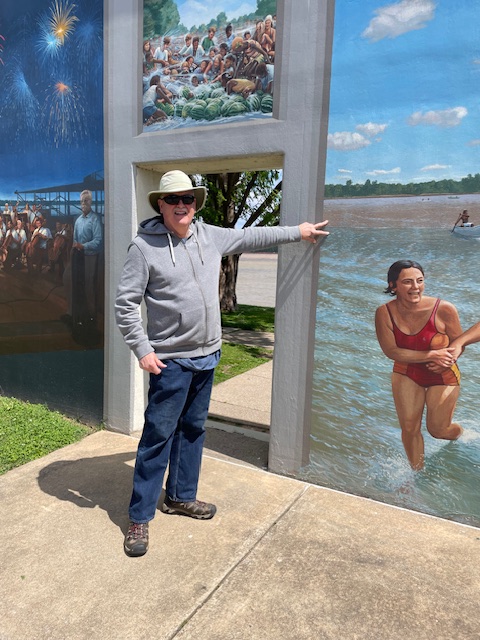
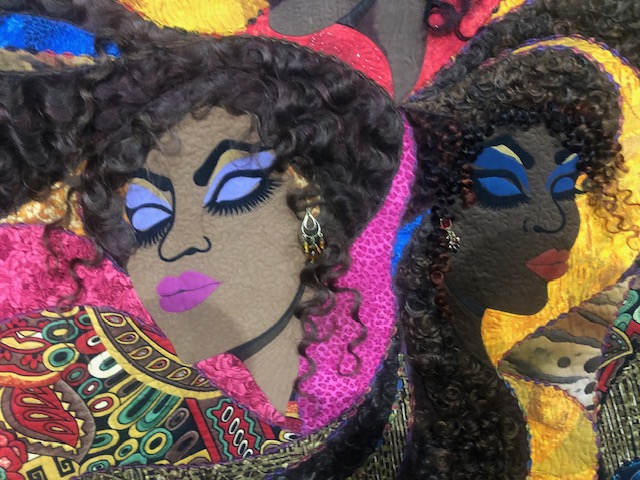
Quilting artist Barbara Ann McCraw has an exhibit at the National Quilt Museum called “Life Stories.” Twenty-two percent of Paducah’s population is Black.

No sooner had I decided to observe rather than judge the differences in Paducah, than I was confronted for what felt like the umpteenth time by a person who declared they could never live in Minnesota because it’s so cold. “How can you stand it up there?” Try as I might to describe the beauty and variety of the four seasons, to explain that you learn to dress for the cold, to cite the social services and amenities that our high tax rate affords us: I could see it. They would visibly shut down.

Whether on the plane, or at Ann Patchett’s bookstore, Paranassus Books (our one stop in Nashville), or in a conversation where I was trying to show genuine interest in Paducah and its confluence of rivers or the stunning Land Between the Lakes Recreation Area that straddles Kentucky and Tennessee, the person who had a preconceived notion about Minnesota clearly wasn’t interested in learning more.

And that’s a shame, because I’d like to show them my home state with the same joy, vigor and gracious hospitality that they showed me theirs. I never thought I would visit Kentucky. I’m too mad at Mitch McConnell and the legacy he’s left us of a conservative six-member super majority on the U.S. Supreme Court. But if politics were a reason to avoid travel, I’d go nowhere but Minnesota in the Upper Midwest.

If Kentuckians want to write off Minnesota for the weather, the best I can say is, “Your loss.” I’m glad I visited Paducah, grateful to have pushed past a stereotype. The docent in the National Quilt Museum described the difference between 18 feet and 18 inches in examining the artwork on their walls. “At 18 feet,” she said, “you see the vision. At 18 inches, you see technique.”

From 18 feet away — or, actually, 744 miles — my vision of Paducah was that of a backwater, no place I’d ever care to visit. From 18 inches, right up close, it was a special community, with a lively arts scene and friendly people. A town I would return to, and one I recommend.

Weather or Not: The Rituals of Daily Dog Walks

How many health habits — physical, spiritual, emotional — have I promised myself I would stick to every day? Pushups and neck stretching, journal writing and meditation: They feel good when you do them, but time gets away from me, and then I forget until the next good intention comes along.

Not so with dog walks. Ever since my family rescued our first dog (the late, great Skip) in 2000, followed by sweet Lucy in 2003, I have dog walked every morning — sick or healthy — without fail, unless I am out of town. When people ask how often I walk my household’s current dogs, Mia and Gabby, I can honestly tell them: “Every day, any weather.”

A recent article in the Washington Post, reprinted in my local newspaper, urged readers not to “skip your dog’s walk” or assume that letting them out in a fenced backyard would suffice. The reasoning shows the human benefits of dog walks, too.

  • Dogs need exercise and don’t pursue it on their own.
  • They need the mental stimulation of seeing — and smelling, always smelling — new things.
  • And they need “human interaction,” which I would reframe as bonding. You develop a relationship with your dogs when you’re outside together every day.

Though I don’t always want to leave my house early in the morning, I am always glad I did once I get out there. Putting my feet on the street and my face in fresh air is as good for my mental health as it is for theirs. Once Gabby does her down-dog stretches, or I see light softening the sky, we suit up and show up. It’s time to go.

Mia (left), Animal Humane Society, born in 2014; and Gabby, Standing Rock Indian Reservation, born in 2018.

The walks go better when I stay calm.

I like to stride when I walk: head up, glutes pumping, spine long and straight. At 66, I am grateful to be able to move so fluidly. Striding uninterrupted rarely works with leashed dogs, however. “Guardians need to take the animals’ lead,” says the dog-walking article, rather than dragging our pets along on our fast-paced walks or runs or on a bike ride — I shudder whenever I see it — with a leashed dog straining to keep pace.

“If your dog wants to sniff every blade of grass, then that’s what they want to do on their walk,” says a dog-training advocate quoted in the Washington Post piece, which, tellingly, never uses the term dog “owner.” My morning dog walks are for Mia and Gabby, not for me. If I want pure exercise, I can schedule that for another time.

Sometimes I imagine the dog walks as a metaphor for life. When the girls pull on their expandable leashes or go off in different directions, forcing me to pirouette in the middle of the sidewalk to keep us all from getting tangled, I liken the aggravation to the pressures I navigate each day. Whether it’s a project that has hit a roadblock, or an imagined slight from a friend, or my perpetually overbooked calendar — it will all smooth out eventually if I respond more than react.

So it is with my willful, unruly dogs. Praise and positive reinforcement, as well as a few consistent commands (“too icy” during the winter, when an unplowed alley looks unsafe), go much further than yelling at them or letting myself get exasperated. I can breathe deeply and watch the sunrise, or admire an artful garden, or look in a shop window while the dogs scratch and sniff. That makes the walk more interesting for them and much more pleasant for me.

My husband loves the New Yorker cartoon that shows a mid-sized dog on a leash with a thought bubble: “Always good dog, never great dog.” Our dogs are great. It’s hard to overstate how much they mean to me. If I praise Mia for listening rather than yelling at her for stopping at every tree, if I kneel and stroke Gabby’s chest while she squirms at a long red light, if I let them visit their regular haunts in our neighborhood — the yard with food scraps outside the fence, the husky with the blue eyes who never barks — then I am allowing them some agency, acknowledging their intelligence.

It isn’t always my agenda; that practice serves me in relationships with humans, too.

Sometimes, the dogs see a cat.

Our neighbor, Tim, walks his cat around the block once a day on a thin nylon rope, and Gabby, especially, goes manic behind the fence that surrounds our backyard. Installed by the previous homeowners, the wrought-iron fence allows her to see who is walking along the side street of our corner property — which, in my view (not to mention the dog’s), is critical.

I feel for the dogs behind those tall, wooden privacy fences who can hear and smell other animals but can’t see them. They paw frantically at the ground, and stick their snouts beneath the gate, baring their teeth but mainly wanting to engage. Which is what I long to tell the owners when they open the back door to yell at the dog for being just that. A dog.

We see the occasional roaming cat on our morning walks. Mia and Gabby bark and lunge while the cat hisses and arches its back, calling to mind the phrase “fighting like cats and dogs.” Rabbits are prey, not to taunt but to kill. Gabby goes into hunting pose, keenly alert, her tail straight up in the air, when she sees a rabbit freeze in self-defense. Her jaw opens and closes as if preparing to chomp down fast. It’s pure instinct on display.

Drawing by Anna Frodesiak (Creative Commons)

A rez dog whose relatives still hunt for most meals, Gabby has killed rabbits in our backyard. She’s even ferreted out a few bunnies in alley bushes on our morning walks, carrying the poor things home squirming or flopped dead between those warmed-up jaws.

We saw a coyote one summer morning, standing in the middle of the street. At first, I thought it was a long-legged, shaggy dog without a leash. But it looked too wary and thin to be domesticated, and the coyote lost interest in making a meal out of my smaller dog, Mia, once it saw me. Instead, it turned and trotted toward the river while I calculated how many busy roads it had to cross.

The beauty and rhythms of nature remain evident, even in the city, if you take the time to notice — contemplating the outsized impact we humans have had on the planet, as though we owned it, holding back leashed dogs that yearn to run.

Pictures at an Exhibition (of My Life)

I am drawn to bookstores and concert halls more than to art museums; to music and literature more than so-called fine art.

Still, given that one of my close friends is a longtime docent at the Minneapolis Institute of Art (MIA), I have learned over the years to appreciate paintings, especially, for their micro and macro characteristics — their ability to evoke personal, sometimes painful memories and to illuminate a perspective beyond my own.

More than other visual art forms, paintings inspire me to interrogate my past and present — the skinny girl I was, the old woman I am becoming — and pose questions about a future that already is proving to be more enriching, difficult and diverse than the narrowly white, middle-class, comfortable environment in which I was raised. Paintings inspire me to learn, to stretch and grow. They help me ponder a life that reaches decades back and point me toward an indeterminate amount of time forward.

The Awakening

My mother hauled us kids around to museums and the theater when we were sometimes too young to appreciate or comprehend the experience. She figured the exposure would be good for us; plus, being a native of Chicago, she yearned always to escape our small town. I did a version of that awakening in 2007 with my younger son, Nate, when he turned 12, arranging with my docent friend, David Fortney, then in training for his role, to conduct a tour of the art institute for 12-year-old boys.

Imagine our surprise (not) when the tour began with a naked male statue, Doryphoros (Roman, 1st century BE), muscled and marbled but missing a left forearm. Other highlights of the tour included surprisingly small battle armor (how our species has grown!) and MIA’s post-World War II Tatra T87 from the Czech Republic, a luxury car designed in 1936 whose front end resembles the earliest Volkswagen Beetle.

These days, I notice how much more diverse the Minneapolis Institute of Art has become, from the offerings in its bookstore and the ages and ethnicities of its clientele to the artwork displayed in its hushed, white-walled galleries.

I was introduced to Indigenous artwork in a variety of media through my friend’s book tours, which MIA hosts monthly, of The Night Watchman by Louise Erdrich (Pulitzer Prize for fiction in 2021) and Horse by Geraldine Brooks (a favorite of mine this year).

On a MIA book tour for the novel Horse, docent David Fortney talks with participants about “Four Days and Four Nites, Ceremony” (2020) by Jim Denomie. An exhibition of Denomie’s work runs through March 24, 2024.

That long-ago museum tour for 12-year-olds left an impression on my son, now 28, because he joins me on these book tours, self-designed by each guide. Widely read in many genres and cultures, Nate has encouraged me to move beyond books about racism and the Black experience (White Fragility, So You Want to Talk About Race, How to Be an Antiracist) and instead read fiction by Blacks and other people of color. That has me currently working through the lyrical, unpunctuated prose and contemporary Black British references of the novel Girl, Woman, Other by Bernardine Evaristo (winner of the Booker Prize in 2019).

Lately, it is Indigenous lives and cultures that I want to explore, perhaps because I am from the town where 38 Dakota men were hanged, in the presence of their families, on December 26, 1862. When I was in school in Mankato during the 1960s and early 1970s, we learned nothing about the mass execution, lessened by three dozen pardons but ultimately approved — the order issued — by Abraham Lincoln, the president we herald as the “great emancipator.”

A Dog’s Life

My childhood family always had pets — dogs, specifically — and my husband and I continued the tradition with our own sons. Pixie, Gretchen, Skip, Lucy: Those beloved family members came to a humane and sad but dignified end until Griffin, the miniature schnauzer my husband adored and carried around on his shoulder as a puppy. My husband, David, called Griffin his grandchild (we still don’t have one), sometimes telling acquaintances at the dog park, “I’m surprised I don’t sit at home and knit him sweaters.”

Griffin was killed at age 6 in November 2018, hit by a car outside a rural house we were renting in my hometown to attend my stepmother’s funeral. The dog was killed instantly, from what we could discern, with no visible damage or blood on his body. “He died immediately, and we found him,” I tried to reassure my husband. To no avail.

David cried — shuddering, back-heaving sobs — as our older son dug a hole in the frozen dirt of our backyard. Then they wrapped Griffin in a sheet and laid him to rest in the cold ground while I watched from the kitchen window.

You can’t replace a “heart dog,” my sister Penny likes to say. But only a month later, I convinced David to adopt a puppy from Standing Rock in the Dakotas, via a neighbor who rehomes dogs from Indian reservations. Gabby is an athlete, a wary and sometimes standoffish girl who barks at any person, dog or school bus that dares to venture down our side street.

She looks like a smaller, tamer, better-fed version of a dog I saw pictured in the Raphael Begay photo Rez-Dog (2017) at MIA’s special exhibition “In Our Hands: Native Photography, 1890 to Now.”

“Rez Dog” (cropped) by Raphael Begay, 2017

“This is a post-butchering celebration and gathering with my family at my late grandmother’s home,” the artist wrote in the statement hanging alongside the photo. “There, I saw this dog dragging a sheep’s head that we left outside. . . . I look at it in the same light as how we treat our unsheltered relatives. There’s this sense of concern, empathy, but there is a lack of responsibility or commitment to help.”

Women’s (R)evolution

The last several times I have visited the Minneapolis Institute of Art, I have returned again and again to a portrait on the third floor of a stern, stylish woman sitting upright in a chair, her face turned to the artist — almost daring him to objectify her.

It stands in stark contrast to the reclining nudes and bare-breasted ogling of traditional, centuries old western European art, which grows tiresome for me in the way that its countervailing fascination with royal propriety and the ruling classes turns off my older son, Sam, a Democratic-Socialist.

The painting that speaks to me is Temma in Orange Dress (1975) by Leland Bell, one of several portraits of his daughter by the largely self-taught painter. I perceive it less as a father’s flattering gaze than a reflection of women’s emerging independence — two years after the U.S. Supreme Court passed Roe v. Wade in a 7–2 vote (inconceivable today) and at a time when women’s labor force participation rate exceeded 46 percent, more than 10 points higher than in 1965, a decade earlier.

Unlike the uncertainty and timidity of Christy White (1958) by the feminist portrait artist Alice Neel, which hangs nearby, Temma projects strength. To me, she reads as a career woman, who pursues her own identity and financial means.

When I showed “Temma” to my younger son, I told him the painting reflects my career-woman phase. “Oh, you mean the 40-year phase?” he shot back. And yet much as my sons have seen me, and I have wanted to see myself, as Temma — fierce and forceful, a woman to be reckoned with — at heart I am more “Christy White.” Fearful, insecure, wrestling to this day with whether I walked the right path in a society that forces women to make hard and heartrending choices.

I walked up to “The Barn,” a 1954 painting by Wisconsin artist John Wilde, to see the rendering of a naked woman breaking free, and then a guard pointed out the face of a man watching in the lower left-hand window, a child’s wagon on the ground nearby. Some time later, I came upon a color-soaked painting, “Think Long, Think Wrong” by Avis Charley, of a fashionably clothed Native woman waiting in the sunshine for a bus.

“I create images that I wish I would have seen growing up,” said the artist’s statement. This painting, she explained, “is about putting aside distractions and staying present.” Aside from the art itself, that’s the beauty of an art museum: It helps us reflect upon our lives and values in a calm, quiet place, and assemble disparate images into a cohesive whole.