Tag Archives: friendship

Ready or not: Here comes retirement!

It happened gradually, and it happened overnight. Over the course of two years — and then seemingly without warning — I have become ready, finally, to embrace retirement. Not to cease being physically active (ever!) or contributing as a volunteer. Not even to give up my quarter-time gig as an editor and nurturer of younger writers.

Instead, after more than 40 years of seeking identity and purpose and meaning through work, I have stopped defining myself as a careerist. As “what I do.” The question to answer now is: Who am I?

“Seasons change, people grow together and apart, life moves on. You will be OK, embrace it.”

— “Words From a Wanderer,” by Alexandra Elle

When I left full-time work in September 2022, at age 65, I would visibly stiffen whenever people asked me about “retirement.” Indeed, I defiantly declared in a blog post that my two part-time jobs qualified me as working — still in the game! —  especially since the positions utilized my skills and had professional sounding titles, which felt important to me then. I also defined retirement, in part, as the decision to draw Social Security, and I aimed to avoid that until I hit my full retirement age of 66 years and 6 months.

Fast-forward to today:

  • I left one of my two part-time gigs in early June, the one that paid better but was more chaotic and uncertain.
  • I opted to begin drawing Social Security when I turned 67, on July 4, and will receive my first check in August.
  • I have become more particular about the freelance work I will accept, turning down a potential offer that would have paid well for at least a year but had aspects that run counter to my values.

Back in February, I woke up earlier than usual on the morning I was set to give notice at my second job. As I sipped my café au lait before sunrise, I listened to a podcast about emotional intelligence in retirement. The speakers urged listeners to name their feelings and even state them aloud, like a 6-year-old: I feel sad. No, not that. I found a letter from the Social Security Administration in a neglected pile of mail, and I recognized a different feeling: I feel scared.

As well as humbled, helpless, hopeful. What comes next?

Where do aging people find community?

Twice last week, on consecutive days, I had rich conversations with women about loneliness and the meaning of friendship, about where we seek and find community now that our networks are shrinking, and our family responsibilities — whether raising children or caring for aging parents — are largely done.

One talk was with my widowed sister, who hasn’t worked in years (the workplace being a hub of socializing and people contact) and who recently moved from her familiar neighborhood. She plays Mahjong with her former neighbors and recently joined a cards group. That squares with advice in a New York Times article back in May, which cited research showing that adults on either end of the age spectrum may be vulnerable to loneliness — and can offset it by volunteering and joining groups.

My second discussion was with a longtime friend who is planning to retire early next year. I told her about the “Women in Retirement” group I had visited recently after months of finding excuses not to go. “The women all looked so old when I walked in,” I said, and then we laughed, knowing full well that the image I carry of myself in my head is not the one that looks back at me in photographs.

Starting from young adulthood, self-reported loneliness tends to decline as people approach midlife only to rise again after the age of 60.

The Loneliness Curve,” New York Times, May 21, 2024

Both conversations revolved around the gap between our own perceptions of our energy and vitality — the contributions we still hope to make in the world — and the diminishing way that people perceive us, if they think of us at all. My sister’s young adult grandkids see her as “an old lady,” she says, and rarely are in touch. My friend and I, who met 40 years ago in a newsroom, discussed the coming loss of a collegial community at work, even in a part-time job like mine.

Friendship was the topic at the “Women in Retirement” group last week, with a focus on the axiom that we have friends for a reason, friends for a season and friends for life (credit a poem by Brian A. “Drew” Chalker). My small coterie of friends for life — the handful of people who know me as myself, not within a role or professional position — are friends I made back in my 20s and 30s.

Am I still capable of forging and investing in such deep and trusting friendships, or has it become easier to blanket myself in the comfort of people I’ve known for years? Time will tell; and time, I now recognize, in one of aging’s many insights, is an ever-diminishing commodity.

How do we reconcile our shifting energies?

During the four decades when I worked full time, full-bore — setting the “gold standard” for work ethic, one of my managers used to say — I had a standard answer when people asked where I was going on vacation: “Off the clock.” I’ve lived by a calendar and to-do lists for so long that I don’t know how else to operate. The part-time job, the one or two freelance gigs I always have going, the uptick in volunteering: All add up to days that feel nearly as full as the 50-hours-a-week career.

But guess what? It’s catching up to me. At 67, I no longer can summon the energy of a 45-year-old. So: Why do I still take so much pride in staying busy? I hear my late mother posing a question that annoyed me at the time: “You’re always running, Amy. What are you running from, I wonder.” Some part is habit. Some is trying to remain relevant (as though a person my age can do that in our ageist society). Some is denial. An even bigger part is fear.
Photo by Patrick Hendry on Unsplash

Professor and historian Heather Cox Richardson recently observed that “democracy is a process, and it’s never finished.” I feel the same way about retirement. To concede that my work life — and productivity, as I’ve defined it — is behind me, to accept that family, friends and volunteering are what can bring me peace and purpose, is to take a giant leap into the unknown.

“There is always something truly restorative, really, finally comforting, in learning what is true. In coming to the end of an illusion, a false hope,” wrote Sue Miller in her 1995 novel “The Distinguished Guest,” which I just finished. If I sit still long enough, I can name the illusion, even as I wince at its futility and hubris — the conceit that I could outrun and outwit age.
Want to celebrate a friendship? Mail a card

I had a memorable birthday celebration on July 4, made no more special by the 10 people (only one of whom I know) who pressed three buttons to wish me a “Happy Birthday” on LinkedIn. Likewise, the 63 Facebook messages, many with the identical auto-filled and poorly punctuated “Happy Birthday Amy!”, were a nominally satisfying way to feel remembered by former coworkers and other folks I’m rarely in touch with anymore.

But that isn’t how my closest friends reached out to me. They sent birthday cards with personal, handwritten messages, the old-fashioned way, through the U.S. mail.

My friend Sarah stays in touch with cards.

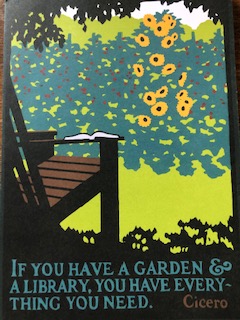
“Well-behaved women rarely make history,” reads one, a quote from Harvard historian Laurel Thatcher Ulrich that women of my vintage sported on T-shirts and book bags when we were young. Another card, from a friend I have known since my mid-20s, pronounces us “friends for life” in a touching handwritten note. “If you have a garden & a library, you have everything you need,” reads a card from a friend who is as busy with work as I am and who suggests we continue our tradition of occasional Sunday morning teas and talks.

  • My birthday was special because each of my two grown sons gave me a book with a long, handwritten letter inside.
  • My birthday was special because my neighbor surprised us with a homemade cake and a socially distanced gathering in her backyard.
  • My birthday was special because my husband’s best friend swung by in his 1981 Corvette with a piece of lemon meringue pie (which I don’t like, but no matter) and sang an off-key rendition of “Happy Birthday” at the top of his lungs from the front sidewalk.

Friendship has become a commodity these days, a point of pride to be measured more in quantity than quality, with hundreds of people on social media calling themselves my “friends.” Except they’re not. They are well-meaning acquaintances — just as I am to them — who are good enough to “like” my family photos and raise a fist in camaraderie to my political posts. My friends are the women I called when my parents died. My friends are the people who help me stay sober. My friends are the ones I can pick up with, after weeks or months, and enjoy a long, freewheeling talk over breakfast or on a bike ride.

My friends send greeting cards, hand-selected to evoke laughter or a sense of well-being, because that process takes time and thought, just as a true friendship does.

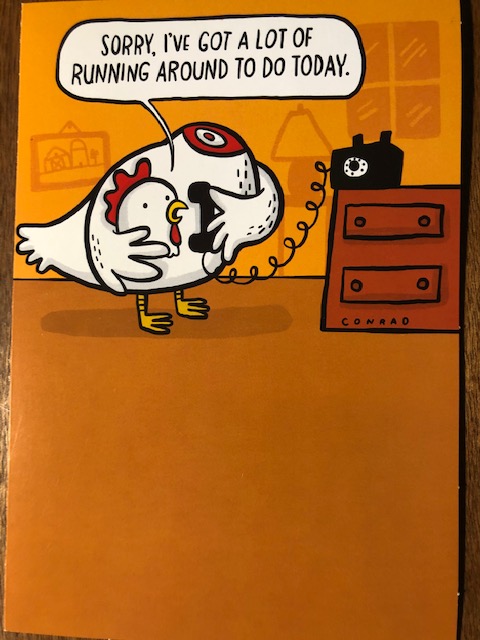
This card from my brother accurately pokes fun at my multi-tasking nature.

A sidewalk sign outside a family-owned business in my neighborhood started me thinking about the thoughtfulness, artistry and relative permanence of greeting cards. “Anyone can send a Facebook post,” it read. “Be a friend. Buy a card.”

Avalon on Grand — one of those charming, well-curated gift shops that has nothing you need but a whole lot of everything you want — boasts “one of the largest selections of greeting cards” in the Twin Cities. It’s one of several stores where I shop for cards all year-round, choosing cards for friends and siblings (sometimes bursting out with laughter in the aisles), and then stashing them away for just the right occasion.

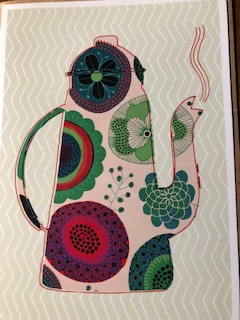
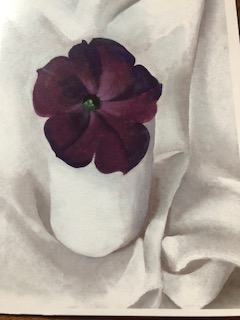
Cards can be standalone works of art.

The Greeting Card Association (who knew there was one?) traces the history of greeting cards back to the ancient Chinese and the early Egyptians. Wikipedia is another good resource for the card curious.

Europeans began exchanging Valentine’s cards as early as 1415. Twenty-five years after the 1775 founding of what is now the U.S. Postal Service, Valentines were becoming an affordable way to express love and affection throughout the fledgling United States. The “first known Christmas card” was published in London in 1843.

Unfortunately, the latest entry in the GCA’s “History of Greeting Cards” is 1943, which doesn’t signal optimism for the practice of card-giving, especially in our digital age. Dig deeper, however, and you’ll learn that Millennials are giving new life to an industry that was faltering with the advent of social media and e-greetings.

“Millennials are . . . seeking a feeling of nostalgia in card-giving,” says a National Public Radio story from Valentine’s Day 2019, just as they’re embracing vintage clothing stores and mid-century modern furniture — the plastic, minimalist ugly basement of my childhood.

Americans overall buy some 6.5 billion greeting cards a year, and women are 80 percent of those card carriers.

“Due to technical difficulties, your cake will be postponed to next year.”

An Amish card holder hangs on a wall by the front door of our home. It’s a vertical piece of maroon cloth strapped around a small clothes hanger; interwoven pieces of green, blue and black fabric decorate the three pockets that are the perfect size for greeting cards.

I don’t remember where we bought it, or when — likely 15 or 20 years ago, when the boys were small, and my mom would watch them over my birthday so my husband and I could bike the Root River Trail in southeastern Minnesota. We’d stay in Harmony, near an Amish enclave, and probably found the handcrafted holder in a coffeehouse or antique shop.

The cards I have saved and selected to place in those three pockets are keepsakes:

  • Smart-ass ones from my oldest sister (“What’s the difference between you and a senior citizen?”).
  • Cards with handwritten notes from my husband and sons.
  • An artsy thank-you card from a friend and spiritual guide that includes a quote from the late, great U.S. Senator Paul Wellstone (“Let there be no distance between the words you say and the life you live”), who raised his three children in Northfield only blocks from where my husband and I brought up our own sons.
  • An undated birthday card from my father with an affectionate note in his barely legible handwriting: “It’s getting hard to think of you as my little girl.”
Greetings from Helene and Connie

Most precious are the two cards I kept from my mother, one from 21 years ago when I was turning 42 and she was a robust 73. I had been sandbagged, apparently, by someone I loved and trusted, though the anger and shock have long since faded. Mom gave me a journal and a handwritten card: “I hope what you put in this little book will help your feelings to heal,” she wrote, with wisdom I surely failed to appreciate at the time. “Recapture the joys and delights you’ve had. Life goes by so fast. Be happy. Love, Mom.”

The other card I saved from her is dated July 4, 2012, four months after she was diagnosed with Alzheimer’s. The handwriting is shakier, the message simpler: “I’ll buy you lunch wherever you want to go.” Could she even still drive? But I can touch the card and see it, and I can feel my mother with me, in a way that an old social media post (“Your Memories on Facebook”) could never replicate.