Can’t find a roadmap for retirement? Write your own!

‘Are you fully retired then?” The question, at a recent gathering of neighbors, came from a former colleague at the institution where I resigned a year ago from my decades-long career. I gave my chipper, by now well-rehearsed answer: “No, no, I actually have two part-time jobs, and as I like to tell people: 1+1=3!

The upbeat response conceals a reality that I had not anticipated when I left full-time employment in fall 2022, three months after turning 65. Although it has been gratifying and intellectually stimulating to take on two jobs that allow me to remain visible and professionally active — in the game — in fact, there’s no such thing as a part-time career. As managing editor of a community blog and as executive director of a small, struggling nonprofit, I often feel as busy as I was before for a fraction of the pay and benefits.

Neither of these is a job where you hang up your apron and forget about work till your next shift. The demands, the brainstorming, the ebb and flow of creative energy are always with me, as are the texts and emails.

I addressed the dilemma of trying to sandwich professional roles into part-time gigs in a blog post back in March, when I was midway through my so-called glidepath year. Since then, the issues have only magnified: Who restores the printer connection when there’s no IT department to call? Who pays for professional development? Why must I rationalize being reimbursed for envelopes, stamps and other office supplies with a new board member of the nonprofit?

Now that a full year has passed, I am evaluating again what retirement really means and why I have resisted the concept so strongly.

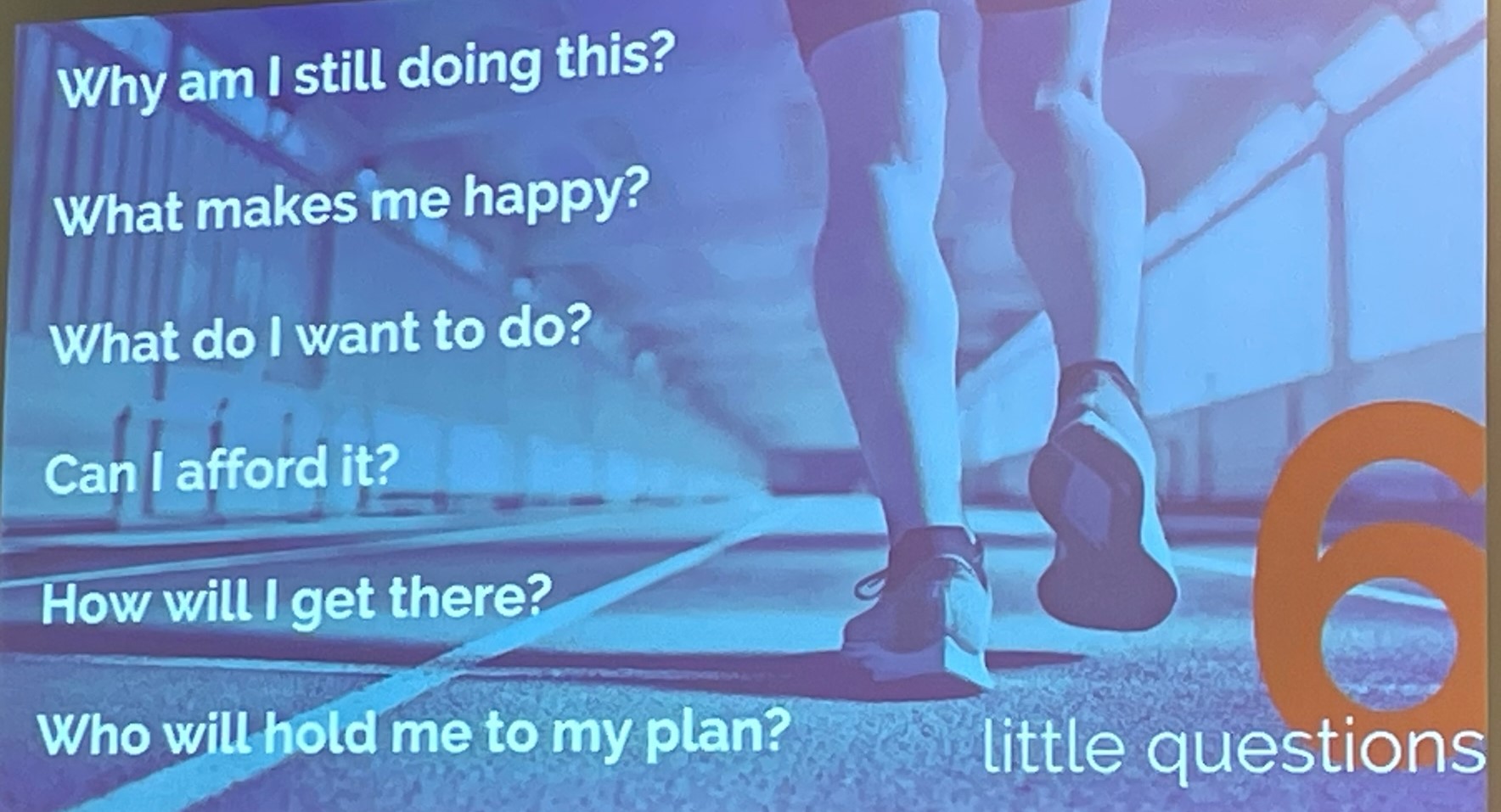
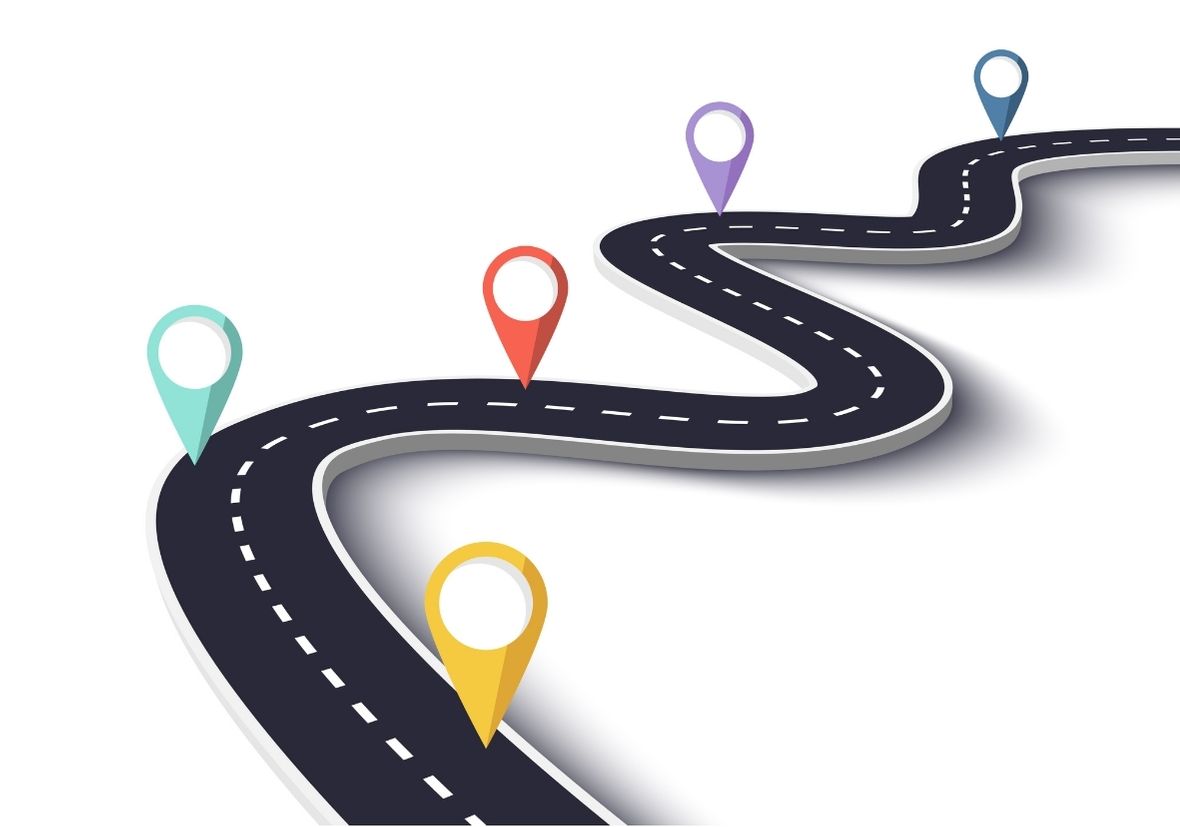
For me, this first year of part-time professional work has proved to be more complex and confusing than the binary choice that society offers of work or retirement, with no options in between. I have yet to find a road map for the life I have been crafting, and so — like Dorothy on the Yellow Brick Road — I am looking for mentors to point the way:

  • When might I be ready to cease defining myself as a careerist?
  • How accepting am I, really, of growing old?
  • What other, nonpaid activities do I want to pursue?
  • Can I concede the disappointments of what I never did accomplish in my career?

And the scariest question, impossible to answer: Will my savings and investments outlive me?

“What gradually increases during our late teens and begins to decline after age 60? Our self-esteem . . .  when we no longer have the status associated with our careers.”

—     Bev Bachel, Retirement Wisdom blog

Part-time professional positions have been a convenient, and cost-effective, way for me to delay examining the inevitable — that my career, and the influence that went with it, are on the wane; that I am aging out of the workforce; and that it’s time to start looking for other ways I can contribute and find meaning.

Meanwhile, increasingly, I just feel outdated, one of those benchwarmers who yearns for how things used to be. When I hear a Gallup social scientist assert that “requiring people to work in the office can lead to lower levels of engagement, higher burnout and a lot of resentment,” I have to wonder whether my way of working is passé.

I miss going to an office, which on the face of it has nothing to do with part-time work, except my two gigs station me at home. I miss dressing in something other than jeans and yoga pants. I miss walking to work and wrapping my head around my day, schmoozing with colleagues, using the walk back home to decompress.

For the last eight years of my full-time career, I had the great good fortune to work walking distance from my house, which made commuting a pleasure, a value added to my mental health. I understand if people who adapted to the Zoom life during COVID or endured congested commutes now resent that employers are demanding face time — but as an older worker, I miss the sociability of the office. I liked the stimulation of younger colleagues and new ideas.

Consider:

  • It took months for me to lose interest in Twitter (OK, X), despite watching a parade of people I respect abandon the platform as it grew more biased and businesslike. I tried Mastodon, but it literally felt too dark and clubbish — and I told myself I didn’t need another social media mouth to feed (in addition to the three email accounts for my two part-time jobs). I finally listened when a young man offered to invite me to Bluesky, which the new platform requires. I poked around and developed a profile, describing myself as “learning as I go.” But the entire process would have been less fraught if I worked in an office with younger colleagues, rather than in a spare bedroom with a dog at my feet.
  • When our young podcast editor suggested recently that we use more video at Streets.mn, I tried to sound enthusiastic but inside I was churning. By today’s standards, do I overvalue the written word? And when might the Millennials who employ me decide that the skills and perspective of a 66-year-old Baby Boomer are no longer relevant to what they need?

“One of the privileges of age is the right to live your life the way you want to, and to truthfully state your preferences.”

—     “Ask Amy” column, by Amy Dickinson, Star Tribune, September 21, 2023

Therein lies the trap of part-time professional work, the gigs that require decision-making and creative solutions, the jobs that spin your brain and sap your strength even after the day is done:

  • I’m a contract worker who bills by the hour, with monthly billing sheets tied to specific outcomes. No one has yet told me that “think time” is among them, the way it used to be when I was employed full time.
  • So, when no one is compensating you to advance your knowledge — to attend noontime seminars or weeklong conferences, to read up on current trends — do you do it on your own time at the expense of volunteerism, relationships, exercise and other self-care?

If I were younger, the answer would be an unequivocal, energetic “yes.” More of my career would be in front of me. But with retirement drawing closer — and the privilege of being able to afford to do it — I am called to examine whether professional work is worth it anymore.

One secret to happiness at this ill-defined stage of post–full-time career — my so-called glide path — is to stay as current as you can without denying your age and the validity of your experience. But for me it’s also recognizing what the career has cost, especially as a woman who broke new ground, in loss of family time, in stress, in misplaced self-importance.

As the curtain rises on my final act, I am pondering who I am becoming, and whether hanging up that apron at the end of a shift might soon be more rewarding than a fancy title on LinkedIn.

Stay Cool, You Don’t Need Air-Conditioning

At night during the summer, my husband sets up a big metal box fan — yellow, decades old, with three speeds powered by three dusty blades — and blows it out the west-facing window in his upstairs den. Then he sucks in the cooler evening air from outdoors by closing every window in the house except three in the bedrooms and one in the living room (to please the dog who commandeers the couch).

This is our old-fashioned, climate-friendly version of air-conditioning, along with ceiling fans in the kitchen, the main bedroom and my home office, a north-facing spare bedroom where I sleep on hot nights because of the bed’s access to the open window. When we first moved to this old house in 2013, we occasionally used a portable air-conditioning unit in the front bedroom, but it was noisy and blocked the light during the day and kept waking me at night every time it clunked off and on. So, we hauled the dripping unit out to the boulevard, where someone quickly claimed it.

For them it was a find, like the perfectly good snow shovels I lugged home from an alley last spring. For me — raised in a household with open windows and floor fans, back when air-conditioning was a nonessential for the middle class — the portable unit symbolized the hedonistic tendencies of our self-absorbed culture. Doing without it was one small way to side with Mother Nature in a battle she inevitably will win.

Billboard at the corner of Grand and Fairview avenues in St. Paul

Where comfort counts

Air-conditioning is a luxury that the vast majority of Americans now judge to be a necessity, and far more of us, especially in Minnesota, could live without it. As a person who tolerates the heat fairly well, in part because I have trained myself to do it, I would welcome not having to shiver in every bus, grocery store, movie theater and office building — enduring this artificial, overcooled air because some HVAC company tells me it is civilized. A symbol of prosperity and progress.

That progress, unfortunately, is costing the planet — fueling the very climate crisis from which air-conditioning helps us hide.

Ninety percent of households in the United States have air-conditioning, compared with 60 percent in China, 16 percent in Mexico and 5 percent in India; versions of those data, from 2016, were cited again this July in news alerts about the record-breaking heat worldwide.

Indeed, air conditioning represents one of the most insidious challenges of climate change, and one of the most difficult technological problems to fix. The more the world warms, the more we’ll need cooling — not merely for comfort, but for health and survival in large parts of the world.

James Temple, MIT Technology Review, September 1, 2020

Summer in the city

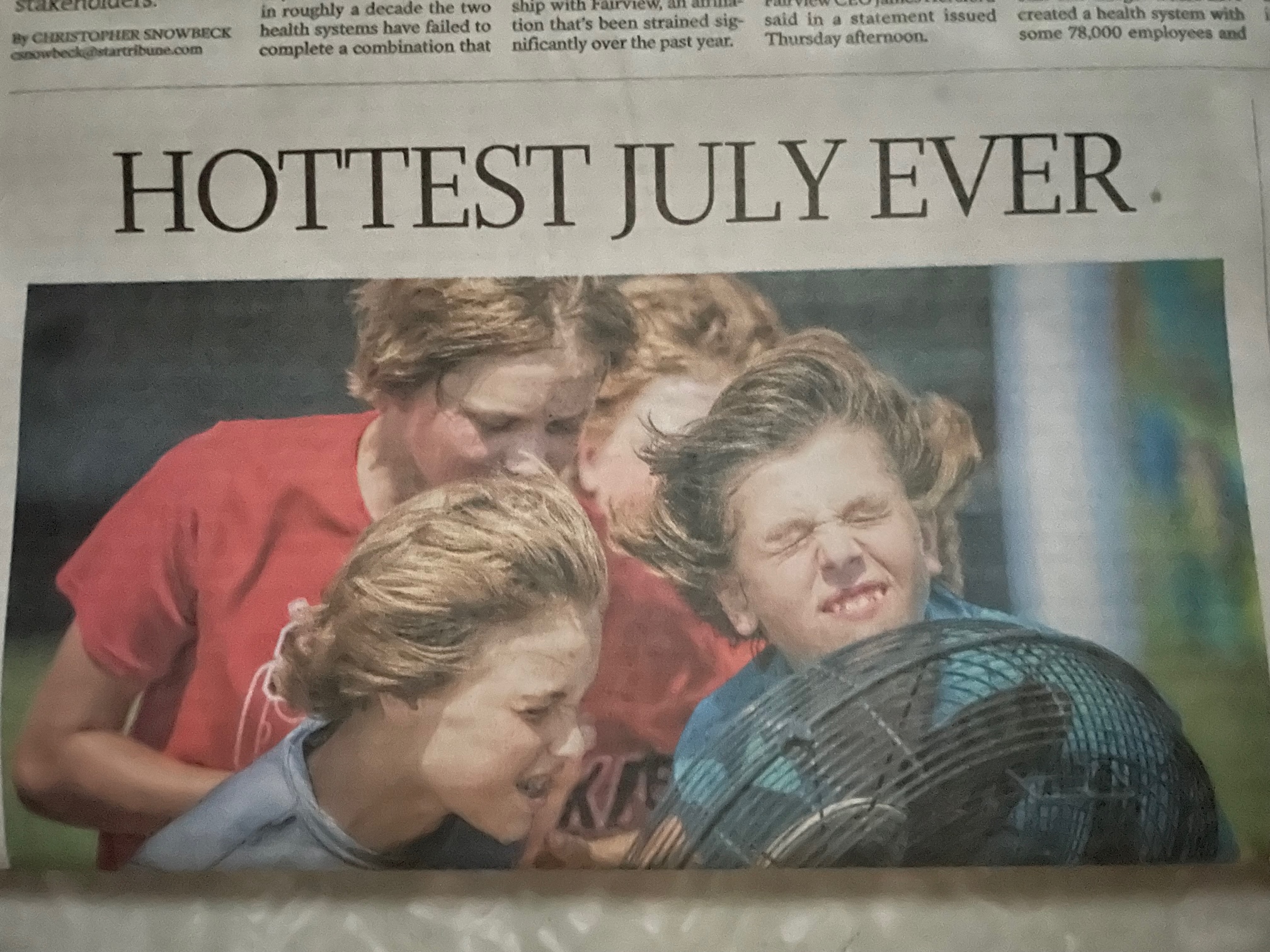
On a cool Sunday afternoon, a comfortable 74 degrees, it’s easy to forget how daunting July 2023 has been. More than 90 million Americans were under heat alerts earlier this week, according to PBS NewsHour. The month itself was the hottest on human record.

I read about farmers trying to keep their animals cool in rural Minnesota; about a man who died at a bus stop in Phoenix, Arizona, where temperatures climbed to over 110 degrees for 27 days in a row; about wildfires blazing in Mediterranean countries. Closer to home, I smelled acrid air in my own yard from Canadian wildfires hundreds of miles north and saw more watering bags going around the thin-trunked saplings that the city planted on boulevards to replace sturdier trees lost to Emerald Ash Borer.

But still, I went outside during our recent record heat wave. I like the heat. I’m a lifelong Minnesotan. We wait for months, from late October until mid-April, for warm weather. Even on the afternoon when it was 96 degrees, with an excessive heat warning, I stood by my decision not to cave on air-conditioning, to cave in to the popular notion that we couldn’t live without it.

Front-page news in the Minneapolis-based Star Tribune on July 28, 2023

Years earlier, when we were selling the family home in Northfield, I wouldn’t budge when the Realtor said the house would move more quickly — and fetch a higher price — if we installed central air. My family had lived comfortably in the house for 20 years. “There’s always one hot week in July when we hang out in the basement,” I told her. “Otherwise, we have plenty of cross breezes and ceiling fans. Find buyers who are green.”

And that’s the point. Minnesotans readily adapt to changing seasons. We think nothing of living differently in the winter: reading more, wearing layers of clothing, making stews and soups, staying home at night with Netflix. Similarly, we can find novel and healthful ways to stay cool, if we resist or cannot afford the immediate relief of air conditioning.

I sent my husband, who is less heat-tolerant than I am, to see Oppenheimer one evening this past week at our historic local movie theater. The next day, he wandered through the cool galleries at the Minneapolis Institute of Art.

There is a long history of industry-funded “deflection campaigns” aimed to divert attention from big polluters and place the burden on individuals.

Michael E. Mann, Time magazine, September 12, 2019

I chose to embrace the weather, as I do during the winter: biking to my errands with an extra side of water and sunscreen; reading on the porch at night and watching vehicles sealed up like tombs against the heat. Moving more slowly, giving myself permission to push away from the computer and relax, to call a friend. Like a snow day in July.

This heat wave, now over, was of our own making: our driving, our air-conditioning, our consumerism, our conveniences. Personal habit change won’t solve the climate crisis, it is said. But right here, today, surveying what little I can control: I see it as the only choice we have.

What the fuck! I’m tired of all the swearing

It isn’t that I never swear. It’s just that shit and fuck and goddamn and all the rest have become so ubiquitous that they’ve lost their ability to stun or shock, which, to my mind, is the whole point of swearing.

There are swear words, like the ones just mentioned, and there is crude or offensive language, and all of it seems subjective and so very public these days. On a bus ride recently to downtown St. Paul, a woman started swearing a blue streak into her phone as another man and I were exiting the bus to participate in a City Council meeting. Amid audible shouts of “Fuck this” and “fuck that,” I said to him: “This is why people are uncomfortable on mass transit.”

No one swore giving testimony at the City Council, except to say “damn” once. Clean language was a sign of respect. We know that swearing has its place, and it’s not in front of public officials whom you are asking to vote yes on your pet issue.

The older I get, the less natural that profanity sounds in my speech, as though I’m trying to sound younger, with it, more relevant than I really am — like putting on an outfit from the 1980s that still fits but no longer suits me.

A study reported on CNN Health shows that people who do swear may be more intelligent and creative, have a useful tool to control pain and are less likely to physically strike out when angered. If that’s true, then why is our society so fractured?

Because other studies from the same period, sometime in 2021, say swearing is on the rise, especially since the pandemic; and I know few people whose mental health has improved since then.

The C-Word

The call came in on a weekend, as they usually did. This time, it was a Saturday afternoon. Everyone in the neighborhood had access to my cellphone number, so I wasn’t surprised that the caller was a woman I had never met.

She had been dog-walking, she told me, across the street from the private-university campus where I worked, near single-family houses that had been given over to student rentals. That meant beer cans and weeds in the once tended yards, sagging and smelly couches on porches, and, on this late October afternoon, carved pumpkins lining the steps that led to the front door of a student house.

The word cunt was carved conspicuously, in capital letters, in one jack-o’-lantern where the teeth should have been in the grinning mouth. The woman said she could read it from the sidewalk. Based on the audible indignation in her voice, I took her to be about my age and stage — a product of a time when women’s liberation, as it was called then, sustained and shaped us.

Yes, I assured her, the C-word offended me, too.

As director of neighborhood relations at the university, I handled infractions and misbehavior among students who lived in the quiet residential blocks that surrounded campus. I prided myself on responding promptly and in person. And so, within 10 minutes, I was pounding on the students’ door. Expecting to encounter guys (entitled football players, maybe?), I was surprised to see they were all women.

“This is sexist hate speech,” I told them, after listening to their story of a (likely drunken) pumpkin carving party the night before. They shrugged it off, as did my colleagues in the Dean of Students’ office, who were dealing with the ramifications of what they considered a far more serious offense — the N-word being scrawled that fall semester on a Black student’s residence hall door.

Photo courtesy of Flickr: Creative Commons

My sons later told me the C-word was part of everyday speech in England and Australia. A female colleague called to gently explain that young women were reclaiming cunt as their own. “I don’t buy it,” I shot back. “They’re participating in their own oppression.” One could argue that Black male comics have reclaimed the N word. That doesn’t mean it should be written on a jack-o’-lantern, in full view of pedestrians — and children — on a public street.

I told her that when I type cunt in a Microsoft Word document, I get a “vocabulary” reminder: This language may be offensive to your reader. What I didn’t say was that the one time a man hurled the C-word at me, he then hurled a gob of spit in my face as well. Luckily, the assault ended there.

“CUNT: An informal name for the vagina. The word was in common use during the Middle Ages and was the name given to a number of streets in various British towns. Parsons Street in Banbury, Oxfordshire was once called Gropecunt Lane.

Urban Dictionary

‘Seven Words You Can Never Say’

We inhabit the speech patterns we heard and learned as children, until we’re old enough to develop and embrace our own. My parents raised my siblings and me to use quiet voices in the library, to address our friends’ parents as “Mr.” or “Mrs.,” a practice I carried into adulthood, and never, ever to swear.

Though I never had my mouth washed out with soap, it was an approved parental practice at the time, much like the paddle for rowdy boys in junior high.

The first time I heard my father use foul language was, oddly, when he was quoted in our small-town newspaper, the Mankato Free Press. He’d been canoeing up north on his annual getaway with the guys, and a fish of some species and considerable size hit my dad’s paddle and landed in the boat. My brother recalls a headline that played on “a real fish story” theme. I was 9 or 10 years old and shocked to read my father quoted in the paper as saying the fish came at them “like a bat out of hell.” I had never heard him swear.

I refused to let my sons say sucks or sucked when they were small, encouraging them to speak more descriptively and expand their vocabulary beyond the vulgar. Both swear liberally now, punctuating their sentences with fuckin’ so often that the word has lost its meaning, or any punch.

I ask why they find it necessary to use fuckin’ as an adjective (“Move your fuckin’ car”) or an adverb (“It was fuckin’ great”). “The concert or the restaurant was great,” spoken with gusto, would convey the same meaning. But this is how their Millennial generation communicates. It’s what they hear on social media and on Ted Lasso (“he’s here, he’s there, he’s every fuckin’ where”) and on countless comedy specials.

That I was raised in an era when comedian George Carlin was arrested for enumerating onstage the “Seven Words You Can Never Say on Television” seems irrelevant to my grown sons. Nowadays, young adults might concede the seven words as slang, even as vulgarities, but not as swear words.

For the record, here are the seven words as Carlin uttered them in 1972:

  • Shit
  • Piss
  • Fuck
  • Cunt (there it is!)
  • Cocksucker
  • Motherfucker
  • Tits.

Two describe private parts of women’s bodies; three are sexual acts, one of which is particularly demeaning (you guess); two are bodily functions. The profanity that people spew so readily these days bothers me not because I’m a prude — though my sons might dispute that — but because I value women in a world that still does not.

Consider how many of these so-called “dirty” terms and phrases denigrate or poke fun at women’s bodies, sexual practices or health habits (yes, a douche bag is a legitimate thing; look it up). And then tell me they are harmless.

“Fuck!”

Ruth Bader Ginsburg and then-President Bill Clinton upon his appointment of her to the U.S. Supreme Court in 1993. Photo courtesy the BBC.

A friend who is a recognized leader in the abortion rights movement in Minnesota telephoned me on September 18, 2020, to break the news that U.S. Supreme Court Justice and feminist icon Ruth Bader Ginsburg had died. “I wanted you to hear it from me,” my friend said.

We both knew this spelled the end of Roe v. Wade. The president, after all, was Donald Trump.

Among the first people I texted was my sister-in-law in Boston, an attorney who, as a law student, got to meet Ginsburg and hear her speak. She replied immediately and with as much fraught emotion as I was feeling.

“Fuck!” the text read. That said it all.

The full weight of the utterance hit me because I rarely hear her swear. It was powerful punctuation to a moment that began to reshape women’s rights and freedoms as my Baby Boomer generation had known them. That was swearing as it should be: effective, to the point and rare.