Health Habits for Women to Practice as We Age

I was born with good health and have been blessed to have medical insurance and routine dental care throughout my life. Dad modeled daily exercise, Mom pushed us kids outside to play (likely because she craved peace and quiet), and both parents ensured we had bicycles and insisted we use them.

I thank them to this day that I still love to ride my bikes.

The habits I have built and the health I have sustained have served me well into my 60s. But it isn’t the decades-long practices — the balanced diet, the use of movement for both physical and emotional wellbeing — that are consuming me these days.

I am thinking instead about the physical changes that come with age, the need to work on bone density and balance, to guard my skin against the sun, to manage unexplained flareups in my hips, hands and feet. “Aging is not for the faint of heart,” my father used to say. (Actually, he said aging is not for “sissies,” but that word feels wrong today.)

So, at a time of life that requires equal doses of courage and self-confidence — and a commitment to spend more time on daily health habits — here are the practices I am working to develop.

ProTip #1: Hug your muscles to your bones.

I would hear this instruction in yoga classes, but I never quite grasped it till I was diagnosed with osteoporosis in November 2022, a blow that tossed me into old age without warning. Indeed, the bone-thinning disease that tends to strike women after menopause elicits sobering statistics:

  • Half of all women over 50 will break a bone because of osteoporosis, a “silent disease” that often is diagnosed only after a hip, wrist or other bone has broken.
  • Of the 10 million Americans who live with osteoporosis, 80% are women.
  • Caucasian and Asian American women are four times more likely to experience thinning bones than African American women and Latinas.

You can take medication for osteoporosis, and deal with the risks and side effects, but women can fight back in natural ways as well: eating more protein, taking Vitamin D3 supplements, lifting weights. In addition, I recommend a 12-pose yoga series designed by Dr. Loren Fishman and brought to light by New York Times writer Jane Brody in 2015.

Among the “side effects” of this prescription for osteoporosis, said Fishman, a physiatrist, in Brody’s “Personal Health” column, are “better posture, improved balance, enhanced coordination, greater range of motion, higher strength, reduced levels of anxiety and better gait.”

Kendra Fitzgerald’s version of the 12 poses on YouTube.

My sister found varieties of the 12 poses on YouTube, and after experimenting with several, I landed on the 20- and 29-minute versions by Kendra Fitzgerald. I’ve also strengthened my practice by taking “yoga for bone density” classes from certified instructors who have taught me the power of engaging muscles deeply while holding each pose (and who claim that the practice can improve your T-score).

Try it: Plant your feet on the floor. Root down through your heels and send that energy up your legs. Engage your thighs, your glutes, your abdominal muscles. Pull your shoulders down your back and radiate strength up your spine. Stand tall, sending your head toward the ceiling and pressing your fingertips toward the floor. Feel your strength as you hug your muscles to the bones.

ProTip #2: Employ your smartphone’s flashlight.

Twenty-five percent of older people — 65 and up, according to the Centers for Disease Control and Prevention (CDC) — fall at least once every year. And women are at greater risk. A weakened lower body, vision problems, a Vitamin D deficiency, impractical footwear, and home hazards such as throw rugs and lack of railings in bathrooms and on stairways are among the causes.

If you fall once, according to the CDC, you are twice as likely to fall again. Traumatic brain injury, broken bones and an increased fear of falling may result. People who feel uneasy on their feet are less likely to move around outdoors or to exercise at all — and, therefore, are more likely to become weak and isolated.

One solution? I turn on my iPhone flashlight both indoors and out, a tip from a young man who uses his phone’s flashlight when he’s crossing a street at dusk with his wife and children. I tried it walking home after dark when I still worked full time less than a mile from my home, scanning the sidewalk for uneven surfaces and tilting the light toward fast-moving vehicles as I approached a crosswalk. Now I use the flashlight when I get up before sunrise during a long Minnesota winter. It helps me navigate around houseplants, resting dogs and rocking chairs — as well as up and down the stairs — without waking my late-sleeping husband.

ProTip #3: Wear a funny hat.

Two age spots on the left side of my face came from years of commuting, a dermatologist told me, when the sun would shine hard through the driver’s door window. And to think I used to revel in the warmth.

A lover of stylish sunglasses, I also used to wonder why so many men wear baseball or bill caps. Now I get it. A bill cap keeps the sun out of your eyes and off your face. Even better are the hats that have a drawstring at the throat and a circular brim that shields the back of your neck as well.

In addition to applying sunscreen throughout the year — another dictate from the dermatologist and one of five skin-protection recommendations from the CDC — I cut my hair short so it looks halfway decent after a sunhat or bike helmet flattens it throughout the spring and summer. I bought my sunhat at REI. But instead of disparaging them as “old lady” hats, I wish I’d started wearing one when my skin was as dewy and wrinkle-free as the young models on this Sungrubbies site.

ProTip #4: Love your feet.

Time seems to speed up as we age, an aphorism cited so often that psychologists are studying whether it is perception or reality. Growing older is like a time machine that swirls you around in busyness for decades until it dumps you in your 60s, with more wrinkles, less ambition, a craving for sleep — and feet that, overnight, start to cramp and crack.

I was introduced to foot massage in a mat Pilates class after my osteoporosis diagnosis, where the teacher has us spend the first 5 minutes of every session rubbing lotion methodically on and between our toes, down the instep, up the outer edge, around the ball of the foot, over the heel. My feet tingle with pleasure, just as they do after I wince and roll barefoot over a spikey red plastic “peanut massage ball” that the Pilates teacher recommended.

“As you age, the muscle tissue in your feet can thin, and your nerves may not work effectively. This can lead to loss of feeling in your feet, [called] neuropathy,” says an article on footcare for seniors, which also instructs women — hooray! — to “avoid shoes that have high heels or pointy toes.”

The next steps? To stride toward the sunlight and shadows of old age, until the next physical and mental challenges present themselves.

Pictures at an Exhibition (of My Life)

I am drawn to bookstores and concert halls more than to art museums; to music and literature more than so-called fine art.

Still, given that one of my close friends is a longtime docent at the Minneapolis Institute of Art (MIA), I have learned over the years to appreciate paintings, especially, for their micro and macro characteristics — their ability to evoke personal, sometimes painful memories and to illuminate a perspective beyond my own.

More than other visual art forms, paintings inspire me to interrogate my past and present — the skinny girl I was, the old woman I am becoming — and pose questions about a future that already is proving to be more enriching, difficult and diverse than the narrowly white, middle-class, comfortable environment in which I was raised. Paintings inspire me to learn, to stretch and grow. They help me ponder a life that reaches decades back and point me toward an indeterminate amount of time forward.

The Awakening

My mother hauled us kids around to museums and the theater when we were sometimes too young to appreciate or comprehend the experience. She figured the exposure would be good for us; plus, being a native of Chicago, she yearned always to escape our small town. I did a version of that awakening in 2007 with my younger son, Nate, when he turned 12, arranging with my docent friend, David Fortney, then in training for his role, to conduct a tour of the art institute for 12-year-old boys.

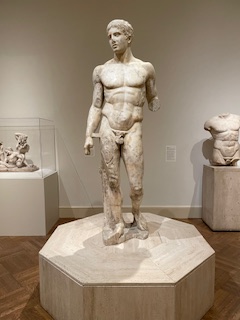
Imagine our surprise (not) when the tour began with a naked male statue, Doryphoros (Roman, 1st century BE), muscled and marbled but missing a left forearm. Other highlights of the tour included surprisingly small battle armor (how our species has grown!) and MIA’s post-World War II Tatra T87 from the Czech Republic, a luxury car designed in 1936 whose front end resembles the earliest Volkswagen Beetle.

These days, I notice how much more diverse the Minneapolis Institute of Art has become, from the offerings in its bookstore and the ages and ethnicities of its clientele to the artwork displayed in its hushed, white-walled galleries.

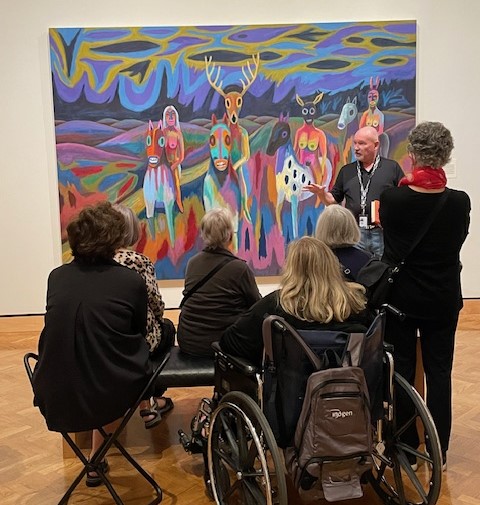
I was introduced to Indigenous artwork in a variety of media through my friend’s book tours, which MIA hosts monthly, of The Night Watchman by Louise Erdrich (Pulitzer Prize for fiction in 2021) and Horse by Geraldine Brooks (a favorite of mine this year).

On a MIA book tour for the novel Horse, docent David Fortney talks with participants about “Four Days and Four Nites, Ceremony” (2020) by Jim Denomie. An exhibition of Denomie’s work runs through March 24, 2024.

That long-ago museum tour for 12-year-olds left an impression on my son, now 28, because he joins me on these book tours, self-designed by each guide. Widely read in many genres and cultures, Nate has encouraged me to move beyond books about racism and the Black experience (White Fragility, So You Want to Talk About Race, How to Be an Antiracist) and instead read fiction by Blacks and other people of color. That has me currently working through the lyrical, unpunctuated prose and contemporary Black British references of the novel Girl, Woman, Other by Bernardine Evaristo (winner of the Booker Prize in 2019).

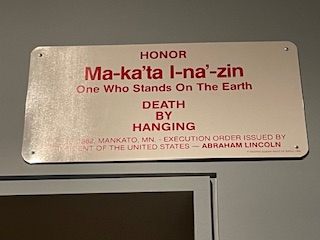
Lately, it is Indigenous lives and cultures that I want to explore, perhaps because I am from the town where 38 Dakota men were hanged, in the presence of their families, on December 26, 1862. When I was in school in Mankato during the 1960s and early 1970s, we learned nothing about the mass execution, lessened by three dozen pardons but ultimately approved — the order issued — by Abraham Lincoln, the president we herald as the “great emancipator.”

A Dog’s Life

My childhood family always had pets — dogs, specifically — and my husband and I continued the tradition with our own sons. Pixie, Gretchen, Skip, Lucy: Those beloved family members came to a humane and sad but dignified end until Griffin, the miniature schnauzer my husband adored and carried around on his shoulder as a puppy. My husband, David, called Griffin his grandchild (we still don’t have one), sometimes telling acquaintances at the dog park, “I’m surprised I don’t sit at home and knit him sweaters.”

Griffin was killed at age 6 in November 2018, hit by a car outside a rural house we were renting in my hometown to attend my stepmother’s funeral. The dog was killed instantly, from what we could discern, with no visible damage or blood on his body. “He died immediately, and we found him,” I tried to reassure my husband. To no avail.

David cried — shuddering, back-heaving sobs — as our older son dug a hole in the frozen dirt of our backyard. Then they wrapped Griffin in a sheet and laid him to rest in the cold ground while I watched from the kitchen window.

You can’t replace a “heart dog,” my sister Penny likes to say. But only a month later, I convinced David to adopt a puppy from Standing Rock in the Dakotas, via a neighbor who rehomes dogs from Indian reservations. Gabby is an athlete, a wary and sometimes standoffish girl who barks at any person, dog or school bus that dares to venture down our side street.

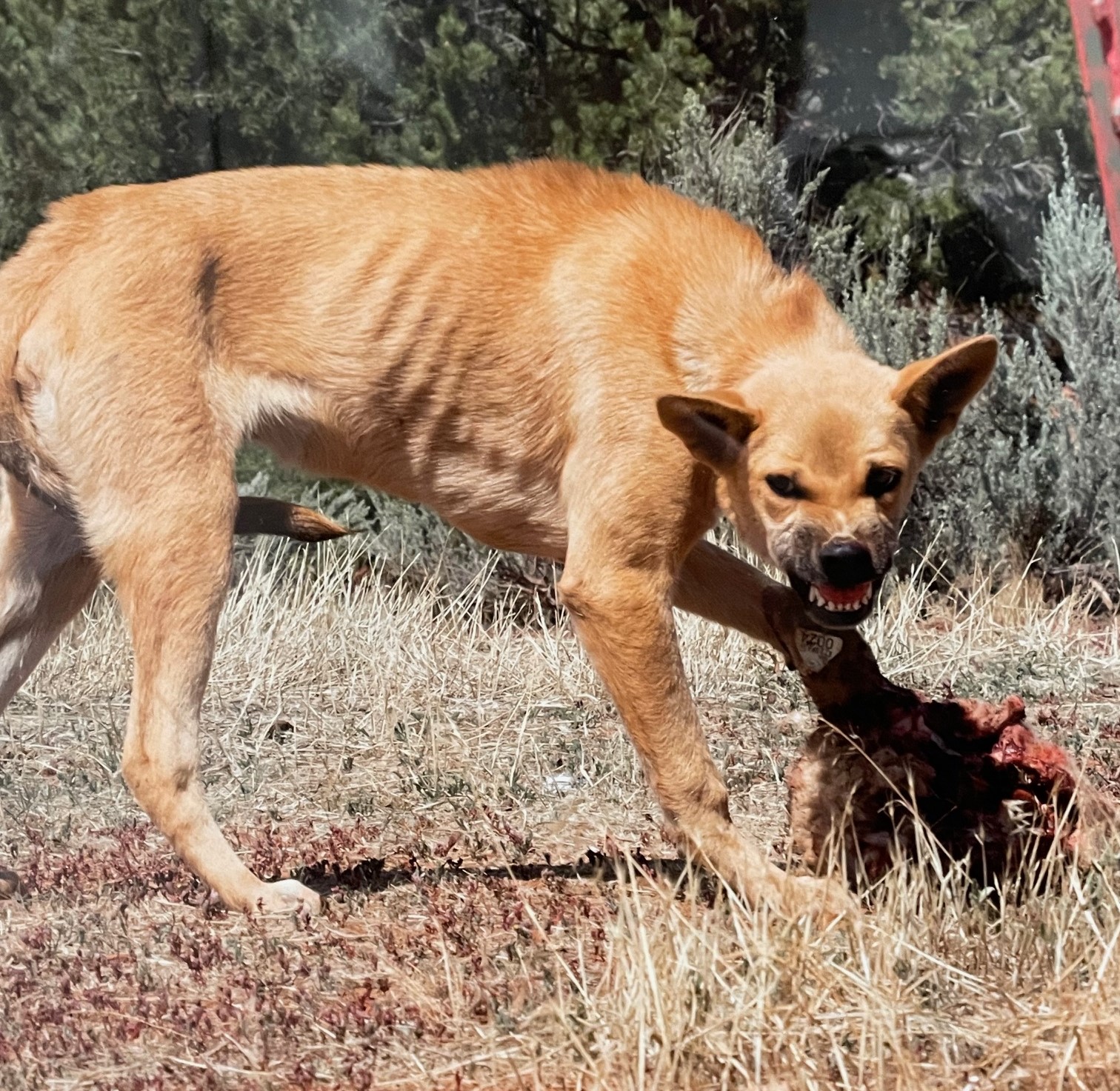
She looks like a smaller, tamer, better-fed version of a dog I saw pictured in the Raphael Begay photo Rez-Dog (2017) at MIA’s special exhibition “In Our Hands: Native Photography, 1890 to Now.”

“Rez Dog” (cropped) by Raphael Begay, 2017

“This is a post-butchering celebration and gathering with my family at my late grandmother’s home,” the artist wrote in the statement hanging alongside the photo. “There, I saw this dog dragging a sheep’s head that we left outside. . . . I look at it in the same light as how we treat our unsheltered relatives. There’s this sense of concern, empathy, but there is a lack of responsibility or commitment to help.”

Women’s (R)evolution

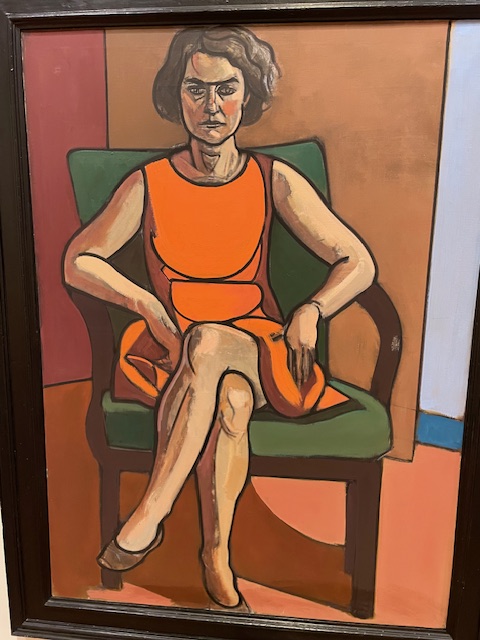
The last several times I have visited the Minneapolis Institute of Art, I have returned again and again to a portrait on the third floor of a stern, stylish woman sitting upright in a chair, her face turned to the artist — almost daring him to objectify her.

It stands in stark contrast to the reclining nudes and bare-breasted ogling of traditional, centuries old western European art, which grows tiresome for me in the way that its countervailing fascination with royal propriety and the ruling classes turns off my older son, Sam, a Democratic-Socialist.

The painting that speaks to me is Temma in Orange Dress (1975) by Leland Bell, one of several portraits of his daughter by the largely self-taught painter. I perceive it less as a father’s flattering gaze than a reflection of women’s emerging independence — two years after the U.S. Supreme Court passed Roe v. Wade in a 7–2 vote (inconceivable today) and at a time when women’s labor force participation rate exceeded 46 percent, more than 10 points higher than in 1965, a decade earlier.

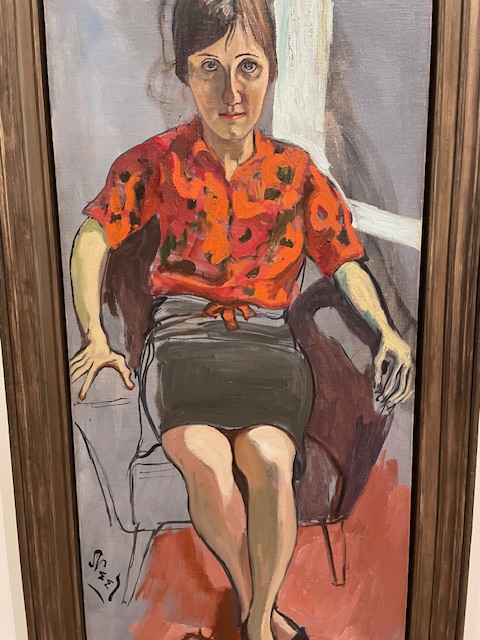
Unlike the uncertainty and timidity of Christy White (1958) by the feminist portrait artist Alice Neel, which hangs nearby, Temma projects strength. To me, she reads as a career woman, who pursues her own identity and financial means.

When I showed “Temma” to my younger son, I told him the painting reflects my career-woman phase. “Oh, you mean the 40-year phase?” he shot back. And yet much as my sons have seen me, and I have wanted to see myself, as Temma — fierce and forceful, a woman to be reckoned with — at heart I am more “Christy White.” Fearful, insecure, wrestling to this day with whether I walked the right path in a society that forces women to make hard and heartrending choices.

I walked up to “The Barn,” a 1954 painting by Wisconsin artist John Wilde, to see the rendering of a naked woman breaking free, and then a guard pointed out the face of a man watching in the lower left-hand window, a child’s wagon on the ground nearby. Some time later, I came upon a color-soaked painting, “Think Long, Think Wrong” by Avis Charley, of a fashionably clothed Native woman waiting in the sunshine for a bus.

“I create images that I wish I would have seen growing up,” said the artist’s statement. This painting, she explained, “is about putting aside distractions and staying present.” Aside from the art itself, that’s the beauty of an art museum: It helps us reflect upon our lives and values in a calm, quiet place, and assemble disparate images into a cohesive whole.

How Women’s Work-Life Choices Are Evolving

The first thing I noticed was the number of women casually wearing blue jeans as they networked, introduced themselves and sipped their morning coffee, as though clothes did not define their role or status.

I had debated what to wear for my first professional women’s conference in over 25 years. Would skirts and blazers still be required? Given that I was taking mass transit to the event, could I get away with athletic shoes? Finally, on a chilly, gray Friday with intermittent showers, I opted for slacks and shoes I could walk in — practical and comfortable. Turns out, I was overdressed!

Between the ages of 36 to 43, I was a full-time newspaper columnist writing about women and work, with a focus on how a generation of middle-class women were navigating the personal and the professional in ways their homemaker mothers never had to do. “On Balance: Issues That Affect Work and Home” the column was called. So, when I heard about the annual women’s conference put on by RSP (Ready. Set. Pivot.) — a Twin Cities-based organization that “guides bold, unapologetic women to their next best thing” — I saw it as a chance to investigate how issues for career women have changed over the past 30 years.

Three conclusions or trends emerged that demonstrate the realities I have recognized in my 60s:

  • Progress can be temperamental, and transitory, but movements for social change do push us forward.
  • Age shifts our priorities, giving us space to quit dwelling on the inevitable regrets and instead channel them into more authentic ways to lead our lives today.

“Always concentrate on how far you have come, rather than how far you have left to go.”

Heidi Johnson

Trend #1: Finally! Flexibility Is Firm

Back when I was writing the column on women and work (a first for a local newspaper in the 1990s), once- or twice-a-week telecommuting was an almost revolutionary option provided by employers wanting to be seen as work-life friendly and to retain women struggling vainly to “have it all.” I was commuting a long way to the newsroom, with my husband as an at-home parent to our two sons. When a top-tier liberal arts college a mile from home offered me a job in communications, I used it to negotiate a partial work-from-home arrangement.

“Flexibility doesn’t mean working from home on Tuesdays,” a source told me at the time. “True flexibility looks different ways on different days.” And true flexibility, back then, was rare.

Years later, flexibility was among the trends that panelists cited at the RSP conference, organized by former Blue Cross Blue Shield marketing executive Wendy Wiesman, 50, who relishes the “insane freedom” that she gained when she left a prestigious job at a reputable company five years ago.

“Women are more ambitious than ever, and workplace flexibility is fueling them,” says the Women in the Workplace 2023 report by McKinsey & Company, produced annually in partnership with LeanIn.org.

Six key questions kicked off the RSP conference in October.

Rather than being the sole exception, as I was, the women I met at the conference treated flexibility as a given rather than a favor that could be taken away. They have the confidence, or perhaps the strength in numbers, to determine how and where they want to work. COVID and a tight labor market have fueled that trend.

I talked with two women in their 40s who are running their own businesses. Diane, a human resources specialist who was often told she “wasn’t typical,” has three children and is the primary breadwinner because her husband is a teacher. Jennifer, who is married with two daughters, lost 100 pounds a decade ago and joined Toastmasters to help her present herself publicly. Now, having tired of working in financial services, she coaches professionals in public speaking.

Wiesman, founder and CEO of Ready. Set. Pivot., says those are the kinds of courageous women her company attracts, who want to design the next stage of their career and leave a secure position if it’s not working. “The DNA is of a woman who is never quite satisfied,” she says. Or, as her website puts it: “The best talent is restless.”

“What does success mean to me now? From the perspective of today, what is most important to me?”

Randi Levin, transitional life strategist

Trend #2: Self-Care Is Not Selfish

As a young business reporter, I interviewed women who wore blue suits to work. Who pulled back their long hair. Who displayed no photos of their children. It’s almost laughable now, how earnestly we tried to blend in with the corporate male establishment (and, of course, it’s the rap against the women’s movement of the 1970s, that we white women of means were merely striving to fit in rather than working to change the system for Black and brown women, too).

Often that meant working harder for less pay and recognition, on the blind faith that someday, it would pay off.

Nowadays, Black women in particular are vocal about the importance — the essentialness — of self-care amid the myriad stressors in their lives. The inaugural “Rest Up Awards,” announced by the Women’s Foundation of Minnesota in September, are granting $10,000 each to 40 nonprofit leaders throughout the state whose organizations are advancing gender and racial justice. All recipients are women of color, according to coverage in the Star Tribune.

“That whole perfectionism thing is out the door,” said the RSP conference’s keynote speaker, Natasha Bowman, a Black attorney, bestselling author and recognized expert on workplace mental health. “Women experience mental health challenges at twice the rate of men, at least. But we women don’t put ourselves on our to-do lists.”

In helping ambitious, hardworking women to design their next phase of life, Wiesman urges them to broaden their focus — and encompass their families, relationships, volunteerism and other interests in a vision of how they want to live. “I first need them not to work 80 hours a week on their day job,” she explains. “It takes a long time to shift out of that. But you have to begin to not over-achieve in that arena. Otherwise, you make no space for the pursuit.”

And you end up in your 60s, as I have, trying to explain your workaholic choices to now-grown children who still resent that you were gone so much while they were growing up.

“I did then what I knew how to do. Now that I know better, I do better.”

Maya Angelou

Trend #3: We Get to Be Who We Really Are

In addition to all the jeans and easy laughter at the women’s conference, I noticed that I had never heard “shit” and “fuck” spoken so often or openly at a professional gathering. My age-related aversion to swearing aside, I took it as a brazen symbol of Generation X women’s comfort with themselves. They’re not looking to anyone else to define what is acceptable. “I’m challenging the universe to think differently about talented women,” said Wiesman during her introductory remarks at the event.

Leadership coach Susan Davis-Ali, Ph.D., author of the book How to Become Successful Without Becoming a Man, spoke during a panel discussion about the “great corporate job” she had 15 years ago before leaving to launch her own work and pursue her own path. “Transformation means to change,” she says, including “behavior and attitudes.”

“Getting personal will create risk,” another panelist said. The mostly middle-aged, mostly white women in attendance — exactly the audience for my long-ago business column — heard about negotiating for what they’re worth (“men ask for significantly more money”), about defining what they are offering the market (“generalists aren’t getting noticed; find your sweet spot”) and about speaking with more authority (less “I think” or “I feel”; “own your expertise”).

Men’s restrooms were repurposed at the RSP conference.

When a panelist asked how many of us were old enough to have been expected to “be in the office from 9 to 5 with pantyhose on,” I was among the few women who raised my hand. Later, during a breakout session, I spoke up on behalf of my Boomer generation: the ones who blazed a trail but failed to notice that some women weren’t on the path, who overinvested in work as our sole means of self-worth and self-expression.

Wiesman’s generation obviously has learned from our mistakes. “Since the pandemic, women are centering more on their lives and themselves,” she told me. “They’re focusing on themselves first and not the system.”

As a woman of retirement age who still enjoys work, I’d say it’s time to start emulating the women coming up behind us, the ones who declare (as Wiesman’s RSP website says): “This is what I want, this is what I need, this is what I’m good at, this is what I love.” And then get out there and show the world that aging women still have a hell of a lot to offer.