How Shabbat Can Heal the Tyranny of Busyness

I attended my first Shabbat service on a recent Friday evening, surprising in its sense of joy and celebration. “We love to sing,” said the program for Temple Beth Shalom in Needham, Massachusetts, where my nephew, Eric Gage, on the cusp of 13, would become B’nei Mitzvah the next day.

I felt both eager and unprepared as I stepped into the reform temple, with its unfamiliar language and practices. My brother helped my sisters and me — raised Methodist, none of us regular church-goers — through the English translations of the Hebrew text. I struggled self-consciously with the left-to-right turning of the pages in the prayer book, before I finally sank into my pew and focused outward, upward.

“Our everyday lives are so busy,” the evening’s program read. “We invite you to relax and enjoy this time away from the quickened pace of the world outside these walls. Please enjoy the gift that is Shabbat by turning off your cell phone, Blackberry, iPhone or anything else that goes ‘buzz.’”

A sense of placekeep-calm-and-shabbat-shalom_SMALL

The word Shabbat literally means “ceasing” or “stopping,” a concept I am only beginning to grasp at middle age — and one made more difficult in a time when being digitally connected (always on, forever reachable) is expected, if not embraced.

“The Sabbath comes to us from the Jewish tradition. In the story of creation in Genesis, each of God’s six acts of creation is like an act in a play. And the climax is: God rests,” says a 2003 article from the UU World, the magazine (and now website and Twitter feed) of the Unitarian Universalist Association.

“It is the rests in the music that make the music,” says a friend of mine who became a UU minister in her 40s.

UUism is my adopted though ill-practiced faith, and I am turning to its teachings and seven principles more often as I discuss my concepts of God and religion with my 19-year-old son, a declared atheist. Absent a relationship with a UU congregation, however, I have lost my sense of the Sabbath, or Shabbat.

I have no place, no church, no sanctuary whose sanctity demands that I leave the buzzing iPhone at home and turn off the incessant buzzing in my brain. Sunday no longer is a special day, with its own quieter rhythms. I go to yoga early in the morning. My husband and I often take in a movie in the afternoon. Beyond that, it’s just another working day when I don’t have to don work clothes.

“Observing the Sabbath, observing a day of mindfulness, taking a real day off . . . call(s) for the intentional creation of sacred space and time,” says the same article in the UU World, a reprint of a sermon by the Reverend Amanda Aikman. “It takes a little discipline. It also calls us to overcome our fear of what we will find in the silence and the emptiness.”

‘Be more, do less’

In my ongoing quest for meaning at midlife — for a greater sense of purpose beyond my work and myself — I am turning to secular sources of inspiration that name the problem but seldom offer any lasting solution:

  • “Be more, do less,” a T-shirt at my yoga studio reads.
  • “We wear our busyness like a badge,” says Duluth, Minnesota–based yogi and teacher Deborah Adele in The Yamas & Niyamas: Exploring Yoga’s Ethical Practice. Describing Brachmacharya, the concept of non-excess, she notes how we Type A drivers tend to soothe ourselves with alcohol or food, shopping or sex, how we habitually overschedule our time. “My ego likes to feel important, and it doesn’t feel very important when I am resting,” Adele says.
  • “Weekends are awful for women who do too much,” says psychologist Anne Wilson Schaef in the handbook Meditations for Women Who Do Too Much. “We do not like the lack of schedule, and we feel lost without our work.”

I used to find sacred space and time on my daily dog walks in the natural lands around Northfield, Minnesota, where my husband and I raised our two sons. Now, in the city, surrounded by traffic and people, I struggle to recreate the sense of gratitude and connectedness that came upon me, unbidden, on those leisurely walks through uninhabited woods and prairies.

When I wrote the “Seeker’s Diary” column for the Minneapolis-based Star Tribune — visiting Baptist and Moravian and Buddhist and Jewish and Catholic and Lutheran houses of worship throughout the Twin Cities — I often envied the congregants’ sense of moral and spiritual certainty, even as I watched the traditions and customs from a distance.

More than anything, I envied them the luxury of being removed from the world. Isn’t that the very essence of carefree?

And so, because increasingly I crave the quiet, my choices are to return to a religious community or to practice and prioritize the Sabbath on my own.

“Walk slowly at night” and “unplug all your devices” are among the tips in a Time magazine cover story called “Finding God in the Dark,” about author and preacher Barbara Brown Taylor. A water-stained copy of the issue has sat near my bathtub for six months. Time to start reading.

Learn more: http://www.bbc.com/news/uk-29751577
Flexibility, Focus Ease Strain of Midlife Career Shifts

Sarah Berger, 47, insists she wasn’t afraid when she got downsized from her director-level job in early September — even though she is single and solely responsible for her mortgage and other household expenses. Even though it’s her second career transition in four years.

Even though — as is often said of women on the other side of 40 — she isn’t getting any younger.

“It doesn’t pay to panic,” Berger explains. And here’s where age and experience served her: “I was feeling confident about what I’d achieved. I felt I had something to offer.

“As soon as I got laid off, literally driving home, I already was putting together my list of people to call,” she says.

Berger began with the women in her book club. “These are professional, well-connected women who believe in lifting up others. So I knew that if I called on them, they would use their network to help me.”

A fund-raising professional, she landed an even better position in mid-October — six weeks to the day after her layoff.

“The networking for me was key,” says Berger, the new director of resource development and communications at Neighborhood House, a nonprofit with a 117-year tradition of serving immigrants, refugees and low-income populations in the Twin Cities.

LinkedIn cartoon

Purposeful connections

This so-called “hidden job market” — in which a matrix of personal and professional connections opens doors — accounts for up to 80 percent of new hires, according to Forbes magazine.

That’s why Cathy McLane, 52, began rebuilding her network a year ago when she decided to ease herself out of a role as marketing and communications director at a prestigious private school in suburban Minneapolis. McLane had been there 14 years and recognizes now that she “had clearly stayed too long.”

She was out of practice in the discipline of connecting with professional peers — and out of step with the digital ways networking is now conducted. “I didn’t realize how deep I’d gotten in my little rut, my happy rut,” she says.

McLane activated her social media presence, which now includes 379 connections on LinkedIn and 578 followers on Twitter, with a handle — @CathyConnects — that describes where she wants her career to grow.

And, because no Tweet beats a face-to-face meeting, she started calling on people in similar roles at health care organizations and in higher education (including me, during my years at St. Catherine University). “People warned me that the level of job I want will come through knowing someone who knows the hiring manager,” McLane explains.

She was businesslike, professional and prepared in her informational interviews. And, without fail, she observed three practices:

  • Ask your business contact who else you should meet.
  • Write a timely and specific “thank you” note.
  • Purposefully stay in touch. “Part of networking should be giving back,” McLane says. “You want to add value. So if I find a good article or blog or website, I send that out.”

‘The age thing’

Six months after leaving her job, McLane has yet to land an equivalent career position. She’s got a long-term contract doing project management and internal communications for Cargill, which she hopes will become the “seed client” of the business she is launching: Cathy Connects LLC.

The glass ceiling she hit during her job search is less about gender than age. “People don’t always want 20 years of experience,” McLane says, because it calls up all sorts of speculations and suspicions:

  • Will you demand a higher salary?
  • Will you be digitally savvy?
  • Can you keep pace with the speed of change in today’s workforce?
  • Will you stay in a position for which you’re clearly “over-qualified”?

Consultant Sue Plaster, a former communications and HR executive who herself was laid off at age 50, says the economy and “the age thing” hit middle-aged men and women equally hard, though women likely pay a higher price for looking older. “The self-confidence aspects of the job search are really challenging,” she says.

And so, three pieces of advice for people in a midlife career transition — from three women who have been there:

  • Plaster: “Invest in a professional headshot for LinkedIn that portrays you in a favorable way — not a glamour shot but no selfies either.”
  • McLane: “Take space, not time,” she says, quoting Karen Himle, the recently named vice president of corporate communications at Thrivent Financial. Rather than mindlessly filling up your calendar, “slow down and take space to reorient: What’s important? What makes you happy?”
  • Berger: “I did not say no to a coffee date, ever. My goal was to make one contact a day. Those professional networks are really important.”

Lesson learned: “I have yet to meet one person who’s transitioned who hasn’t landed in a good place. It’s how you approach life, your attitude,” concludes Cathy McLane.

Become a Midlife Revolutionary: Walk to Work

Minneapolis is among the 10 safest cities for pedestrians in the country, the local newspaper announced this week. Seattle was the most safe, Detroit the least among the 25 large urban areas studied.

That’s comforting news, given that I do a lot of walking in Minneapolis and its twin city, St. Paul, where I live and work. But the data ignore the more interesting sociology.

Buried in a recent U.S. Census Bureau analysis of the percentages and characteristics of people who walk or bike to work is an age-related statistic that speaks to the subtle mind shifts that start to happen in middle age.

Although walking to work is most common — no surprise — among young adults with relatively low incomes, it creeps up again among people 55 and older. People like the violin maker who lives across the street from my house and walks more than a mile to work in all weather, or like his wife, a college bookstore manager who commutes a similar distance by foot or bicycle.

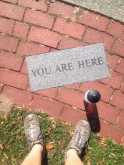
People like You Are Hereme, who a year ago traded a 40-mile commute for a walkable distance to work of 1.2 miles. Now, instead of nonstop meetings by iPhone in unpredictable weather and crawling traffic, my commute entails reading sidewalk poetry, admiring the art of urban landscaping and simply getting lost in my own thoughts.

Why walk? Why bother?

A higher percentage of people walk to work in Minneapolis (and, by extension, St. Paul) than in other cold Midwestern cities like Chicago and Milwaukee, according to the Census data. Across all 50 metro areas studied, an eco-friendly commuting method — walk, bike, bus, train — is most prevalent among people who live and work in the same city.

But the uptick in “older worker” walking interests me most — because my experience correlates exactly with the statistics. Walking has become, for me, a social statement, a political action. I walk to work because our neighborhood streets are choked with cars. I walk because I polluted the planet for years so I could enjoy both the city career and the small-town family.

I walk because the United States has become a fat and lazy nation, with obesity rates more than double what they were in 1970 and an average of 2.28 vehicles per household. “We don’t have a parking problem” in St. Paul, a City Council legislative aide told me recently. “We have a walking problem.”

And so, while it would be easy for me to talk about the more balanced perspective that middle age brings — along with the resulting confidence to slow life’s pace, to find my path — in truth I’m not sure that’s why I’m walking more. I walk because “excess” has become the U.S. brand, a hedonism we export to further justify our self-centered shopping and consumption.

I walk because I’m a child of Depression-era parents who raised my siblings and me without air-conditioning, with one TV and with the discipline to turn off lights even back when electricity was “penny cheap.”

I walk because I’m a sucker for the starfish story, and walking to work is one thing I can do, one small difference I can make, in a planet that grows more damaged by the day.

It’s not easy being green

Living an eco-life is more palatable and possible in a granola-eating, rainbow-flag–waving neighborhood with bus lines close by and a grocery store, Thai restaurant and charming retro movie theater within easy walking distance.

Still, walking to work has its challenges, especially for middle-aged women. Discomfort and inconvenience top the list:

  • Walking takes longer than driving, and that’s a pain on Monday morning when I have to be at the weekly staff meeting by 8:30 a.m.
  • It rains in Minnesota, and, of course, it snows.
  • My building has a Wudu station in the second-floor bathroom where Muslim women can wash their feet before prayer, but the closest showers for commuters who walk or cycle are at the athletics facility across campus.
  • My lunch gets squished in my backpack, which also gets heavy with a laptop and a pair of work-suitable shoes inside.
  • It’s harder to walk and wear a skirt or suit — the expected attire for a woman my age. I dress more casually than I’d like because it’s easier to stuff jeans or cotton pants in my backpack than to carry dry-clean-only clothes.
  • You have to plan. I need my car for work — at least that’s what I tell myself when I have an appointment more than a mile away. Instead, I have learned to plan outside meetings at the top of the workday, so I can drive there and back, park my car at home and then walk in. I also meet with people more often by phone.

Most important: I have a tolerant employer who has no problem with me working from home sometimes or varying my schedule. And that’s what a walk-to-work movement will require — flexibility from employers who recognize that a healthy, calm person is a more balanced, productive employee.

The sidewalk art three blocks from my house says it best: I don’t know enough about balance to tell you how to do it. / I think, though, it’s in the trying and the letting go / that the scales measuring right and wrong — quiver and stand still.

Lesson learned: “Walking the talk” is a literal action. By living my values, I may inspire someone else to do the same.