Category Archives: Social Studies

Signs of the Times: Do Yard Signs Make a Difference?

In the 11 years that I’ve lived across the street from John and Carey, I’ve not known them to showcase their preferences or opinions with yard signs, unlike many in our liberal, activist, urban neighborhood. So I took note when a Friends of the Saint Paul Public Library sign went up in their front yard — an innocuous enough message, in a neighborhood with two colleges and at least one Little Free Library on every block. And I paid even more attention at the blue and white reminder for traffic to slow down on the side street that we share in our corner houses.

“I feel it’s some kind of miracle that a serious accident has not occurred at our intersection,” Carey told me, citing that as the reason why she got the “20 Is Plenty” sign, which the City of Minneapolis began distributing in 2020, when it lowered its speed limit to 25 miles per hour. (St. Paul began offering free signs to residents earlier this year.) The library sign was a gift to donors, she recalls.

The absence of political signs in their yard on a well-traveled corner is no accident. “We haven’t put up political signs for years,” Carey says. “Personally, I don’t think seeing a campaign sign in someone’s yard would ever influence me to vote for that candidate.”

Her stance is at the heart of my own household’s disagreement about political yard signs. My husband, David, thinks they’re a distraction and a blight. America “fought for the secret ballot for a reason,” he says, and it’s nobody’s business how we vote. I counter that when ill-informed voters fail to recognize all the names on their ballots, I want my candidate’s moniker top of mind: “Oh, yeah, I’ve heard of that one.”

I didn’t have yard signs at the house where we raised our sons in Northfield because I had visible jobs — editor of the twice-weekly local newspaper, later director of communications for one of the town’s two private liberal arts colleges — and expressing my viewpoints publicly would have been inappropriate (and unethical as a journalist).

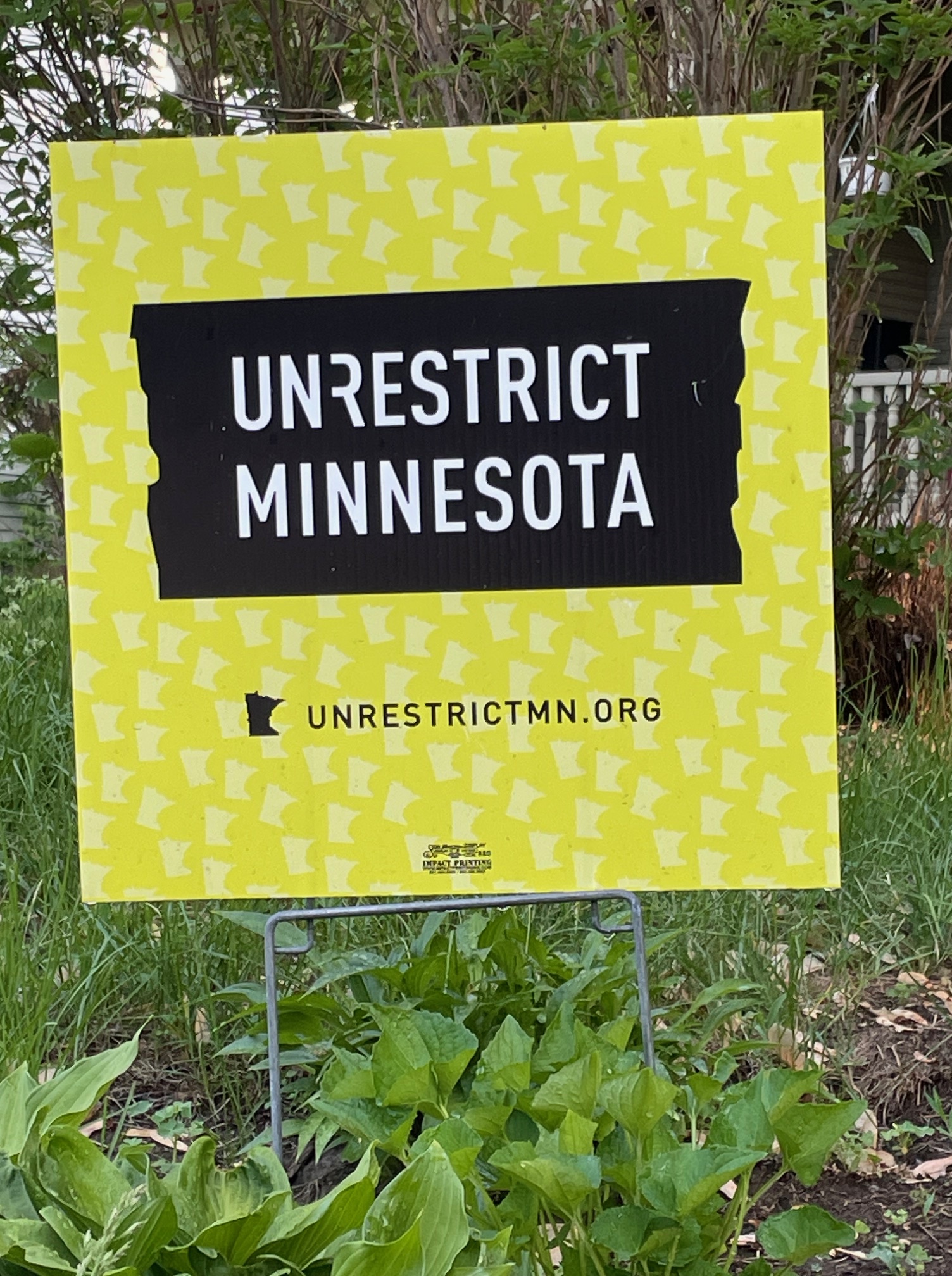
Later, when we moved to St. Paul, I hesitated to display my liberal leanings because of my position as director of neighborhood relations for the state’s largest private college, a Catholic institution. Many students and neighbors knew where I lived, five blocks east of the campus’ northern edge. An “All Are Welcome Here” sign by my own Little Free Library seemed harmless enough, but I waited to plant the pro-choice UnRestrict Minnesota sign in my front yard until I had left the university in September 2022. Having been reported to the general counsel’s office for my activism with Planned Parenthood North Central States, I prioritized job security and bided my time.

Freedom of speech

Signs, flags, bumper stickers: They can serve as advertisements, virtue signaling, rebellions against the establishment or just plain fun.

I laughed out loud when I first saw an “Any Functioning Adult” yard sign in Minneapolis during the 2020 presidential race. More recently, during another heated presidential campaign, I smiled at a yard sign in Grand Rapids, Minnesota to elect a family pet amid the battling Harris-Walz and Trump-Vance signs.
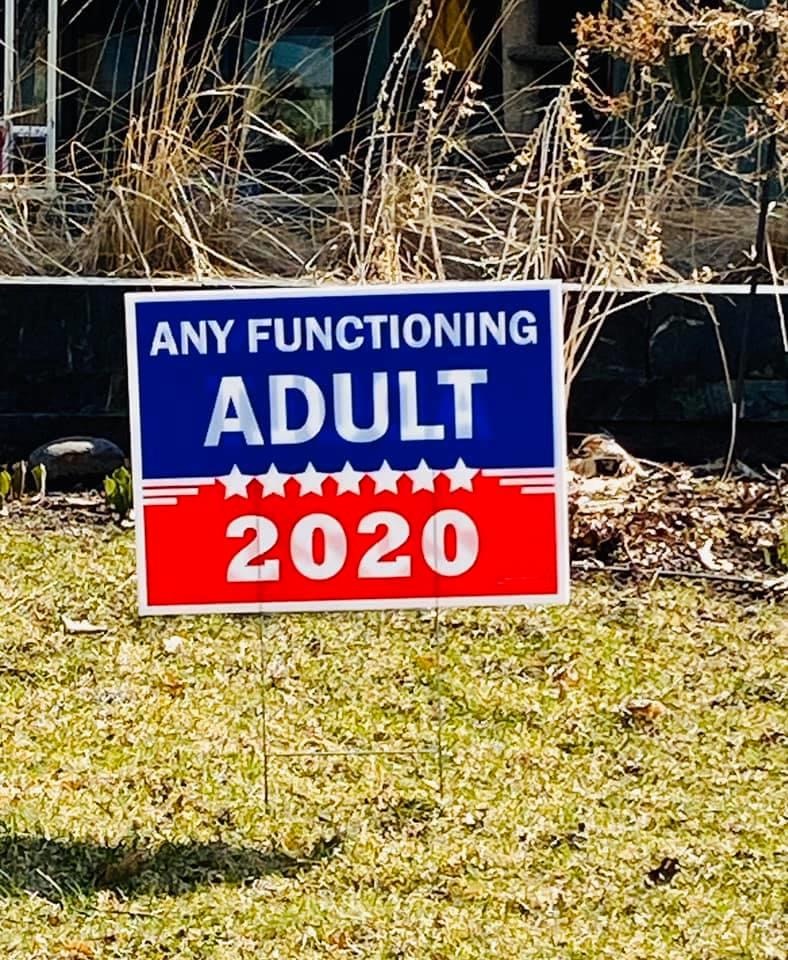
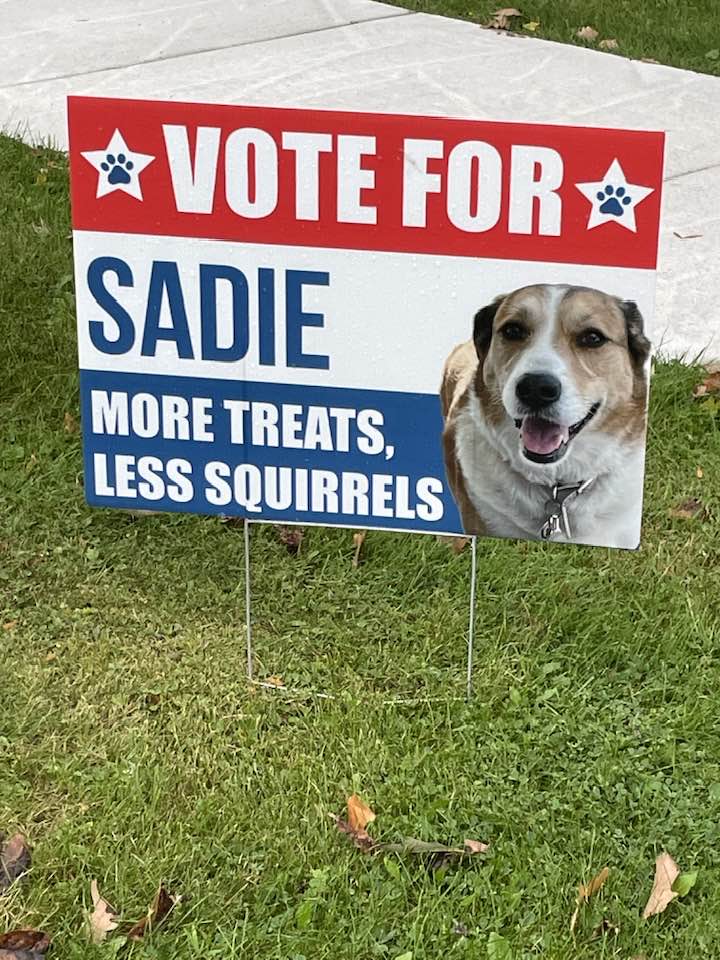
For others in my neighborhood, yard signs are both joyful expressions and serious business. Jamie, the husband and father in the family next door, has printed anti-Project 2025 signs for his yard (and mine) and was among the first on our block to put a Black Lives Matter stake in the ground. “I believe yard and window signs express my beliefs and values,” he says, “especially related to landmark and once-in-a-lifetime cultural change issues like gay marriage or systemic racial injustice.”

Jamie also has printed a T-shirt that he wears when he waves pro-democracy signs with other activists on a busy street corner once a week: “People of quality are not threated by people seeking Equality,” the T-shirt reads.

Two hand-made porch signs at my next-door neighbors’ home.

His wife says the handmade signs in their porch windows were a creative outlet for the oldest of their three children during the early days of COVID and in the explosive aftermath of the police killing of George Floyd. “Signs serve as an entry point to launching a discussion about a difficult or controversial subject,” she says, “and hopefully help others consider opposing views as less threatening.”

Another nearby neighbor — the only Republican I know on the block — put out a Nikki Haley sign back when the presidential candidate was still standing up to Donald Trump. I asked him about it one morning as we were dumping our recycling in the alley bins. He looked wary at first but later explained his motivation in an email.

“I thought she was the most qualified person in the race at the time, and I wanted to show my support and get others to notice,” he told me. “This is the first time I’ve put up a sign in more than 15 years. Nikki was the only presidential candidate I’ve been excited about in many, many years.”

Power and privilege

The Reverend Kelli Clement, a Unitarian Universalist minister, puts up signs in the front yard of her house in south Minneapolis “without worrying too much,” she says. Many of her neighbors share her views, and she works inside an institution that aligns with her values.

She describes both of those circumstances as a privilege:

  • Freedom from fear that a progressive sign would get “shot up or stolen,” which has happened to people she knows in small-town Wisconsin and other rural areas.
  • Freedom from worry that the UU congregation she serves would reprimand or discipline her for voicing opinions that run contrary to church teachings.

The UU “values of justice, equity and inclusivity are my values,” Kelli says. She can’t imagine wanting to post a yard sign that runs contrary to those. Plus, “nonprofit leaders and religious folk are individuals in their own right,” she declares. “We don’t owe our civic opinion to our place of employment.”

For Joan, whom I met through community and political organizing, yard signs are a catalyst to explore and confirm her beliefs. They help her step beyond what’s comfortable “and proclaim a position and values.” Which can be hard, she says, “if you believe you are in the minority.”
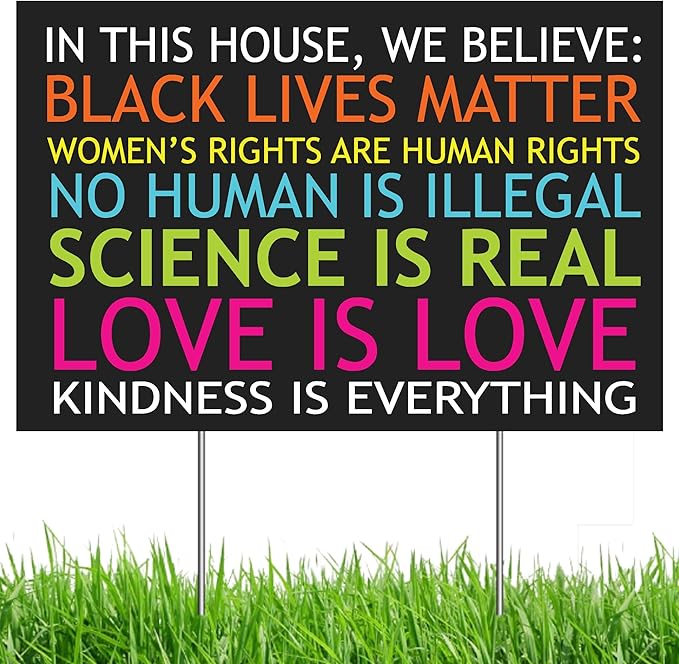
I am at an age and stage where I no longer have to appease an employer — a time of life when I am developing what I consider a healthy disregard for whether people approve of me. At 67, after decades of working hard and playing by the rules, I feel I have earned the right to be forthright and frank, so long as I don’t disrespect others. My yard signs may mean little to neighbors or passerby, but for me they represent a visible, colorful, even audacious symbol of being true to myself.
Boomers Can Help Biden By Speaking Up About the Realities of Aging

My then–eight-day illness coincided with President Joe Biden’s stricken performance at the first presidential debate on June 27; and so, I have been thinking about age and the limits it imposes on our energies; and how long it takes some of us to acknowledge its real impacts, as though we might have prevented our physical decline and mental slowdown. As though we are at fault.

Let’s begin with the obvious: The debate’s 9 p.m. start time in the president’s time zone is when most old people (including me) get ready for bed. He was tired! I’ve since heard that Biden had a cold that Thursday night, which explains the weak, scratchy voice. (Or was that the excuse the campaign invented?) Regardless, if Biden felt half as compromised as I have with my upper respiratory infection — when I have misspelled “horseradish” on the grocery list, run over a curb on a day when I had no business driving, repeatedly emailed “Christy” at work when I meant to send messages to “Crystal,” and committed any number of verbal gaffes with my antibiotics-addled brain — then I’d be willing to give the president a pass on his poor performance.

But I don’t think physical exhaustion explains it, unless you acknowledge it as a natural consequence of his age. That’s the conversation that anxious Democrats seem reluctant to have. Joe Biden is old. We don’t have to hide it, mock it or try to explain it away. When performing without the benefit of a teleprompter, or the psychological comfort of his team of aides, Biden acted like what he is — an 81-year-old man who is decades past his prime. And who should not be running for the most rigorous, visible and consequential job in the world.

I doubt whether Biden can be convinced to pass the baton less than two months before the Democratic convention, though the next-day New York Times column by his friend Tom Friedman made an eloquent and compassionate case for why that decision would serve the country. “[T]ime has finally caught up with him,” Friedman wrote. “And that was painfully and inescapably obvious on Thursday.”

Asked to bet today, I’d predict we are careening toward a second Trump presidency, which will be a disaster for the environment, for women’s reproductive rights, for immigrant protections, for an independent judiciary, for public-school funding and so much more. Perhaps, in the meantime, we can salvage a graceful exit for Joe Biden by ceasing to slap our foreheads and exclaim about his perfectly normal signs of aging: the shuffling gait, the search for words, the raspy voice, the stooped posture. All of which I remember from my own father’s decline, a man who, like Biden himself, had once been a sharp-minded attorney and politician, too.

As I stare down turning 67 on July 4, I am mindful that we can best locate empathy when we have experienced another person’s plight ourselves. It’s no surprise that I felt nothing but sadness for Joe Biden, who is nearly 15 years my senior, as he lumbered and stumbled onstage. I saw in him a quality that, until recently, I’ve been unwilling to see within myself — a refusal to concede to age, to recognize when it is time to step back and clear the path for younger people.

My upper respiratory infection hung on for 10 days and took two different prescriptions to kick because I had spent weeks performing like I was 20 years younger than I am. Having assured my retired husband I would scale back my work commitments this year, I instead stubbornly hung on to my two part-time jobs while taking on freelance assignments and contract work that I was afraid to turn down — all at a pace I once readily sustained. Mix too little sleep and too much multitasking with generalized stress, and you eventually get sick.

And if you’re old, you take a long time to get well.

I’ve since quit one of the part-time jobs and am scheduling my freelance work more carefully. But more than once during this extended illness, I have remarked to my husband that I tire more easily, that I must start prioritizing rest. “If that’s aging in a healthy 67-year-old,” I’d say, “how does an 81-year-old president do it?” Those comments now seem prescient, post-debate.

Neither my husband nor I is a huge Biden fan, but we are staunch Democrats and we’re afraid of Donald Trump. We’ll vote for Biden if he stays in the race and are trying to convince our Socialist older son that he should care enough to vote at all. The broader realization, however, is that we aging Boomers lack humility. We’ve been in charge for so long, during such a pivotal time in U.S. history — a period that I now recognize to be an anomaly of liberalism in a self-interested, deeply conservative country — that we can’t see our limitations and step off the stage.

We wouldn’t be in this position now if the Democratic National Committee had built a bench back when Biden was billing himself as a “transition” president, the only one who could defeat Trump in 2020. We wouldn’t be here if he had made more use of a Black female vice president whom, it appears now, he picked for show and to appease a constituency he couldn’t afford to alienate.

But here we are. The commentators who call for this clearly exhausted president to get on his feet again, prizefighter-style, to schedule interviews “in unfriendly places” and to forcefully compete are themselves still in denial. They’re asking him to summon a level of energy that most 81-year-olds cannot muster, let alone keep up between now and November.

Being this sick for this long, I have been forced to cancel appointments, to read and nap, to recognize that my body no longer will allow me to push at the edges of my energy. I can still contribute, but it’s going to have to be in different ways. Biden’s greatest gift to the country, to his family and to himself would be to make way for a successor and offer himself as the advisor and elder statesman that he deserves to be.

Some question whether the president, from his seat at the pinnacle of power, is capable of that level of self-awareness. “What was the combination of moral conviction, personal confidence and selfishness that propelled Biden, despite the risks, toward his decision to seek another term?” asked columnist David Ignatius in a Washington Post commentary that my sister shared with me the day after the debate.

To say that Biden no longer is up to the job is neither to blame him nor to deny the achievements of his administration. In fact, it is ageism — a perverse sort of shame — to avoid citing his diminishing capabilities. We aging Boomers must speak publicly about the realities we are experiencing as we grow old. Only then can we demystify and make peace with this most natural, and inevitable, of life’s progressions.

‘Could’ve Been a Contender’: Why I Love Women’s Sports

It’s not just that I’ve jumped on the Caitlin Clark bandwagon, though I have — along with the 14,624 other people who filled the Barn at the University of Minnesota this week to watch her Iowa Hawkeyes take on my alma mater’s Golden Gophers.

Nor is it that I watched the U.S. Women’s National Team ascend the ranks in the “beautiful game” — a foreign sport, in my youth — in the 1990s and early 2000s, at the very time that my two sons were starting to excel at soccer.

It took 2 minutes and 12 seconds against Michigan to make women’s scoring history.

My father and older brother followed the Purple People Eaters–era Minnesota Vikings when I was a kid, back when the team played outdoors and years before one of the fearsome foursome became a state Supreme Court justice. I’ve watched wistfully from the sidelines while my siblings bond each year over their Fantasy Football League.

But now I, too, have found my sport to follow — women’s college basketball in the Midwestern-based Big 10 — and I’m finally feeling it. Here’s what the hoopla is all about!

I’d written off sports as just a guy thing, a way for men to connect and converse while revealing nothing of themselves. I saw the energy but missed the emotions beneath the surface. Following a team through highs and lows, through wins and losses, through “the thrill of victory and the agony of defeat” — to call up Jim McKay on ABC’s The Wide World of Sports — is a rush, a disappointment, a heady exhilaration, a shoulder-drooping drag.

It’s a slice of life in a single season.

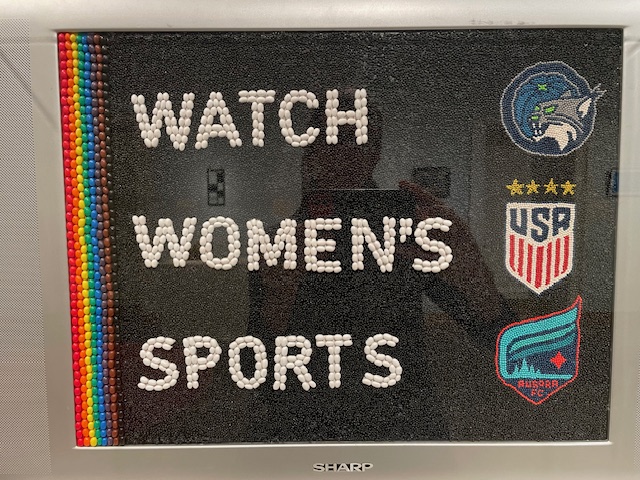
Kate Brenner-Adams’ crop art from the Minnesota State Fair photographed at the Minneapolis Institute of Art. “Sports are a microcosm of society,” she says, “therefore inherently political.”

As my career was winding down, my husband and I started going to the occasional Thursday morning concert at Orchestra Hall (the ones with free coffee, cellophane-wrapped doughnuts and an audience base that makes me feel young). Those are lovely and elegant, and they underscore my exposure to classical music as a kid.

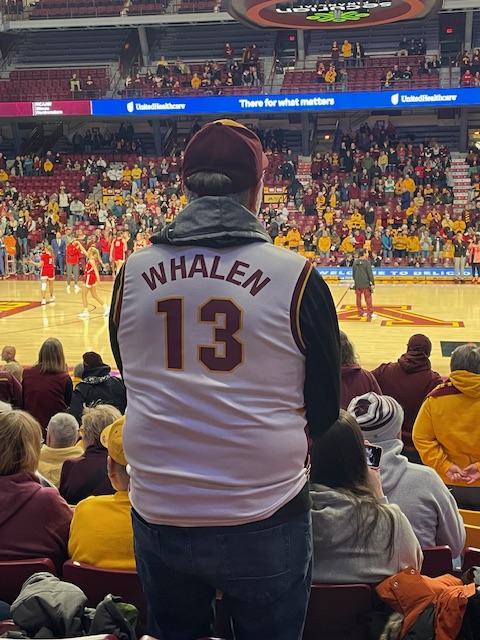
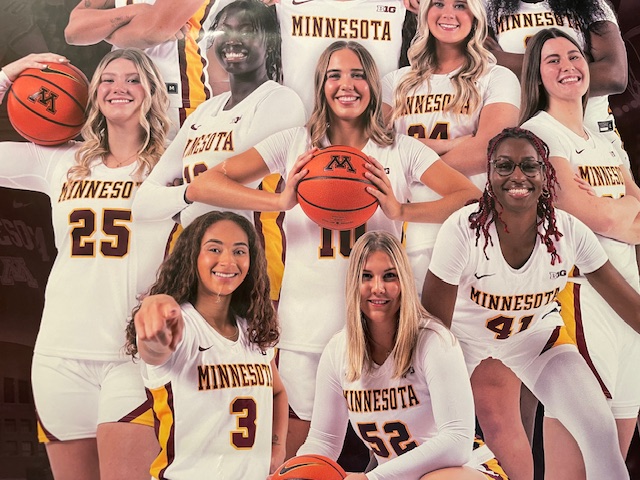
But what I really enjoy are the rowdy, rollicking Gopher women’s basketball games that we began attending last year to see Lindsay Whalen coach and then committed to with season tickets this year, hoping that new coach Dawn Plitzuweit could coalesce the team.

David and I met at the University of Minnesota, and we followed the Gophers nominally when Whalen was an award-winning 5-foot-9 point guard and, of course, stuck with her storied pro career with the Minnesota Lynx. David says women play basketball the way he did, “below the rim.” (I firmly believe the NBA should raise the men’s rim, but that’s a different story.)

Basketball is not the only sport where fans are paying more attention to female athletes. Minnesota now has a team in the Professional Women’s Hockey League, and the Minnesota Aurora, a pre-professional soccer team, has been selling tickets and winning matches — all with an honorable and enviable mission: “to create pathways for women and girls to reach their potential, on and off the field.”

Women my age rarely had that chance. Title IX, which mandated equity in sports at institutions that receive federal funds, passed in 1972. I was 15 years old, a leggy, athletic girl who was a cheerleader and took dance lessons and loved to bike and was always a fast sprinter (“for a girl”) but who never was allowed to be an athlete, to play on a team.

I see them now in the stands, women like me in their 60s and 70s or even older, some with white hair and walkers. These are women who have lived through historic shifts in our society — abortion rights won and lost, better pay and political representation, the Violence Against Women Act extended to lesbians, immigrants and Native American tribal lands — and who are showing up and cheering loudly, despite being told for years that they were lesser, they couldn’t compete, they weren’t enough.

Following women sports, being a vocal and unabashed fan, lets us demonstrate that we still are standing strong.

Image courtesy of Reader’s Digest

I was working as a “Women in Business” columnist at the Saint Paul Pioneer Press in 1999, when Brandi Chastain kicked the winning goal for Team USA in the Women’s World Cup final at the Rose Bowl in Pasadena. My sister Debbie and her family were there. “I actually overheard somebody in the stadium say, ‘They play just like boys!’” she recalls now.

As one of few women on the newspaper’s business desk — and the only one who focused on women’s issues — I was the go-to when male colleagues wanted to get the “woman’s point of view.”

Sure enough, after the sports section displayed the infamous photo of Chastain on her knees, eyes closed, fists raised in the air after she had ripped off her soccer jersey in celebration, my editor called me over to his desk. Was her action unsportsmanlike, inappropriate, simply in poor taste? Or was it sexist that Chastain was getting grief for her exuberance when male players ripped off their jerseys all the time?

And then came the predictable: What do you think of this, Amy?

Newsweek celebrates Brandi Chastain and women’s soccer: July 19, 1999.

It was one of those rare moments when I had the perfectly timed response. Pausing to give the photo a once-over, I looked my male editor in the eye and said calmly: “Nice abs.” And then I turned and walked away.

Twenty-five years later, Target Center in Minneapolis is sold out for the Big 10 women’s basketball tournament in March, a women’s sports bar is opening in the Seward neighborhood several miles away and Brandi Chastain, now 55, has framed the famous sports bra, which hangs in her home. As for me? I barely know a fast break from a field goal, but I’m having the time of my life — watching young women excel at opportunities that were denied me, and supporting them every step of the way.