
Category Archives: Life Purpose

Elder-care duties call us to seek the best inside ourselves

I’d heard the news about women and memory loss by the time my sister sent her foreboding e-mail — “a little scary, sisters” — with a link to a story headlined: “Women Descend into Alzheimer’s at Twice the Speed of Men.”

One in six women has a chance of getting Alzheimer’s by age 65, compared with one in 11 men. I recognize that truth every time I count the female heads at our mother’s memory care building.

What is less in the news — but ever-present in the lives of thousands of Baby Boomers, the majority also women — is the stress of caring for a loved one with Alzheimer’s.

I’ve been my mother’s primary caretaker since February 2012, when she was diagnosed with the disease. I get the 6 a.m. phone call when she refuses to take her shower. I press the doctor about why he prescribed an anti-depressant without consulting me. I clean the toilet and the sink every time I visit.

These chapters of my life are writing themselves as I rush through them. Unlike my journal, I rarely linger long enough to reflect on how I really feel. All I can hope is that my sons observe the constancy and discipline, and that, one day, they will do the same for me.

Chapter 1: The Professional Caregiver

I joined 40 other scared, sad middle-aged people at a talk in late April by Charles Schoenfeld, a Wisconsin-based author who retired from truck driving and studied to become a certified nurse assistant in dementia wards.

“Human kindness can often reach where medicine and textbooks cannot,” said Schoenfeld, the only man in his CNA classes. “It takes a special person to work in these facilities.”

We daughters and sons or spouses and partners were invited that evening by a physicians’ group that services upscale memory-care facilities. But 800,000 people in the United States who have dementia live alone, without benefit of the long-term-care insurance that allows my mother to reside in a well-appointed place with daily activities, on-site nursing care and an aide-to-patient ratio of 8:1.

The cost of $5,500 a month will drain her financial resources and exhaust her insurance within five years. At that point, if she’s still living, county assistance will kick in.

“So, what do low-income people do who have Alzheimer’s or dementia?” I asked Schoenfeld, adding that every resident but one at my mother’s home is white and all of the aides are people of color, many of them first-generation immigrants.

“That’s a head-scratcher,” he said, clearly not expecting this twist at a white-table-cloth dinner hosted at a country club. Next question?

Chapter 2: Caregiving and Work

It would be dramatic, and inaccurate, to say I downsized my career a year ago solely to care for my mother. It is absolutely true, however, that a non-management job — and the 15 hours a week it nets me — makes my time with her more possible and more pleasant.Audrie Gage_06.15
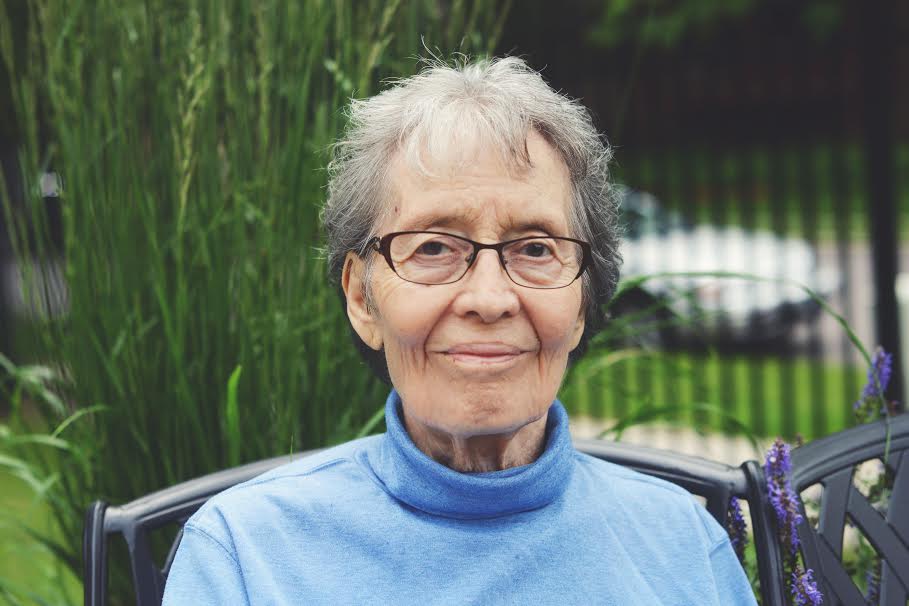
Now that Mom can no longer shop or talk politics or converse on the phone, I focus on what we can do. I wash and style her hair when I visit. I attend and sometimes lead the seated exercise class — and tear up when the residents close by singing multiple verses, from memory, of “You Are My Sunshine.”

Mom has lost 12 pounds in six months as the disease has claimed her appetite and sense of taste. I sit with her at mealtime and urge her to eat. I bring her candy bars and sugared coffees from the Caribou nearby.

I’m grateful for those moments when my maternal instincts take over, when I sit beside her on the bed and rub her shoulders or stroke her cheek. When I am thinking less about my loss than her own. And I do it all unquestioningly and mostly without complaint. I take the responsibility as seriously as I did my duties to my children.

“Working at home,” “on vacation” and “sick child” are among the dozen or so descriptive magnets on the check-out board at work. Not one of them says “elder care” or “Alzheimer’s” or “gone to see my mother while some shell of her is left.”

Work-life balance is still defined as moms with kids.

Chapter 3: Caregiver Support Group

The first time I heard about the caregivers’ support group at The Alton Memory Care, where my mother lives, I pictured the group therapy sessions on The Bob Newhart Show of the 1970s. Kooks and cranks sitting awkwardly in a circle while a droll, befuddled expert tried to lead them back to mental health.

The image amused me till I recognized the kook and crank inside myself — and felt my resistance and resentment at having to sit around that table.

Two weeks ago a woman named Julie dominated the conversation. Her mom was just diagnosed at age 86, and Julie wanted to know every fact and facet about Alzheimer’s:Alzheimers word cloud
  • How many stages are there? (“Most experts say seven.”)
  • What’s the difference between Alzheimer’s and dementia? (“The former is a subset of the latter.”)
  • How is Lewy bodies dementia different from Alzheimer’s? (She had me there.)

“What does it matter?” I finally asked her, as kindly as I could. “You won’t be able to predict the course of this disease. Your mother will have good days and bad days. Every time you see her will be different.”

Our group leader steered us back to the strengths of people who have dementia. They live in the moment, observe non-verbal cues, always appreciate music and experience a range of emotions.

I note the absence of emotion every time I leave Mom’s building. I turn off the car radio and drive home stony-faced, in silence, seeking the distance between myself and the inevitable.
A Getaway Gets Me Closer to Who I Am and Hope to Be

I wake up early the morning we are to check out of the hotel room. It’s 4:30 a.m., and I feel myself preparing to leave, to return to what we call “real life.”

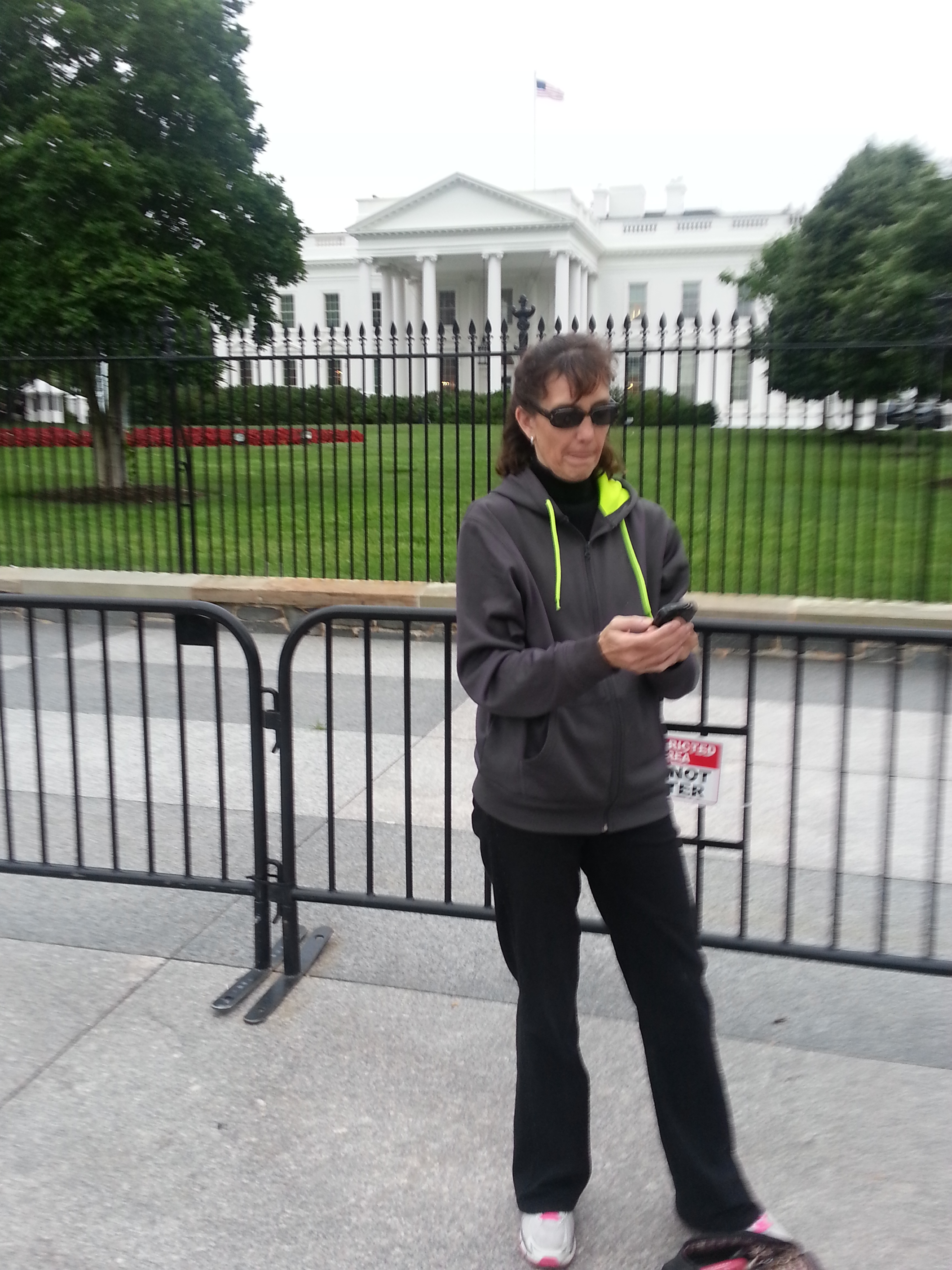
Facebook at White House_06.15

Facebooking at the White House

This trip to Washington, D.C., is the first vacation my husband and I have taken together since December 2012. We often travel by combining my business trips with a short vacation, which affords us a half-price trip. This time I was attending a four-day conference, during which he stomped the city with his map and sturdy shoes, and afterward we tacked on a few days of sight-seeing together.

In between we had moments — separately and as a couple — when the distance from our daily lives helped us see ourselves more clearly. For me, that is the discipline and the reward of a vacation. I maintain enough of my routine to feel physically healthy and keep pace in the high-strung cities where work trips invariably take me.

But I step back, too. I allow myself the time and space to read, write in my journal and reflect upon a life that, in many ways, is blessed.

Proudly Minnesotan
“Where are you from?” is a common question at a conference. It’s an ice-breaker, a way to forge a quick connection. I used to be embarrassed to mention Minnesota given the indifference I encountered on the East Coast, the lack of curiosity about the Upper Midwest.

These days — likely because I’m more comfortable with who I am — I proudly tell people where I’m from and where I’ve always lived. At this conference for community relations specialists in higher education, I resisted the urge to compete with the woman from Chicago who challenged my labeling of St. Paul as the “Boston of the Midwest” given our number of colleges and our status as the state’s capital.

Chicago is the nation’s second city. St. Paul is the second sibling to its better known Twin City, but I like the relative quiet and the friendly neighborhood feel, and I’m finally to an age where I can acknowledge that.

I felt that pride of place again at the “Reporting Vietnam” exhibition at the Newseum (a worth-the-trip experience for a former journalist) where Eugene McCarthy and Hubert Humphrey were featured as prominently as LBJ and Richard Nixon.

Elsewhere in the museum, a series of comedy clips from “Laugh In” and “Saturday Night Live” about anchors and reporters featured Al Franken from the early ’90s. “That’s one of my state’s senators!” I crowed to the woman sitting next to me. I’m not sure she saw the humor, and maybe it only reinforced her impression of Minnesota as a backwoods state. I didn’t care.

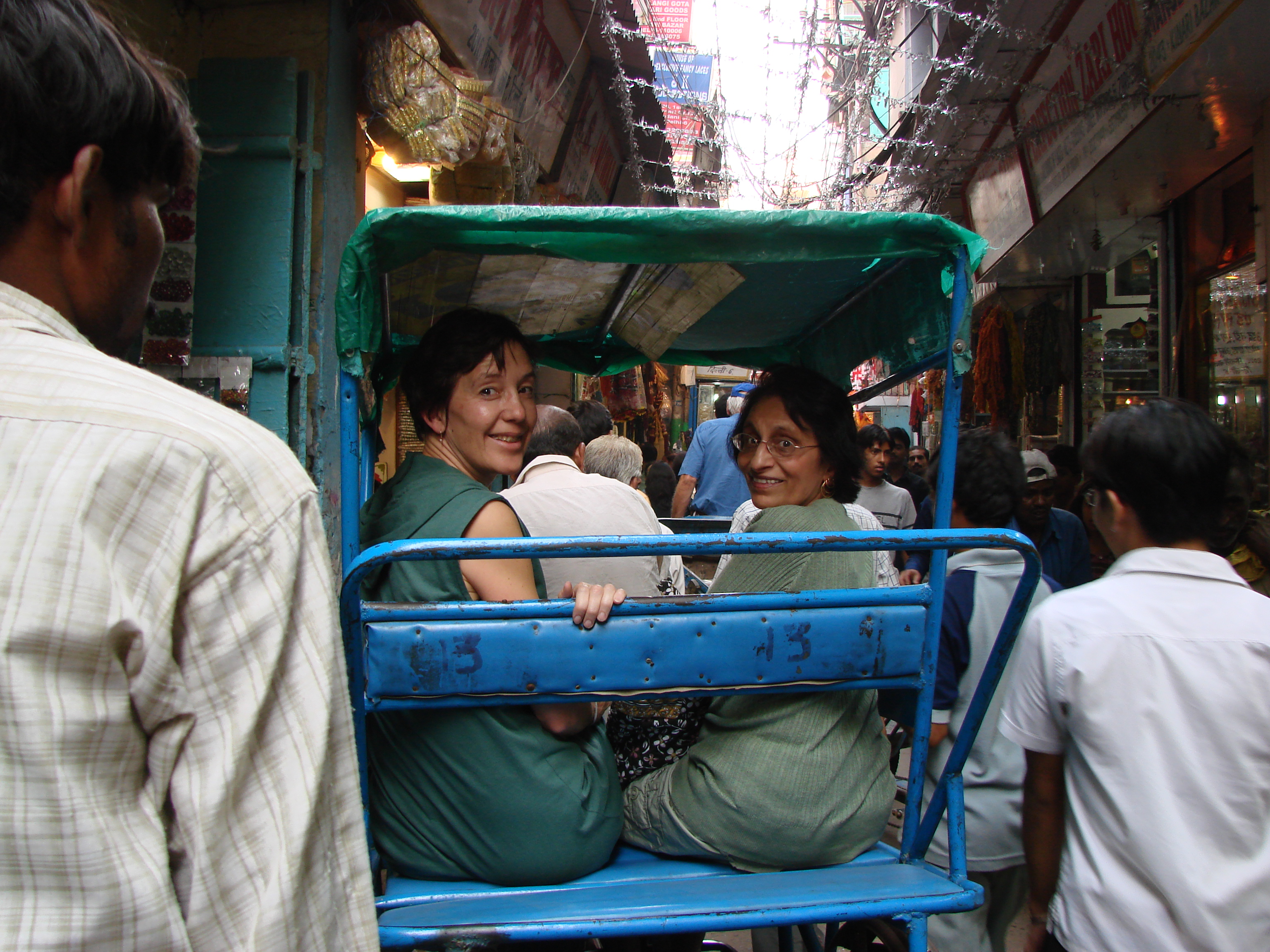
A different lensindia amy
The emotion of traveling hits me more acutely as I age. It’s not that this trip took me out of my Westernized, middle-class comfort zone, as a 16-day journey through India did back in 2006. Instead it was the roller-coaster ride of anticipation, exhilaration, exhaustion, reflection and elation again that had me hyper-alert to my surroundings.

That, in turn, made me nostalgic about my youth and wistful sometimes about what my life is missing and what I hope it still can be.

    • I called my father, a retired attorney, from the steps of the U.S. Supreme Court and reminisced into his message machine about our trip to D.C. when I was 11 years old and he patiently walked me through “The First Ladies” exhibition at the Smithsonian. Instead of heeding the selfish and self-defeating voice that said, “He never calls back,” I reassured myself that being a decent daughter is the one piece of this equation that I control.
    • I stood below the steps where Dr. Martin Luther King delivered his “I Have a Dream” speech and watched a group of African-American parents and children from Indiana mourn and celebrate their sons and brothers who have been shot dead. And I recognized how little I can do to save my own sons and felt the painful tug-and-pull of parenting young adults — the impulse to hang on, the absolute requirement to let go.
    • I joined the touristy throngs in front of the White House and felt the satisfaction of knowing that I voted for the president who lives there. That wasn’t true during my last visit in 2002. And I challenged myself to work to get my candidate elected in 2016. Women’s Studies was my second major in college. Time to put the theory into action.

Coming homeSkip
Back home for a week now, I have settled into the life I sought to escape. Living paycheck to paycheck but grateful for interesting work. Both tired of and devoted to my 15-year-old, food-obsessed dog. Worried for the economic climate my sons are inheriting and proud of them for making their way in it.

Nearly one-fourth of working Americans have no paid vacation or holidays, and those of us who do are often too driven or insecure to take it.

After years as a workaholic, I’ve come to see vacation as a worthwhile investment, a rare chance for a broader view. “All work and no play” not only makes Jack a dull boy; it makes him unaware of customs and cultures beyond his own, and way too invested in the illusion that he’s irreplaceable.

Thank God, February’s Over: Bring on Spring!

The longest shortest month of the year, February makes me wish time away — something  most of us cease doing at middle age.

We’ve had 26 sub-zero mornings in Minnesota so far this winter. February is among the slowest months for local businesses; people would rather be keeping company with their screens.

Native Minnesotans are supposed to take the icy sidewalks and bitterly cold temperatures in stride. But I’ve eaten too much. Gotten off my running routine. And been too distracted and stir-crazy even to finish reading a book.Penguins on ice

Enough. Spring starts in March, and I am holding myself to better habits, starting today:

1) Keep moving. I felt reborn the other day when I ran four miles along Mississippi River Boulevard with a friend I hadn’t seen in months. Yes, it was cold, but I know how to dress for winter running: layer your clothing, go lighter below the waist, wear a black Ninja hood to encase your head and neck.

The sun was shining. The conversation was lively. And I adopted her trick of thinking positive when the going got tough. Rather than “damn, this hill is steep” we’d exclaim to each other: “Look at the view!”

2) Gain perspective. The death of New York Times journalist David Carr on February 12 threw me, as it did many of his former colleagues. I knew Carr, barely, back in the roaring ’80s, when we both worked at MSP Communications. He chastised me once for wearing a campaign button in the newsroom. He swept through a party at my upper duplex in northeast Minneapolis, pronouncing that I had a “nice pad.”

I envied his self-confidence and single-minded ambition. I recognized his talent, even as I viewed it from a distance. I was never brave enough to travel in his pack.

Like others, I was shocked and saddened to read of his collapse. But I also personalized the news in a way that feels ungenerous, both to him and to myself. I didn’t think about the wife and daughters he left behind or his unfinished work in the world.

When I read about Carr’s globe-trotting career, the mark he made on his profession, and his canny ability both to overcome and capitalize on his addiction, I felt small by comparison. Just as I did back then. Only a year younger than he was when he died, I assessed my career and wondered what I have accomplished.

Weeks later — given time, perspective and a review of his candid, pragmatic interviews with Terry Gross on Fresh Air — I recognize that Carr would want his hometown coworkers to be not intimidated but inspired.

3) Build community. A couple of colleagues asked me in January to teach a weekly yoga practice over the noon hour, even though I hadn’t taught for more than a year. We meet in a drafty gym, with no music. We bring our own blocks and other props. We have a varying range of abilities.

And it’s become a high point of my week. They overlook my rusty teaching. I watch then bring courage and humility to the mat. We’re taking risks, and that helps us appreciate one another in a way that simply working together does not.

4) Just do it. I’m grateful for the discipline developed over decades in the workplace. You suit up and show up, even when you’d rather be somewhere else. “My whole life is have to,” Steve Martin declares in Parenthood, a spot-on film I saw the day I learned I was pregnant with my older son.Parenthood

I don’t want to walk my dogs in the minus-zero wind-chill every morning. I don’t always want to visit my mother in the memory-care facility, or shop for groceries, or sort the boxes taking up space in our one-car garage. But I do it, because I have to. And because action is always preferable to riding the merry-go-round inside my head.

5) Write it down. On my best days, I see that obligation gives my life purpose. People count on me. I have a good job and a strong network of friends. I’ve built a family to care for and about.

On the harder days — which was most of sub-zero February — I start the day with a cup of coffee and a journal. Thirty minutes later, the world looks right again.

Then I haul out the long, black down coat and the boots that hold me upright on the ice — and I get on with it, whatever it is, because having places to go and people to see brings me one step closer to spring and beats the alternative of wallowing in the winter blues.