Category Archives: Health and Wellness

Sit Still! Can a ‘Staycation’ Become a Daily Practice?

I skipped my company Christmas party this year — not a smart move for a new employee who hopes to grow her job and widen her influence at work.

It wasn’t because I’d had a lousy week and my boss had barked at me (though both are true). I just needed a night at home, alone, after six straight days of having e-mails, texts and virtual meetings intrude on weekend plans and overtake every evening.

My iPhone is running my life. More accurately, my connectivity-fueled agenda is my life, and the signs of that imbalance — inability to concentrate, a craving for constant movement and excitement, and, recently, the not-so-subtle suggestions from coworkers and friends that I seem hyper and wired — have me worried.

Which leads to less sleep and more caffeine.

What’s an over-achiever to do? What else? Draw up a list on the iPhone. Make a plan.

Power down

Love it, hate it

Lately I have been drawn to media reports about the downside of an internet-amplified, over-scheduled life:

  • Ever check your iPhone before and after a Sunday matinee? Or read e-mail on the sidelines of a soccer game? Me, too. In fact, the tools designed to keep us current and organized have stolen our leisure, according to a special report in The Chronicle of Higher Education on the cost of living in a state of fast-moving distraction.

“Plugged in 24/7/365, we are constantly struggling to keep up but are always falling further behind,” the Chronicle declares. “The faster we go, the less time we seem to have. As our lives speed up, stress increases, and anxiety trickles down from managers to workers, and parents to children.”

Read a book or a newspaper in its original form, he says, without the temptation to click through to related sites or articles on your portable device. Daydream. Sit still. (And do what?)

  • “The time I’ve spent going nowhere is going to sustain me much more than the time I’ve spent running around,” says travel writer Pico Iyer. He schedules some amount of downtime every day to reflect on and process his various experiences.

In an August 2014 TED talk called “The Art of Stillness,” Iyer described how Wired founding editor Kevin Kelly found the space and creativity to write his latest book by eliminating smart phones and television from his home. Take an “Internet Sabbath” at least one day a week, Iyer says, “in order to develop the perspective and sense of direction when you go online again.”

What is scary about stillness?

I’ve been taking stay-at-home vacations since before the shorthand, staycation, was even coined. My husband and I couldn’t afford to travel when we were raising our two sons. Plus, I enjoyed hanging out at our small-town home after daily commutes to the city.

When colleagues asked, “Where are you going?” my standard reply would be: “Off the clock.” Lately, I’ve amended that to “off the iPhone.”

Since finally buying a smart phone in May 2012, I’ve learned that a staycation is no vacation if I stay plugged in to office e-mail and my social media accounts. Nor is time off a break if I’m scheduled dawn to dusk with workouts, lunches, errands and appointments.

A Type A person tends to see weekends or vacations not as opportunities to relax and recharge but as prime time to get things done. And that’s OK, she tells herself, because the busyness is tied to her family and friends. Problem is, the deeper I get into middle age, the more I find that “always on” is not sustainable.

I want to live more in silence, not with Minnesota Public Radio on as background news and noise, not with music blaring while I clean or cook, but silence. Without distraction, with myself. I want more mental freedom, more unstructured moments to get lost in a book or in my thoughts.

I want to live more often without a schedule and the tools that tie me to it.

“Be curious,” one of my yoga instructors used to say. So, what would happen if:

  • I swore off caffeine for 24 hours?
  • I invited a friend out spontaneously?
  • I did yoga at home, instead of in a structured class, and followed wherever my mind and body took me?
  • I turned off my iPhone for an entire weekend?
  • I committed to focused reading time for a natural wind-down in the evening?
  • I explored the observation my mother made of me long ago: “You’re always on the go. What are you running from, I wonder?”

I won’t find the answer till I learn how to be still.
Become a Midlife Revolutionary: Walk to Work

Minneapolis is among the 10 safest cities for pedestrians in the country, the local newspaper announced this week. Seattle was the most safe, Detroit the least among the 25 large urban areas studied.

That’s comforting news, given that I do a lot of walking in Minneapolis and its twin city, St. Paul, where I live and work. But the data ignore the more interesting sociology.

Buried in a recent U.S. Census Bureau analysis of the percentages and characteristics of people who walk or bike to work is an age-related statistic that speaks to the subtle mind shifts that start to happen in middle age.

Although walking to work is most common — no surprise — among young adults with relatively low incomes, it creeps up again among people 55 and older. People like the violin maker who lives across the street from my house and walks more than a mile to work in all weather, or like his wife, a college bookstore manager who commutes a similar distance by foot or bicycle.

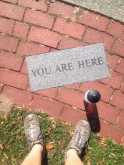
People like You Are Hereme, who a year ago traded a 40-mile commute for a walkable distance to work of 1.2 miles. Now, instead of nonstop meetings by iPhone in unpredictable weather and crawling traffic, my commute entails reading sidewalk poetry, admiring the art of urban landscaping and simply getting lost in my own thoughts.
Why walk? Why bother?

A higher percentage of people walk to work in Minneapolis (and, by extension, St. Paul) than in other cold Midwestern cities like Chicago and Milwaukee, according to the Census data. Across all 50 metro areas studied, an eco-friendly commuting method — walk, bike, bus, train — is most prevalent among people who live and work in the same city.

But the uptick in “older worker” walking interests me most — because my experience correlates exactly with the statistics. Walking has become, for me, a social statement, a political action. I walk to work because our neighborhood streets are choked with cars. I walk because I polluted the planet for years so I could enjoy both the city career and the small-town family.

I walk because the United States has become a fat and lazy nation, with obesity rates more than double what they were in 1970 and an average of 2.28 vehicles per household. “We don’t have a parking problem” in St. Paul, a City Council legislative aide told me recently. “We have a walking problem.”

And so, while it would be easy for me to talk about the more balanced perspective that middle age brings — along with the resulting confidence to slow life’s pace, to find my path — in truth I’m not sure that’s why I’m walking more. I walk because “excess” has become the U.S. brand, a hedonism we export to further justify our self-centered shopping and consumption.

I walk because I’m a child of Depression-era parents who raised my siblings and me without air-conditioning, with one TV and with the discipline to turn off lights even back when electricity was “penny cheap.”

I walk because I’m a sucker for the starfish story, and walking to work is one thing I can do, one small difference I can make, in a planet that grows more damaged by the day.

It’s not easy being green

Living an eco-life is more palatable and possible in a granola-eating, rainbow-flag–waving neighborhood with bus lines close by and a grocery store, Thai restaurant and charming retro movie theater within easy walking distance.

Still, walking to work has its challenges, especially for middle-aged women. Discomfort and inconvenience top the list:

  • Walking takes longer than driving, and that’s a pain on Monday morning when I have to be at the weekly staff meeting by 8:30 a.m.
  • It rains in Minnesota, and, of course, it snows.
  • My building has a Wudu station in the second-floor bathroom where Muslim women can wash their feet before prayer, but the closest showers for commuters who walk or cycle are at the athletics facility across campus.
  • My lunch gets squished in my backpack, which also gets heavy with a laptop and a pair of work-suitable shoes inside.
  • It’s harder to walk and wear a skirt or suit — the expected attire for a woman my age. I dress more casually than I’d like because it’s easier to stuff jeans or cotton pants in my backpack than to carry dry-clean-only clothes.
  • You have to plan. I need my car for work — at least that’s what I tell myself when I have an appointment more than a mile away. Instead, I have learned to plan outside meetings at the top of the workday, so I can drive there and back, park my car at home and then walk in. I also meet with people more often by phone.

Most important: I have a tolerant employer who has no problem with me working from home sometimes or varying my schedule. And that’s what a walk-to-work movement will require — flexibility from employers who recognize that a healthy, calm person is a more balanced, productive employee.

The sidewalk art three blocks from my house says it best: I don’t know enough about balance to tell you how to do it. / I think, though, it’s in the trying and the letting go / that the scales measuring right and wrong — quiver and stand still.

Lesson learned: “Walking the talk” is a literal action. By living my values, I may inspire someone else to do the same.

The Oldest Woman in Yoga

Ask middle-aged women which physical changes have surprised them, and they’ll talk about joints: aching knees, fragile ankles, sore shoulders that restrict range of motion.

The less common complaints are about bathroom habits. “Jumping makes me pee!” says a 56-year-old yoga instructor and nutrition coach. Another woman, 62, says simply “constipation” when asked about the physical change she least expected.

Our skin starts to dry out as early as our late 20s. We begin to lose muscle mass in our 30s. By our 40s, we see parentheses flank our mouths and darker circles beneath our eyes. But for some of us who have been athletic all our lives, the hardest signs of aging are the physical limitations.

“The payback for pushing yourself too hard gets worse as you age,” says Web MD, a valuable online resource for both diagnosis and healing of athletic injuries.

Gayle Winegar, president and co-owner of the SweatShop in St. Paul, Minn. — a Pilates- and strength-based studio that attracts women of middle age and older — agrees that shoulders and knees become more vulnerable with age. And injuries take longer to heal. “You get one injury, and that has a downward spiral. It’s hard to get up to the frequency, intensity and duration you had before,” she explains.

Slow down, you move too fast

Ego invariably is at the core of my athletic injuries. Whether it was the right hamstring muscles I blew out by showing off during a step aerobics class I was teaching, or the advice I failed to heed in my late 40s that middle-aged runners are less prone to injury if they slow down and even take “walk breaks” on their runs, I have consistently yielded to that competitive drive to keep up, win, be the best or — most humbling, in hindsight — to appear younger than I am.

Now, at 57, I finally recognize that if I don’t act my age, I’ll be sidelined.

I practice yoga at Core Power, a high-octane urban chain that attracts primarily young professionals. I joined in February 2011, desperate for the 104-degree rooms and chance to sweat during a typically frigid Minnesota winter. I also wanted Western-style yoga classes that focused more on fitness and rigorous workouts than Eastern philosophy.

Proudly referring to myself as the Oldest Woman in Yoga, I jumped into the most demanding classes, determined to keep pace with the youthful peacocks whose “body art” danced as they flowed through the poses.

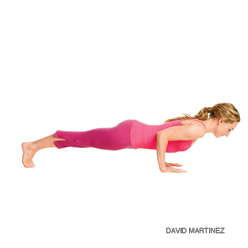
Months later, I sustained a shoulder injury from doing the difficult Chaturanga Dandasana (yoga push-up) pose too quickly and with insufficient back and abdominal strength. It cost me weeks in physical therapy and a three-month hiatus from Core Power.

Yoga push-up

Yoga push-up

Older and wiser

Ego is the antithesis of what a yoga practice is supposed to be about. But that pastoral ideal — to “stay on your mat,” to focus solely on your own breath, to resist comparing body types and flexibility — is difficult to practice at a Type A studio like Core Power. And for a Type A practitioner like me.

Then I figured out that injury could heal me, not only the other way around.

When I returned to Core Power, I went to slower-moving, balance-focused classes that don’t include multiple repetitions of Chaturanga. I learned the 26 poses of hot yoga and sought out teachers who are closer to my age. And, just as yoga calls us to take its spiritual tenets with us off the mat, out into the world, I began to look at myself and others differently.

The Oldest Woman in Yoga quit mentally competing and comparing. If the loose skin shows on my lower belly, stretched twice — mightily — by nearly 10-pound baby boys, so be it. To paraphrase Gloria Steinem: “This is what 57 looks like.”

I ask instructors how to modify for my tight hips and weak left shoulder. I warmly greet the young women who clean the studios and bathrooms, and strike up conversations with other middle-aged women.

And, in an effort to focus less on being thin than being strong, I tried a TRX class at the SweatShop.

“I would love to look good in an Academy Awards ball gown, but that no longer is the highest thing on my list,” says Winegar, who founded the SweatShop in 1981, at the cusp of what would become a booming fitness movement. “Now, I want to get up without an achy back or stiff hands or feet that don’t work or a shoulder that doesn’t move.

“Women need different things at all stages of life.”

Lesson learned: I am working to accept my age rather than denying it. If enough of us come to celebrate the inevitable, society may see the wisdom that comes with wrinkles.