Author Archives: Amy Gage

Unknown's avatar

About Amy Gage

A community relations director in higher education and mother of two adult sons, Amy Gage spent the first 20 years of her career as a journalist and public speaker in St. Paul and Minneapolis, Minnesota. The issues addressed in her award-winning newspaper column, "On Balance: Issues That Affect Work and Home," remain relevant today. In "The Middle Stages," she continues the vital conversation about women's work and lives, with a focus on the challenges and contradictions of aging, the mixed blessings of forsaking family time for the more immediate rewards of a career, and how middle-aged women can continue to forge full lives even as their priorities and sensibilities change.

Weather or Not: The Rituals of Daily Dog Walks

How many health habits — physical, spiritual, emotional — have I promised myself I would stick to every day? Pushups and neck stretching, journal writing and meditation: They feel good when you do them, but time gets away from me, and then I forget until the next good intention comes along.

Not so with dog walks. Ever since my family rescued our first dog (the late, great Skip) in 2000, followed by sweet Lucy in 2003, I have dog walked every morning — sick or healthy — without fail, unless I am out of town. When people ask how often I walk my household’s current dogs, Mia and Gabby, I can honestly tell them: “Every day, any weather.”

A recent article in the Washington Post, reprinted in my local newspaper, urged readers not to “skip your dog’s walk” or assume that letting them out in a fenced backyard would suffice. The reasoning shows the human benefits of dog walks, too.

  • Dogs need exercise and don’t pursue it on their own.
  • They need the mental stimulation of seeing — and smelling, always smelling — new things.
  • And they need “human interaction,” which I would reframe as bonding. You develop a relationship with your dogs when you’re outside together every day.

Though I don’t always want to leave my house early in the morning, I am always glad I did once I get out there. Putting my feet on the street and my face in fresh air is as good for my mental health as it is for theirs. Once Gabby does her down-dog stretches, or I see light softening the sky, we suit up and show up. It’s time to go.

Mia (left), Animal Humane Society, born in 2014; and Gabby, Standing Rock Indian Reservation, born in 2018.

The walks go better when I stay calm.

I like to stride when I walk: head up, glutes pumping, spine long and straight. At 66, I am grateful to be able to move so fluidly. Striding uninterrupted rarely works with leashed dogs, however. “Guardians need to take the animals’ lead,” says the dog-walking article, rather than dragging our pets along on our fast-paced walks or runs or on a bike ride — I shudder whenever I see it — with a leashed dog straining to keep pace.

“If your dog wants to sniff every blade of grass, then that’s what they want to do on their walk,” says a dog-training advocate quoted in the Washington Post piece, which, tellingly, never uses the term dog “owner.” My morning dog walks are for Mia and Gabby, not for me. If I want pure exercise, I can schedule that for another time.

Sometimes I imagine the dog walks as a metaphor for life. When the girls pull on their expandable leashes or go off in different directions, forcing me to pirouette in the middle of the sidewalk to keep us all from getting tangled, I liken the aggravation to the pressures I navigate each day. Whether it’s a project that has hit a roadblock, or an imagined slight from a friend, or my perpetually overbooked calendar — it will all smooth out eventually if I respond more than react.
So it is with my willful, unruly dogs. Praise and positive reinforcement, as well as a few consistent commands (“too icy” during the winter, when an unplowed alley looks unsafe), go much further than yelling at them or letting myself get exasperated. I can breathe deeply and watch the sunrise, or admire an artful garden, or look in a shop window while the dogs scratch and sniff. That makes the walk more interesting for them and much more pleasant for me.

My husband loves the New Yorker cartoon that shows a mid-sized dog on a leash with a thought bubble: “Always good dog, never great dog.” Our dogs are great. It’s hard to overstate how much they mean to me. If I praise Mia for listening rather than yelling at her for stopping at every tree, if I kneel and stroke Gabby’s chest while she squirms at a long red light, if I let them visit their regular haunts in our neighborhood — the yard with food scraps outside the fence, the husky with the blue eyes who never barks — then I am allowing them some agency, acknowledging their intelligence.

It isn’t always my agenda; that practice serves me in relationships with humans, too.

Sometimes, the dogs see a cat.

Our neighbor, Tim, walks his cat around the block once a day on a thin nylon rope, and Gabby, especially, goes manic behind the fence that surrounds our backyard. Installed by the previous homeowners, the wrought-iron fence allows her to see who is walking along the side street of our corner property — which, in my view (not to mention the dog’s), is critical.

I feel for the dogs behind those tall, wooden privacy fences who can hear and smell other animals but can’t see them. They paw frantically at the ground, and stick their snouts beneath the gate, baring their teeth but mainly wanting to engage. Which is what I long to tell the owners when they open the back door to yell at the dog for being just that. A dog.

We see the occasional roaming cat on our morning walks. Mia and Gabby bark and lunge while the cat hisses and arches its back, calling to mind the phrase “fighting like cats and dogs.” Rabbits are prey, not to taunt but to kill. Gabby goes into hunting pose, keenly alert, her tail straight up in the air, when she sees a rabbit freeze in self-defense. Her jaw opens and closes as if preparing to chomp down fast. It’s pure instinct on display.

Drawing by Anna Frodesiak (Creative Commons)

A rez dog whose relatives still hunt for most meals, Gabby has killed rabbits in our backyard. She’s even ferreted out a few bunnies in alley bushes on our morning walks, carrying the poor things home squirming or flopped dead between those warmed-up jaws.

We saw a coyote one summer morning, standing in the middle of the street. At first, I thought it was a long-legged, shaggy dog without a leash. But it looked too wary and thin to be domesticated, and the coyote lost interest in making a meal out of my smaller dog, Mia, once it saw me. Instead, it turned and trotted toward the river while I calculated how many busy roads it had to cross.

The beauty and rhythms of nature remain evident, even in the city, if you take the time to notice — contemplating the outsized impact we humans have had on the planet, as though we owned it, holding back leashed dogs that yearn to run.
‘Could’ve Been a Contender’: Why I Love Women’s Sports

It’s not just that I’ve jumped on the Caitlin Clark bandwagon, though I have — along with the 14,624 other people who filled the Barn at the University of Minnesota this week to watch her Iowa Hawkeyes take on my alma mater’s Golden Gophers.

Nor is it that I watched the U.S. Women’s National Team ascend the ranks in the “beautiful game” — a foreign sport, in my youth — in the 1990s and early 2000s, at the very time that my two sons were starting to excel at soccer.

It took 2 minutes and 12 seconds against Michigan to make women’s scoring history.

My father and older brother followed the Purple People Eaters–era Minnesota Vikings when I was a kid, back when the team played outdoors and years before one of the fearsome foursome became a state Supreme Court justice. I’ve watched wistfully from the sidelines while my siblings bond each year over their Fantasy Football League.

But now I, too, have found my sport to follow — women’s college basketball in the Midwestern-based Big 10 — and I’m finally feeling it. Here’s what the hoopla is all about!

I’d written off sports as just a guy thing, a way for men to connect and converse while revealing nothing of themselves. I saw the energy but missed the emotions beneath the surface. Following a team through highs and lows, through wins and losses, through “the thrill of victory and the agony of defeat” — to call up Jim McKay on ABC’s The Wide World of Sports — is a rush, a disappointment, a heady exhilaration, a shoulder-drooping drag.

It’s a slice of life in a single season.

Kate Brenner-Adams’ crop art from the Minnesota State Fair photographed at the Minneapolis Institute of Art. “Sports are a microcosm of society,” she says, “therefore inherently political.”

As my career was winding down, my husband and I started going to the occasional Thursday morning concert at Orchestra Hall (the ones with free coffee, cellophane-wrapped doughnuts and an audience base that makes me feel young). Those are lovely and elegant, and they underscore my exposure to classical music as a kid.

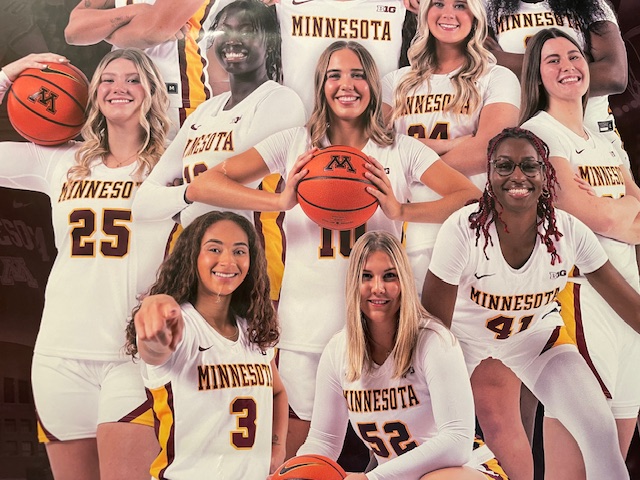
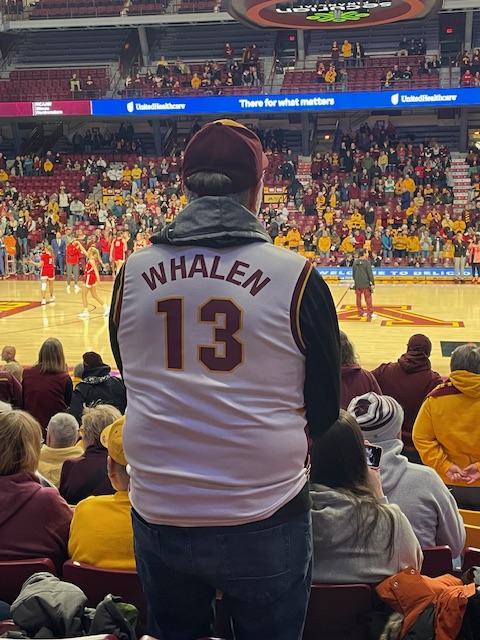
But what I really enjoy are the rowdy, rollicking Gopher women’s basketball games that we began attending last year to see Lindsay Whalen coach and then committed to with season tickets this year, hoping that new coach Dawn Plitzuweit could coalesce the team.

David and I met at the University of Minnesota, and we followed the Gophers nominally when Whalen was an award-winning 5-foot-9 point guard and, of course, stuck with her storied pro career with the Minnesota Lynx. David says women play basketball the way he did, “below the rim.” (I firmly believe the NBA should raise the men’s rim, but that’s a different story.)

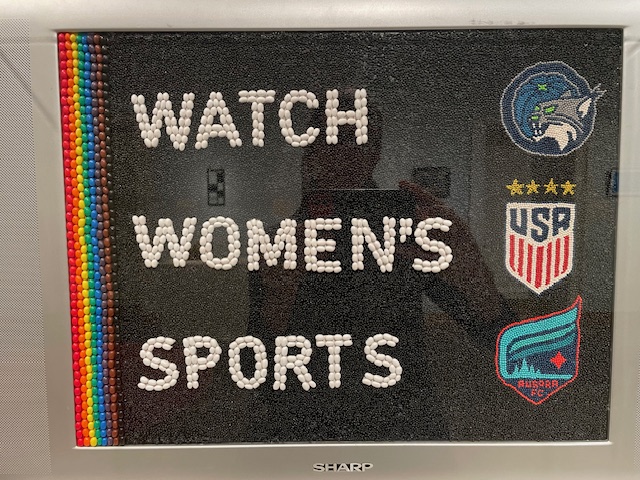
Basketball is not the only sport where fans are paying more attention to female athletes. Minnesota now has a team in the Professional Women’s Hockey League, and the Minnesota Aurora, a pre-professional soccer team, has been selling tickets and winning matches — all with an honorable and enviable mission: “to create pathways for women and girls to reach their potential, on and off the field.”

Women my age rarely had that chance. Title IX, which mandated equity in sports at institutions that receive federal funds, passed in 1972. I was 15 years old, a leggy, athletic girl who was a cheerleader and took dance lessons and loved to bike and was always a fast sprinter (“for a girl”) but who never was allowed to be an athlete, to play on a team.

I see them now in the stands, women like me in their 60s and 70s or even older, some with white hair and walkers. These are women who have lived through historic shifts in our society — abortion rights won and lost, better pay and political representation, the Violence Against Women Act extended to lesbians, immigrants and Native American tribal lands — and who are showing up and cheering loudly, despite being told for years that they were lesser, they couldn’t compete, they weren’t enough.

Following women sports, being a vocal and unabashed fan, lets us demonstrate that we still are standing strong.

Image courtesy of Reader’s Digest

I was working as a “Women in Business” columnist at the Saint Paul Pioneer Press in 1999, when Brandi Chastain kicked the winning goal for Team USA in the Women’s World Cup final at the Rose Bowl in Pasadena. My sister Debbie and her family were there. “I actually overheard somebody in the stadium say, ‘They play just like boys!’” she recalls now.

As one of few women on the newspaper’s business desk — and the only one who focused on women’s issues — I was the go-to when male colleagues wanted to get the “woman’s point of view.”

Sure enough, after the sports section displayed the infamous photo of Chastain on her knees, eyes closed, fists raised in the air after she had ripped off her soccer jersey in celebration, my editor called me over to his desk. Was her action unsportsmanlike, inappropriate, simply in poor taste? Or was it sexist that Chastain was getting grief for her exuberance when male players ripped off their jerseys all the time?

And then came the predictable: What do you think of this, Amy?

Newsweek celebrates Brandi Chastain and women’s soccer: July 19, 1999.

It was one of those rare moments when I had the perfectly timed response. Pausing to give the photo a once-over, I looked my male editor in the eye and said calmly: “Nice abs.” And then I turned and walked away.

Twenty-five years later, Target Center in Minneapolis is sold out for the Big 10 women’s basketball tournament in March, a women’s sports bar is opening in the Seward neighborhood several miles away and Brandi Chastain, now 55, has framed the famous sports bra, which hangs in her home. As for me? I barely know a fast break from a field goal, but I’m having the time of my life — watching young women excel at opportunities that were denied me, and supporting them every step of the way.

Health Habits for Women to Practice as We Age

I was born with good health and have been blessed to have medical insurance and routine dental care throughout my life. Dad modeled daily exercise, Mom pushed us kids outside to play (likely because she craved peace and quiet), and both parents ensured we had bicycles and insisted we use them.

I thank them to this day that I still love to ride my bikes.

The habits I have built and the health I have sustained have served me well into my 60s. But it isn’t the decades-long practices — the balanced diet, the use of movement for both physical and emotional wellbeing — that are consuming me these days.

I am thinking instead about the physical changes that come with age, the need to work on bone density and balance, to guard my skin against the sun, to manage unexplained flareups in my hips, hands and feet. “Aging is not for the faint of heart,” my father used to say. (Actually, he said aging is not for “sissies,” but that word feels wrong today.)

So, at a time of life that requires equal doses of courage and self-confidence — and a commitment to spend more time on daily health habits — here are the practices I am working to develop.

ProTip #1: Hug your muscles to your bones.

I would hear this instruction in yoga classes, but I never quite grasped it till I was diagnosed with osteoporosis in November 2022, a blow that tossed me into old age without warning. Indeed, the bone-thinning disease that tends to strike women after menopause elicits sobering statistics:

  • Half of all women over 50 will break a bone because of osteoporosis, a “silent disease” that often is diagnosed only after a hip, wrist or other bone has broken.
  • Of the 10 million Americans who live with osteoporosis, 80% are women.
  • Caucasian and Asian American women are four times more likely to experience thinning bones than African American women and Latinas.

You can take medication for osteoporosis, and deal with the risks and side effects, but women can fight back in natural ways as well: eating more protein, taking Vitamin D3 supplements, lifting weights. In addition, I recommend a 12-pose yoga series designed by Dr. Loren Fishman and brought to light by New York Times writer Jane Brody in 2015.

Among the “side effects” of this prescription for osteoporosis, said Fishman, a physiatrist, in Brody’s “Personal Health” column, are “better posture, improved balance, enhanced coordination, greater range of motion, higher strength, reduced levels of anxiety and better gait.”

Kendra Fitzgerald’s version of the 12 poses on YouTube.

My sister found varieties of the 12 poses on YouTube, and after experimenting with several, I landed on the 20- and 29-minute versions by Kendra Fitzgerald. I’ve also strengthened my practice by taking “yoga for bone density” classes from certified instructors who have taught me the power of engaging muscles deeply while holding each pose (and who claim that the practice can improve your T-score).

Try it: Plant your feet on the floor. Root down through your heels and send that energy up your legs. Engage your thighs, your glutes, your abdominal muscles. Pull your shoulders down your back and radiate strength up your spine. Stand tall, sending your head toward the ceiling and pressing your fingertips toward the floor. Feel your strength as you hug your muscles to the bones.

ProTip #2: Employ your smartphone’s flashlight.

Twenty-five percent of older people — 65 and up, according to the Centers for Disease Control and Prevention (CDC) — fall at least once every year. And women are at greater risk. A weakened lower body, vision problems, a Vitamin D deficiency, impractical footwear, and home hazards such as throw rugs and lack of railings in bathrooms and on stairways are among the causes.

If you fall once, according to the CDC, you are twice as likely to fall again. Traumatic brain injury, broken bones and an increased fear of falling may result. People who feel uneasy on their feet are less likely to move around outdoors or to exercise at all — and, therefore, are more likely to become weak and isolated.

One solution? I turn on my iPhone flashlight both indoors and out, a tip from a young man who uses his phone’s flashlight when he’s crossing a street at dusk with his wife and children. I tried it walking home after dark when I still worked full time less than a mile from my home, scanning the sidewalk for uneven surfaces and tilting the light toward fast-moving vehicles as I approached a crosswalk. Now I use the flashlight when I get up before sunrise during a long Minnesota winter. It helps me navigate around houseplants, resting dogs and rocking chairs — as well as up and down the stairs — without waking my late-sleeping husband.

ProTip #3: Wear a funny hat.

Two age spots on the left side of my face came from years of commuting, a dermatologist told me, when the sun would shine hard through the driver’s door window. And to think I used to revel in the warmth.

A lover of stylish sunglasses, I also used to wonder why so many men wear baseball or bill caps. Now I get it. A bill cap keeps the sun out of your eyes and off your face. Even better are the hats that have a drawstring at the throat and a circular brim that shields the back of your neck as well.

In addition to applying sunscreen throughout the year — another dictate from the dermatologist and one of five skin-protection recommendations from the CDC — I cut my hair short so it looks halfway decent after a sunhat or bike helmet flattens it throughout the spring and summer. I bought my sunhat at REI. But instead of disparaging them as “old lady” hats, I wish I’d started wearing one when my skin was as dewy and wrinkle-free as the young models on this Sungrubbies site.

ProTip #4: Love your feet.

Time seems to speed up as we age, an aphorism cited so often that psychologists are studying whether it is perception or reality. Growing older is like a time machine that swirls you around in busyness for decades until it dumps you in your 60s, with more wrinkles, less ambition, a craving for sleep — and feet that, overnight, start to cramp and crack.

I was introduced to foot massage in a mat Pilates class after my osteoporosis diagnosis, where the teacher has us spend the first 5 minutes of every session rubbing lotion methodically on and between our toes, down the instep, up the outer edge, around the ball of the foot, over the heel. My feet tingle with pleasure, just as they do after I wince and roll barefoot over a spikey red plastic “peanut massage ball” that the Pilates teacher recommended.

“As you age, the muscle tissue in your feet can thin, and your nerves may not work effectively. This can lead to loss of feeling in your feet, [called] neuropathy,” says an article on footcare for seniors, which also instructs women — hooray! — to “avoid shoes that have high heels or pointy toes.”

The next steps? To stride toward the sunlight and shadows of old age, until the next physical and mental challenges present themselves.