
I didn’t expect to find myself here, one year after I became an empty-nest mother and my husband and I downsized to a smaller house. We moved back to the city, barely a mile from where I work, after raising our two sons in Northfield, Minnesota, a two-college town with open minds and well-funded public schools.
I didn’t expect to become a cliché, the classic Baby Boomer whose grown kids have boomeranged home. And yet, that is precisely where life has landed me.
My boys — or men, as I’m training myself to call them — are living with us again, with their huge shoes and crusty socks and bicycles and soccer balls crowding our 1,500-square-foot house in St. Paul, minus the mud room and second full bathroom we had in Northfield. (Quick! Add a toilet in the laundry room.)
By habit and definition, I am a working mother again, balancing my time between job and family, and failing again, daily, to “have it all.” This time, however, I am called to redefine what “mother” means. Do I sign my reminder notes “Love, Mom” or “Amy”? Why do I write reminder notes at all? After 20 years as the family breadwinner, slogging through a 40-mile commute to my city job, do I sacrifice the yoga practice, time with friends and renewed commitment to writing that an empty nest allowed me?
Financial realities
Other parents struggle with these questions, too. Thirty-six percent of young adults in America ages 18 to 31 live with their parents, according to the Pew Research Center. That’s 21 million “emerging adults,” many of them educated and under- or unemployed. Pew calls families like mine “multi-generation households,” an effect of the still-lingering recession.
An August 2013 article in The Economist about the boomerang trend drew 70 comments — some by young people pointing out the sorry state of the job market, others by snarky “olders” criticizing the Millennials’ work ethic and impractical liberal arts degrees.
I worry whether my sons — both liberal arts majors — will be able to build a career as I did with only a baccalaureate degree. Will living at home, at ages 24 and 19, respectively, affect their social lives and ability to function independently?
Facts rarely assuage emotion. Knowing that other middle-aged mothers are buying milk by the gallon again and hauling three times the recycling to the curb every Thursday doesn’t change my experience — or my feelings about the experience.
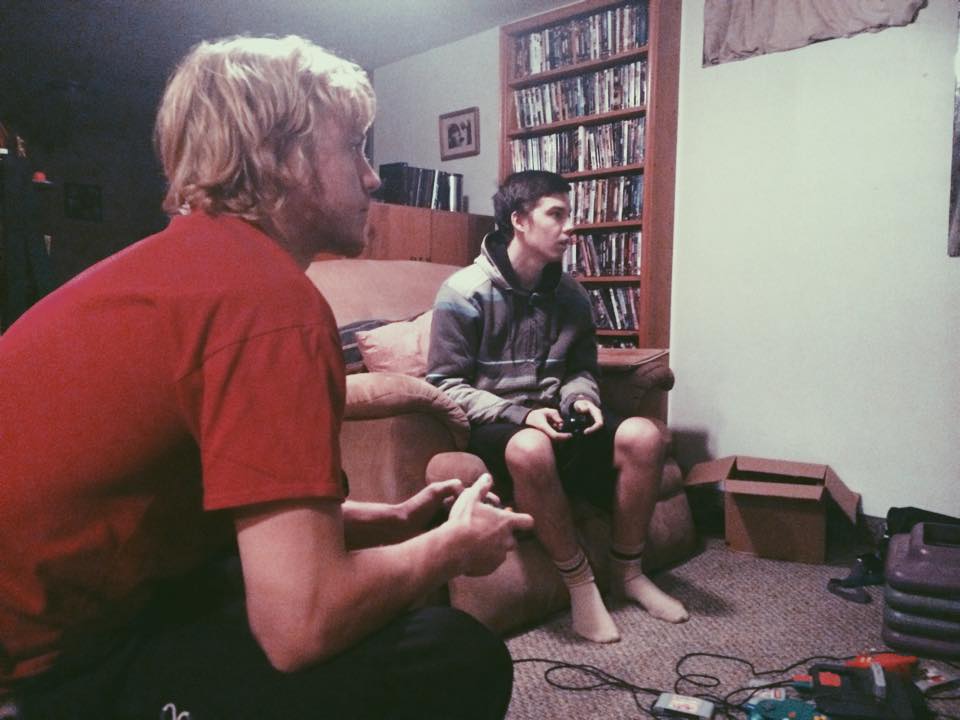
Welcome back, Sam and Nate!
So, ever the organizer, I have put some rules in place:
- Don’t over-parent. The 6-year-old boy who declared, “You’re not the boss of my clothes” has grown into a 24-year-old man who is working two jobs and recently spent seven months volunteering on behalf of injured animals and at-risk children in South America. He neither needs nor wants his mother overseeing his diet or other details of his daily life.
- Set financial expectations. With three active young adults in the house (did I mention the college student and his girlfriend in the basement?), the grocery bills alone would break the budget. The five of us negotiated an equitable system of shopping and paying for groceries; a magnetized whiteboard in the kitchen holds reminders and receipts.
- Catch the small stuff before it explodes. I get crabby when I’m the only one scanning the back yard for dog poop or when my small-town sons forget to lock the front door. So I shoot them a text message — simple, to the point and less threatening than face-to-face confrontation.
- Get to know them as adults. My college sophomore, an atheist, has shared his strong views about what he considers the hypocrisy of organized religion. He’s been willing to open up — and openly disagree with my free-form spirituality — because his dad and I are genuinely interested in what he has to say.
- Claim your alone time. As a careerist whose work kept me away from home a lot, I didn’t think adjusting to the empty nest would be so challenging. But the strange brew of relief and regret, seasoned with the powerful whoosh of time’s passage, left me feeling adrift and powerless for months. Solitary journal writing and teary talks with other mothers got me through it. Now, I don’t sacrifice my hard-earned alone time, even when the only way to claim it is behind a closed door — with the sound of music and my sons’ laughter drifting up the stairs.
Lesson learned: The concept of reframing helps me enjoy life as I age. Getting more time with my sons — at a point in life when I thought I’d rarely see them — feels like a second chance at all the family time I missed.
 The Middle Stages: Between Midlife and Old Age