Tag Archives: Trump

The Morning After . . . and What Comes Next

None of us saw this coming.

The morning after a presidential election that will go down in history for its sweeping affirmation of a “me first” brand of nationalist politics, I was doing what I do every morning: walking my two dogs. After crossing a busy street, the dogs were straining at their expandable leashes as we approached a person in a black trench coat.

“Two dogs behind you!” I yelled. As we passed the individual, I turned and explained, “We didn’t want to scare you.” And then, exhausted from a 15-hour shift as a poll worker the previous day and after a night when, again, I got too little sleep, I said: “It’s a dark morning today.”

The person, a young adult of indeterminate gender, looked over and apparently judged me to be safe. “I’m trans,” they said, “and I’m terrified.”

My eyes filled with tears as I put a gloved hand to my heart. “I’m so sorry,” I said. “I am so, so sorry.” As they moved on, I called out, “Be well,” and we exchanged a look of compassion and understanding that has been replicated many times in my liberal urban neighborhood during this awful, incomprehensible week.
“I wouldn’t want this man for my neighbor, let alone my president,” said the owner of an antiques store two blocks from my house as he unlocked his front door. He told me he had read the Gettysburg Address right before the election and lamented that the days of a president with the intellect, humanity and foresight of Abraham Lincoln were clearly long past.

“Government of the people, by the people, for the people.” Indeed. We liberals and progressives misjudged what the people wanted.

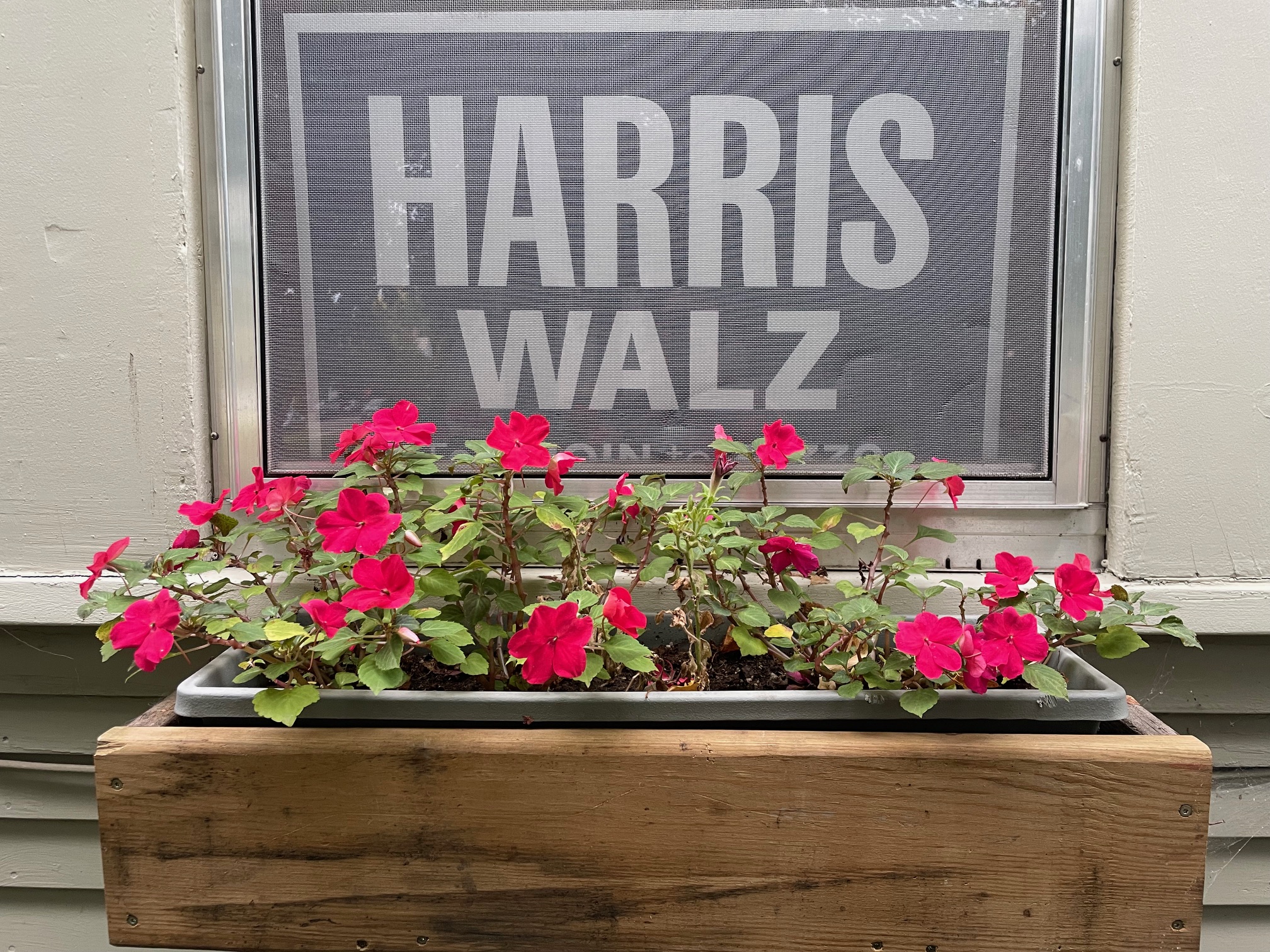
At my husband’s request, I returned the “No Project 2025” sign to my next-door neighbor, who had handmade a number of them for people’s yards. “I don’t want us to be a target,” my husband said, and I understood immediately. The Harris/Walz sign in our dining room window, however, remains. My virtue signaling, yes; my small rebellion.
On PBS NewsHour last night, which I watch every Friday for the analysis of journalists David Brooks and Jonathan Capehart, former anchor and sometime reporter Judy Woodruff checked in again with voters whom she had interviewed throughout the fall.

The economy and immigration were key themes, as they were among the majority of Americans who voted for Donald Trump, but identity politics and fear came up as well:

  • A middle-aged Black man said when he woke up the day after the election, “it was a feeling of, ‘Here we go again.’ We’re moving back in time.”
  • A young white man said he supported Trump because he is tired of being blamed. “Being male and white in recent years, we’ve been told that we’re the problem in society. . . . Everyone who’s oppressed, quote-unquote, is being oppressed by white men.” He said Trump ran against diversity, equity and inclusion (DEI) initiatives “meant to lower the amount of white men in any sphere.”
  • A person who identifies as nonbinary, gave birth to a child and is married to a woman said they are “very concerned that legally my marriage may be dissolved” and that their wife ultimately could lose “legal rights to our son.”
  • Reflecting my own identity, one woman described herself as “an older, post-menopausal, white, retired woman.” She may not personally feel the effects of changing social policies, she explained, but her friends’ transgender children and her married lesbian niece likely will.

These thoughts echo the conversations and text exchanges I have had throughout this week. When I told my friend David, a retired attorney, that the three liberal justices on the U.S. Supreme Court “better hang on by their toes,” he took a different view. Samuel Alito and Clarence Thomas, the two oldest conservative members of the high court’s six-person super majority, will retire “within two years,” he said, “while they still have a strong [U.S.] Senate.” Trump will appoint replacements “who are 40 years old,” cementing that super majority for decades.

Mary, a friend and former colleague whose family background mirrors mine, right down to our Republican attorney fathers, called the afternoon after the election while I was soothing myself in a bubble bath. “I’m white, straight, a legal citizen, non-trans, educated and in a good financial situation,” she told me. “I’m aware that others will suffer far more.”

My spiritual advisor, a socially liberal and politically active minister, put the same thought into stark historic terms: “This will be bad for others before it’s bad for us,” she said. “We have to be the good Germans now.”

It was such a hopeful 107 days. As a proud Minnesota DFLer, I reveled in Vice President Kamala Harris’ choice of Governor Tim Walz as her running mate in early August. The spirit of joy in the early days of their all-too-brief campaign (see my previous thoughts on President Joe Biden) was infectious and electrifying — and the prospect that Walz could introduce my state’s progressive agenda to the nation had me more optimistic than I have been since the Dobbs decision shut down women’s fundamental right to bodily autonomy in June 2022.

I am struggling to regain that optimism now. Some 53% of white women voted for Donald Trump, a convicted rapist whose political career should have ended when he bragged about grabbing women “by the pussy” back in 2016. His blatantly sexist (and racist and xenophobic) comments have only gotten more pronounced since then.

One conservative female columnist pushed back against those of us who would castigate white women for not caring enough about abortion rights or the significance of electing the country’s first female president, when, in fact, she said, Trump “spoke directly to voters’ top concerns.”

My top concern is short-term thinking. That the cost of a gallon of milk or a gallon of gas ultimately matters more than the loss of climate protections and democratic freedoms — including Trump’s promised mass deportations of “illegal aliens” and retribution against his “enemies,” and the threat of violence from conservative extremists when elections don’t go their way — is stunning to me. None of them has shouted the words “election fraud” this week!

On rising prices: I’d take the hit from any Trump supporter who called me privileged and middle-class, which both are true, if it weren’t for the photo of a jubilant, bejeweled blonde in West Palm Beach adorning that conservative writer’s column to illustrate the president-elect’s female support.
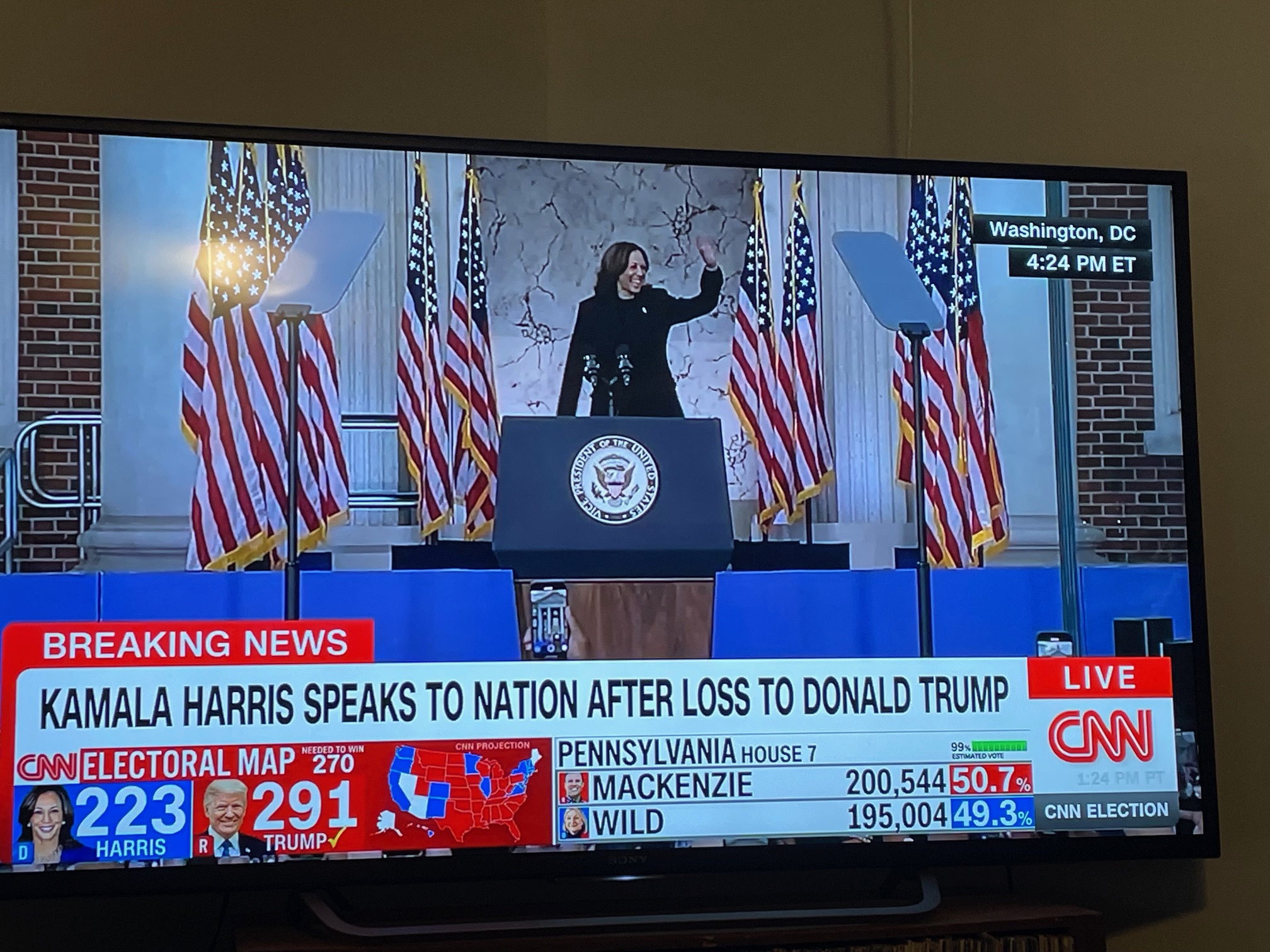
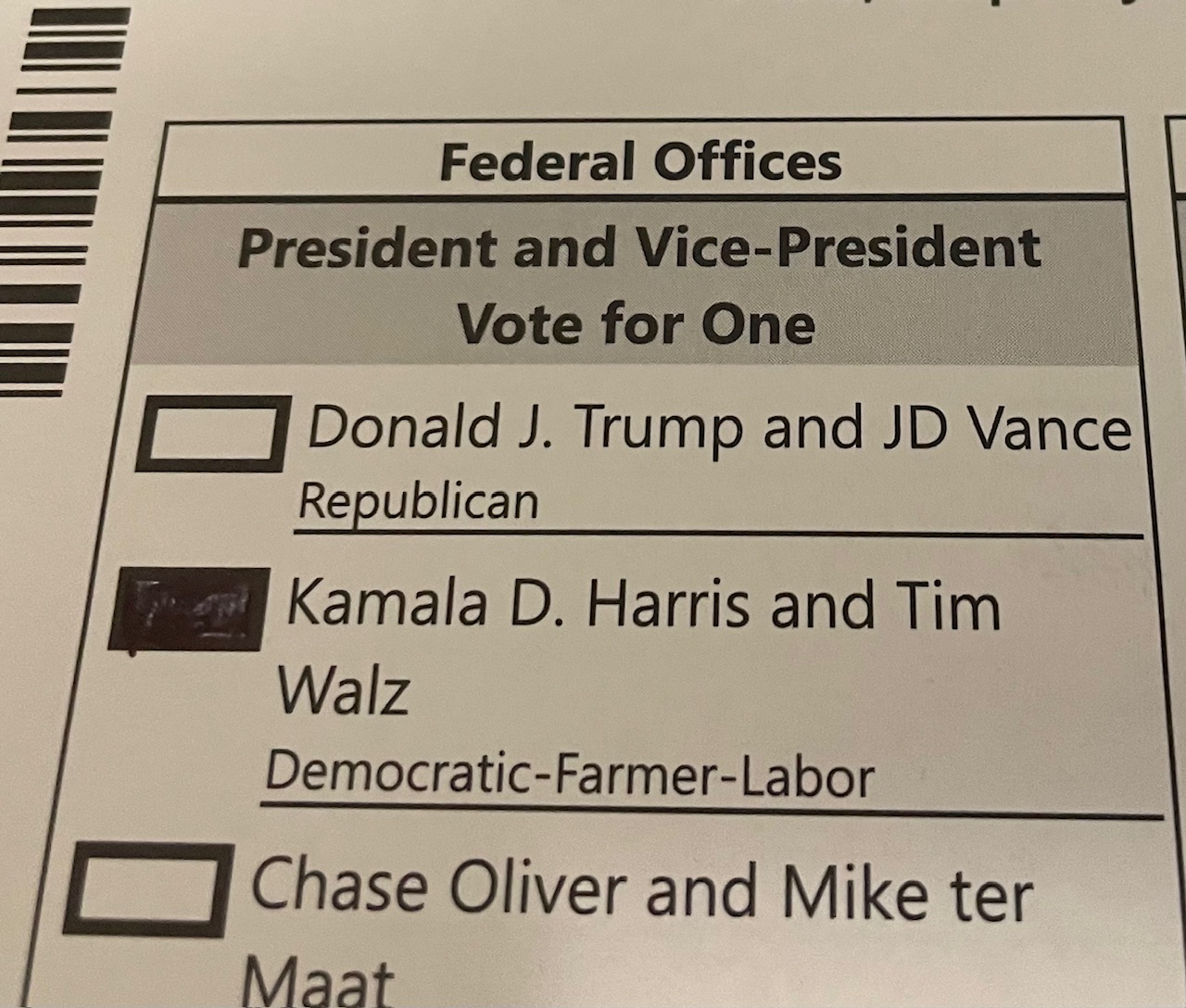
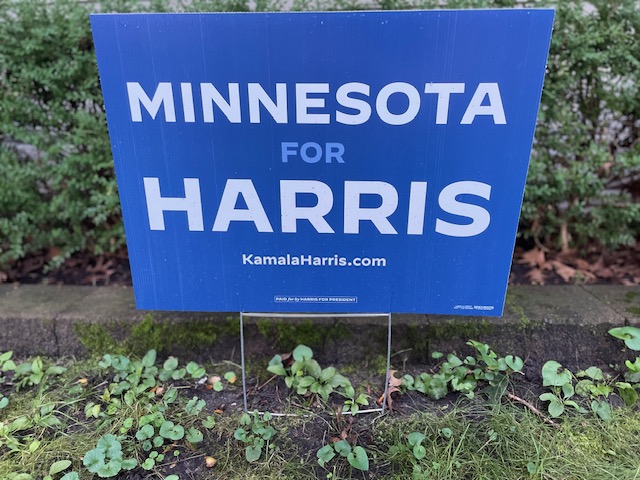
‘I don’t recognize the America I live in,” I wrote on Facebook on Wednesday, November 6. But here we are. He got elected, his coattails extending to Republican candidates across the country. My job now is to step out of the blue bubble that I live in, where 70 percent of voters in Ramsey County supported Harris/Walz, and start talking with — and listening to — people from the other side.

Among the folks who reached out to me that morning, after Wisconsin tipped the balance for a second Trump presidency, was my oldest friend, a woman I have known for 65 years. Janey was with me in the delivery room for the birth of each of my two sons. She held my mother’s hand and stroked her forehead in a memory-care center days before Mom died. Janey is as much a sister to me as my two older sisters.

Janey also is a Republican who voted for Trump, and we still love each other. “My hopes and prayers are we can come together as one nation that wants the best for our country,” she texted the morning after the election. “We can move on from this. We can be gracious to one another no matter which side of the aisle one belongs. We need to love and respect each other, and to understand we all come from different backgrounds and experiences.”

I do resolve to listen and learn, rather than blaming or pointing fingers. And I resolve to keep working for equity and human rights, just as I did this election cycle: door-knocking, phone banking, writing postcards. I owe that to my younger son, who yearns to have a child. I owe it to my older son, who has left the country. And I owe it to that trans neighbor walking down the street, facing a terror I cannot know.

We are here with you.
Boomers Can Help Biden By Speaking Up About the Realities of Aging

My then–eight-day illness coincided with President Joe Biden’s stricken performance at the first presidential debate on June 27; and so, I have been thinking about age and the limits it imposes on our energies; and how long it takes some of us to acknowledge its real impacts, as though we might have prevented our physical decline and mental slowdown. As though we are at fault.

Let’s begin with the obvious: The debate’s 9 p.m. start time in the president’s time zone is when most old people (including me) get ready for bed. He was tired! I’ve since heard that Biden had a cold that Thursday night, which explains the weak, scratchy voice. (Or was that the excuse the campaign invented?) Regardless, if Biden felt half as compromised as I have with my upper respiratory infection — when I have misspelled “horseradish” on the grocery list, run over a curb on a day when I had no business driving, repeatedly emailed “Christy” at work when I meant to send messages to “Crystal,” and committed any number of verbal gaffes with my antibiotics-addled brain — then I’d be willing to give the president a pass on his poor performance.

But I don’t think physical exhaustion explains it, unless you acknowledge it as a natural consequence of his age. That’s the conversation that anxious Democrats seem reluctant to have. Joe Biden is old. We don’t have to hide it, mock it or try to explain it away. When performing without the benefit of a teleprompter, or the psychological comfort of his team of aides, Biden acted like what he is — an 81-year-old man who is decades past his prime. And who should not be running for the most rigorous, visible and consequential job in the world.

I doubt whether Biden can be convinced to pass the baton less than two months before the Democratic convention, though the next-day New York Times column by his friend Tom Friedman made an eloquent and compassionate case for why that decision would serve the country. “[T]ime has finally caught up with him,” Friedman wrote. “And that was painfully and inescapably obvious on Thursday.”

Asked to bet today, I’d predict we are careening toward a second Trump presidency, which will be a disaster for the environment, for women’s reproductive rights, for immigrant protections, for an independent judiciary, for public-school funding and so much more. Perhaps, in the meantime, we can salvage a graceful exit for Joe Biden by ceasing to slap our foreheads and exclaim about his perfectly normal signs of aging: the shuffling gait, the search for words, the raspy voice, the stooped posture. All of which I remember from my own father’s decline, a man who, like Biden himself, had once been a sharp-minded attorney and politician, too.

As I stare down turning 67 on July 4, I am mindful that we can best locate empathy when we have experienced another person’s plight ourselves. It’s no surprise that I felt nothing but sadness for Joe Biden, who is nearly 15 years my senior, as he lumbered and stumbled onstage. I saw in him a quality that, until recently, I’ve been unwilling to see within myself — a refusal to concede to age, to recognize when it is time to step back and clear the path for younger people.

My upper respiratory infection hung on for 10 days and took two different prescriptions to kick because I had spent weeks performing like I was 20 years younger than I am. Having assured my retired husband I would scale back my work commitments this year, I instead stubbornly hung on to my two part-time jobs while taking on freelance assignments and contract work that I was afraid to turn down — all at a pace I once readily sustained. Mix too little sleep and too much multitasking with generalized stress, and you eventually get sick.

And if you’re old, you take a long time to get well.

I’ve since quit one of the part-time jobs and am scheduling my freelance work more carefully. But more than once during this extended illness, I have remarked to my husband that I tire more easily, that I must start prioritizing rest. “If that’s aging in a healthy 67-year-old,” I’d say, “how does an 81-year-old president do it?” Those comments now seem prescient, post-debate.

Neither my husband nor I is a huge Biden fan, but we are staunch Democrats and we’re afraid of Donald Trump. We’ll vote for Biden if he stays in the race and are trying to convince our Socialist older son that he should care enough to vote at all. The broader realization, however, is that we aging Boomers lack humility. We’ve been in charge for so long, during such a pivotal time in U.S. history — a period that I now recognize to be an anomaly of liberalism in a self-interested, deeply conservative country — that we can’t see our limitations and step off the stage.

We wouldn’t be in this position now if the Democratic National Committee had built a bench back when Biden was billing himself as a “transition” president, the only one who could defeat Trump in 2020. We wouldn’t be here if he had made more use of a Black female vice president whom, it appears now, he picked for show and to appease a constituency he couldn’t afford to alienate.

But here we are. The commentators who call for this clearly exhausted president to get on his feet again, prizefighter-style, to schedule interviews “in unfriendly places” and to forcefully compete are themselves still in denial. They’re asking him to summon a level of energy that most 81-year-olds cannot muster, let alone keep up between now and November.

Being this sick for this long, I have been forced to cancel appointments, to read and nap, to recognize that my body no longer will allow me to push at the edges of my energy. I can still contribute, but it’s going to have to be in different ways. Biden’s greatest gift to the country, to his family and to himself would be to make way for a successor and offer himself as the advisor and elder statesman that he deserves to be.

Some question whether the president, from his seat at the pinnacle of power, is capable of that level of self-awareness. “What was the combination of moral conviction, personal confidence and selfishness that propelled Biden, despite the risks, toward his decision to seek another term?” asked columnist David Ignatius in a Washington Post commentary that my sister shared with me the day after the debate.

To say that Biden no longer is up to the job is neither to blame him nor to deny the achievements of his administration. In fact, it is ageism — a perverse sort of shame — to avoid citing his diminishing capabilities. We aging Boomers must speak publicly about the realities we are experiencing as we grow old. Only then can we demystify and make peace with this most natural, and inevitable, of life’s progressions.

Three ways to wring some good from the grief of 2020

It was the year we couldn’t wait to see end, even though most of my siblings and friends and I are so deeply into middle age that we’re not sure we can call it that anymore. We’re supposed to savor time, at this stage of life, not wish it away.

But this was 2020, the year of Trump. Of COVID-19. Of a nearly recalled election. Of George Floyd getting murdered and Twin Cities businesses getting burned. Of debates about policing as armed car-jackers were targeting and terrorizing women. Of we white people talking earnestly among ourselves about privilege and our overdue awakening to racial inequities. A year when food lines, tent encampments and rising unemployment brought those inequities to public consciousness and squarely to our doors.

“What will you miss about 2020?” someone asked me on (of course) a Zoom call just as the year was about to turn. “Is there anything you’ll want to take with you?”

Outside Fireroast Coffee and Wine in south Minneapolis

My facility for thinking on my feet failed me (“COVID brain”). I couldn’t come up with an answer. And so, as experience has taught me, I turned to the wisdom of trusted friends. Since we’re all going to be masked and socially distanced for a while, their insights can apply equally to 2021.

1. Isolation can also yield peace

“Everyone’s narrative is so negative with COVID,” one friend told me. Instead, consider how working from home, enforced isolation from family and friends, watching movies on Netflix and concerts on our computers have “slowed things down,” he pointed out. During a recent medical appointment, a nurse told him she had gone sledding with her daughter, that COVID restrictions helped her be a more present mom. “We’re not rushing,” she explained.

More time for family was a theme of my friends’ responses. “One thing I will miss when it is all over is time with my kids,” said a member of my weekly women’s group. “I would not want this to go on forever — it would not be good for any of us. But I am very aware that I will never spend this much time with them again.”

Stay-at-home orders “brought a forced simplicity due to isolation,” said a woman who was widowed last year. Another woman, mother to 4- and 5-year-old girls, has enjoyed being released from the pressure “to do-do-do: swimming lessons, gymnastics, dance, soccer, birthday parties, church.”

My most culturally connected friend filled the empty space with reading. “I will miss the luxury of being able to spend time with authors I love and ones I’ve just met,” he said. “I have never read so many books in one year in my entire life!”

Dogs and being outside in nature are even more important than I had thought (and I had already thought they were very important).

Northfield, Minnesota, volunteer and civic activist

2. You get to reframe your own world

A woman who describes herself as an “extreme introvert” would like the less chaotic version of Christmas 2020 to continue. “There was so much less commercial onslaught,” she explained. “I didn’t go to stores with cheesy music, nasty people and buy-buy-buy messages, did not have to navigate the food and drink and noise at parties, and could just be with my little family.” This year’s downsized Christmas reminded her of Chanukah, celebrated by her husband’s side of the family.

The “low-key social life” that comes with COVID restrictions were a blessing to a friend who gave up alcohol more than a year ago after some months of struggling to stay sober. “No pressure to fit in and no drinks to turn down,” she said. “Instead of feeling left out for not being invited to the bar or the club for drinks, I feel like everybody else.”

One woman described “an emotional flash of thankfulness” every time her furnace clicks on. It reminds her of the creature comforts she can enjoy while she cocoons. “I hope I can keep that visceral association with that sound,” she said.

As for me: Aside from running shoes and Smartwool gloves, I haven’t updated my wardrobe in nearly a year. Dresses and dress pants gather dust in the closet. I maintain a skincare routine but rarely wear makeup. I am now so accustomed to dressing for warmth and movement first that I can’t imagine reverting to dressing for professional appearance, for someone else’s notion of what women are supposed to wear. I want that liberation to continue.

I’m feeling connected to the world in a scary but important way.

Minneapolis writer, mother and naturalist

3. Getting rested but staying woke

One friend answered my email query on January 6, the afternoon of the armed insurrection — the revolting revolt — at the U.S. Capitol. “We’re so ready to move on from 2020 that it would be easy to leave behind what we can learn,” she said.

Here are her lessons:

  • “What I do impacts others and they impact me. COVID has brought that message home. Who knew as simple an action as wearing a mask could literally save someone’s life? Or livelihood?”
  • “I’ve learned that a significant part of the population sees the world very differently than I do,” said this woman who, like me, was raised in a white, middle-class neighborhood with quiet streets and good schools and assumed safety. “It’s more than having differing political persuasions or religious beliefs. They are working with a different fact set and underlying assumptions about the nature of our society.”
The author, distracting herself in nature before the election last November

Another woman, a former politician who remains civically engaged, said that George Floyd’s “public, brutal, coldly cruel and unnecessary” killing makes her want to work harder for civil rights in 2021.

My strongest memories from 2020 relate to the aftermath of George Floyd’s murder on May 25: seeing billowing smoke from a torched Walgreen’s less than a mile from my house during the civil unrest, walking through the Floyd memorial at 38th and Chicago in Minneapolis on my birthday, biking past the destruction on East Lake Street in Minneapolis and the Midway business district of St. Paul, alerting neighbors to wheel out their hoses and put their garbage bins away after a Speedway in my neighborhood got firebombed.

I finished a book in December about historic and contemporary racism in Minnesota, my home state, the place I have always lauded as progressive. I’ve been donating more money to more diverse causes, watching as the neighborhoods around me reboot and rebuild.

“What I want to take with me is the awareness of how the year demonstrated both the fragility and the resilience of human beings,” a friend said. For me, 2020 threatened to upend everything I once believed in. I guess that’s how a more enlightened perspective starts.