Tag Archives: Ageism

Boomers Can Help Biden By Speaking Up About the Realities of Aging

My then–eight-day illness coincided with President Joe Biden’s stricken performance at the first presidential debate on June 27; and so, I have been thinking about age and the limits it imposes on our energies; and how long it takes some of us to acknowledge its real impacts, as though we might have prevented our physical decline and mental slowdown. As though we are at fault.

Let’s begin with the obvious: The debate’s 9 p.m. start time in the president’s time zone is when most old people (including me) get ready for bed. He was tired! I’ve since heard that Biden had a cold that Thursday night, which explains the weak, scratchy voice. (Or was that the excuse the campaign invented?) Regardless, if Biden felt half as compromised as I have with my upper respiratory infection — when I have misspelled “horseradish” on the grocery list, run over a curb on a day when I had no business driving, repeatedly emailed “Christy” at work when I meant to send messages to “Crystal,” and committed any number of verbal gaffes with my antibiotics-addled brain — then I’d be willing to give the president a pass on his poor performance.

But I don’t think physical exhaustion explains it, unless you acknowledge it as a natural consequence of his age. That’s the conversation that anxious Democrats seem reluctant to have. Joe Biden is old. We don’t have to hide it, mock it or try to explain it away. When performing without the benefit of a teleprompter, or the psychological comfort of his team of aides, Biden acted like what he is — an 81-year-old man who is decades past his prime. And who should not be running for the most rigorous, visible and consequential job in the world.

I doubt whether Biden can be convinced to pass the baton less than two months before the Democratic convention, though the next-day New York Times column by his friend Tom Friedman made an eloquent and compassionate case for why that decision would serve the country. “[T]ime has finally caught up with him,” Friedman wrote. “And that was painfully and inescapably obvious on Thursday.”

Asked to bet today, I’d predict we are careening toward a second Trump presidency, which will be a disaster for the environment, for women’s reproductive rights, for immigrant protections, for an independent judiciary, for public-school funding and so much more. Perhaps, in the meantime, we can salvage a graceful exit for Joe Biden by ceasing to slap our foreheads and exclaim about his perfectly normal signs of aging: the shuffling gait, the search for words, the raspy voice, the stooped posture. All of which I remember from my own father’s decline, a man who, like Biden himself, had once been a sharp-minded attorney and politician, too.
As I stare down turning 67 on July 4, I am mindful that we can best locate empathy when we have experienced another person’s plight ourselves. It’s no surprise that I felt nothing but sadness for Joe Biden, who is nearly 15 years my senior, as he lumbered and stumbled onstage. I saw in him a quality that, until recently, I’ve been unwilling to see within myself — a refusal to concede to age, to recognize when it is time to step back and clear the path for younger people.

My upper respiratory infection hung on for 10 days and took two different prescriptions to kick because I had spent weeks performing like I was 20 years younger than I am. Having assured my retired husband I would scale back my work commitments this year, I instead stubbornly hung on to my two part-time jobs while taking on freelance assignments and contract work that I was afraid to turn down — all at a pace I once readily sustained. Mix too little sleep and too much multitasking with generalized stress, and you eventually get sick.

And if you’re old, you take a long time to get well.

I’ve since quit one of the part-time jobs and am scheduling my freelance work more carefully. But more than once during this extended illness, I have remarked to my husband that I tire more easily, that I must start prioritizing rest. “If that’s aging in a healthy 67-year-old,” I’d say, “how does an 81-year-old president do it?” Those comments now seem prescient, post-debate.

Neither my husband nor I is a huge Biden fan, but we are staunch Democrats and we’re afraid of Donald Trump. We’ll vote for Biden if he stays in the race and are trying to convince our Socialist older son that he should care enough to vote at all. The broader realization, however, is that we aging Boomers lack humility. We’ve been in charge for so long, during such a pivotal time in U.S. history — a period that I now recognize to be an anomaly of liberalism in a self-interested, deeply conservative country — that we can’t see our limitations and step off the stage.


We wouldn’t be in this position now if the Democratic National Committee had built a bench back when Biden was billing himself as a “transition” president, the only one who could defeat Trump in 2020. We wouldn’t be here if he had made more use of a Black female vice president whom, it appears now, he picked for show and to appease a constituency he couldn’t afford to alienate.

But here we are. The commentators who call for this clearly exhausted president to get on his feet again, prizefighter-style, to schedule interviews “in unfriendly places” and to forcefully compete are themselves still in denial. They’re asking him to summon a level of energy that most 81-year-olds cannot muster, let alone keep up between now and November.

Being this sick for this long, I have been forced to cancel appointments, to read and nap, to recognize that my body no longer will allow me to push at the edges of my energy. I can still contribute, but it’s going to have to be in different ways. Biden’s greatest gift to the country, to his family and to himself would be to make way for a successor and offer himself as the advisor and elder statesman that he deserves to be.

Some question whether the president, from his seat at the pinnacle of power, is capable of that level of self-awareness. “What was the combination of moral conviction, personal confidence and selfishness that propelled Biden, despite the risks, toward his decision to seek another term?” asked columnist David Ignatius in a Washington Post commentary that my sister shared with me the day after the debate.

To say that Biden no longer is up to the job is neither to blame him nor to deny the achievements of his administration. In fact, it is ageism — a perverse sort of shame — to avoid citing his diminishing capabilities. We aging Boomers must speak publicly about the realities we are experiencing as we grow old. Only then can we demystify and make peace with this most natural, and inevitable, of life’s progressions.
Is age a point of pride, or a fact to be denied?

I caught myself doing it again on a chilly evening in October, telling a group of young parents and first-time homeowners at a neighborhood block party that my husband and I are being careful to take Coronavirus precautions because we are “not young.”

During a Zoom call recently with students at the college where I work, I referenced “people my age” to distinguish myself from the students’ generation, but I didn’t say how old I really am. Similarly, in a conversation with my 30-something manager about whether in-person contact with college students is safe during COVID-19, I said, “You know, Josh, I’m not young anymore.”

Why can’t I state the obvious, to speak the very word (“old”) that I am trying to embrace? Here’s why:

  • Because my colleagues at work might see me as irrelevant.
  • My young neighbors might deem me a person not worth befriending, no longer fun, with my aversion to swearing and dated love of high-waist jeans.

Just as it’s OK in our culture to describe someone as “thin” but never “fat” — even though both adjectives layer a none-of-my-business judgment onto someone else’s body — it is a compliment to say someone looks young but never old. To deny that I am old, at 63, is to imply that age is a deficit, an embarrassment, rather than an achievement that grants us wisdom and perspective. By using euphemisms to sidestep the truth, I am colluding with the stereotype I seek to shatter.

“Lots of old people don’t get wise, but you don’t get wise unless you age.”

Educator, author and scholar Joan Erikson

I want to claim the word “old,” just as some young women have “reclaimed” a pejorative that I consider so sexist and vile I refuse to reference it as anything other than “the C word.” My hairdresser, who is five years my junior, dismissed my reasoning with a tinge of anger the last time I had a haircut. “You’re not old,” she snapped. “My mother is old. She’s 91 and in a nursing home.”

Except I am old. Not elderly, as in physically decrepit or unable to manage my daily life. But at 63, I am hardly in midlife any longer. I use wordplay to describe this shapeless period bridging authentic middle age — the 40s and 50s — and the point at which I will retire from my career. I say that I’m in “upper middle age” or in “my early 60s.” I say that I am ”older,” borrowing the tentative nomenclature in an article about a scientific study of walkers in their 60s, 70s and 80s; the reporter called them “older people in good health.” Older than what, or whom?

Maybe “young-old” is the most accurate (and palatable) as I navigate this mystical, mysterious final third of my life, the one with the end I know is coming but cannot see.

Age is relative

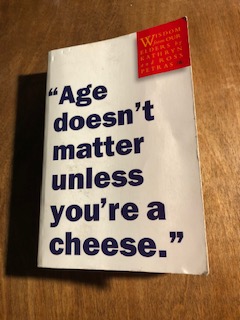
I walk by a well-tended Little Free Library on a warm autumn day, and the book that calls to me is one of those little handbooks of sayings, the kind you keep at a lake cabin or in the bathroom. It’s called “Age Doesn’t Matter Unless You’re a Cheese.”

I smile, of course, but do I believe the title’s true? Isn’t claiming that “age doesn’t matter” just another way of denigrating old age, of saying it is a reality and simple fact to be denied?

We dismiss age in our culture. We exchange disparaging birthday cards about growing older, like the one I saw recently of a drooping, half-naked granny wearing leather sex gear (how preposterous that an old woman would have a sex life). We women lie about our age, feeding a multi-billion-dollar “beauty” industry with face creams and makeup and hair dye and Botox injections — and taking it as the highest compliment when someone reassures us that we look good, “for your age.”

We deny that age will affect us. As an athletic person and daily exerciser, I have done so myself, until sore knees and slower bike rides and more need for sleep have told me otherwise.

During a get-out-the-vote phone bank before the election, I commented in the Zoom chat to my young colleagues that it would be interesting to discuss what conclusions we draw based on the prospective voter’s age, which we can see. “I usually look forward to talking with older women because I assume they’ll be kinder,” said one woman who’s maybe 30. “But I have talked to some feisty older ladies lately.”

I might have counted National Public Radio reporter Nina Totenberg as a “feisty older lady” until she poked fun at her age on “The Axe Files” podcast with political commentator David Axelrod. He noted that Totenberg, who’s 76, has been covering the U.S. Supreme Court longer than any current justice has been serving. “Thanks,” she said sarcastically. And then came the predictable: “I’ve been covering the court since I was 6.”

Right, LOL.

My extended family had a Zoom call recently to meet my 82-year-old uncle’s second wife. They like to golf and someone asked what her handicap is. “That’s like asking a woman her age,” one of my cousins said to a round of laughter. I wondered whether I — the humorless feminist — was the only one who felt the sting of shame behind the joke, the hard and hurtful implication that women lose value as they age.

Name it and claim it

My younger son sits in the kitchen of our family home, thumbing through a novel he has stopped by to give me. He reads a quote by Buddhist author Pema Chodron at the beginning of the book: “Since death is certain, but the time of death is uncertain, what is the most important thing?”

I expect him to ask me the question that Chodron posed. Instead he says: “Do you worry about death?” My son is 25, old enough to be framing some structure around his life but still young enough to see the vista of options spread out before him. He asks me if I fear death because he sees my lifespan as limited. In his eyes, through his experience, I am old.

I answer not reflectively as an older woman but instinctively as a mother, with a Mama Bear protectiveness that has been part of me since I gave birth. “No, I don’t worry about my death,” I tell my son. “I worry more about yours.” He looks surprised and oddly pleased, while I am momentarily caught in the memory of the color draining from my father’s face as we waited for my older brother’s funeral to begin barely three weeks after he had turned 33.

“Never regret. If it’s good, it’s wonderful. If it’s bad, it’s experience.”

Writer Victoria Holt

I don’t fear death. I fear decline. I think of the woman a decade my senior who told me that she began to feel more physically vulnerable by age 70. I’m more afraid of falling than I used to be, less willing to risk a new activity like rollerblading or scooter riding for fear of being injured.

The righteousness, the declarations that age won’t slow you down, the rage against society’s youth-culture machine: Those all feel deliciously true, until you turn the corner and stare age squarely in the face. Until you recognize that time moves through a lifetime as it does through a vacation — starting slowly, stretching out in front of you as though it will last forever, then speeding up as the end draws near. And then you’re scared.

I’m never going to run an 8-minute mile again, and my waistline will never be what it was before my pregnancies. So how can I embrace who I am today? How can I love this wrinkled, wiser woman who nursed her mother to a dignified death, who raised two boys to be good men, who is trying to come to grips with the reality that her career is almost over and a decades-long sense of purpose will have to be replaced?

“During much of my life, I was anxious to be what someone else wanted me to be,” says poet Elizabeth Coatsworth in the Age Doesn’t Matter quotations collection. “Now I have given up that struggle. I am what I am.”

And what I am, vibrantly and gratefully, is old, with wisdom and a wealth of experiences that compensate for the swift and sometimes bittersweet passage of time.

Women’s worldview at work shifts with age

Maybe it’s my status as the oldest person in my graduate school class — not by years, mind you, but by decades.

Maybe it was my conscious career choice at 56 to walk away from a well-compensated director-level position rather than risk a late-50s layoff in that organization’s uncertain, chaotic culture.

My current job provides a lower salary but far less stress — and that has allowed me to branch out and explore at a time of life when I finally have the freedom to do so.Worldview

Research and anecdotal evidence show that some professional women are leaving the work force deep into middle age for reasons that include disillusionment, early retirement and elder-care duties. Other career-oriented women in their 50s and early 60s are scaling back their careers, as I did, shedding their intense, single-minded focus as they would a wool blazer on a warm spring day.

  • “I find myself less ambitious by workplace standards — wanting to climb the corporate ladder — and more interested in doing work that is truly meaningful to me,” says a journalist, 64, whose children are older than some of her colleagues.
  • “I have definitely shifted gears in the last seven or eight years,” says a nonprofit manager, 55, who would like to write. “Now that my sons are mostly off on their own, I don’t feel the pressure to provide for them like I used to, which meant going for the more demanding, higher accountability positions. I like having time to do other things I enjoy.”
  • “Age both gives and limits options,” says a project manager who just turned 59. “As an empty nester whose step-kids have graduated from college and are married, I find that my husband’s and my significant expenses are behind us. There’s some freedom in that. At the same time, ageism is real. I would not want to be looking for a new job at my age.”

Do you consciously try to look younger?

My hair is finally turning gray, and I’m not sure I like either the expense or the ethic of maintaining “artificial auburn.”

Most respondents told me they do color their hair in order to appear younger at work. Others emphasized the importance of maintaining a wardrobe that defies stereotypes about their age. “I don’t wear things like flower-print shirts or tops with cats,” one woman says dryly.

“Looking younger is a tricky proposition, especially with women,” explains my 62-year-old neighbor, a well-coiffed Frenchwoman whose accent alone is elegant. “I dress to reflect that I have style but that I am not interested in looking 30.”

“I do worry about my looks,” says a friend and colleague, 57. “I feel young, but when I catch myself in the mirror on a day when I’m tired, I see an older woman, and I freak out. I fear others are judging me as not being in the flow of what is happening now.”

Seeking the perspectives of younger people helps some Baby Boomers stay current.

“I try to really listen to what younger generations do, say, think,” says a 55-year-old IT manager who oversees a young staff. “I like to know what they do for fun, how they’ve solved a problem, what they’re worried about. I think that keeps my thinking young.”

“Since I am somewhat slim and flat-chested, I don’t feel as if I am trying hard to appear young,” says a Chicago librarian, 54. “But because I have three youngish children, I have the vernacular of the young. That, more than my dressing, I think, makes me appear youthful.”

One 57-year-old entrepreneur maintains her vibrancy with daily meditation, healthful food and exercise. “I walk in a strong and confident manner,” she says.

Personally, I consider exercise the fountain of youth, and I am proud at 58 of being among the fittest people in my office.

How does aging benefit your career?

I inherited my work ethic — and perfectionism and sense of duty — from my father, a retired attorney and state senator who is now a relatively robust 90. I remember my dad’s exasperation in his 50s that his mind was less sharp, just as my own mental lapses now embarrass me.

Here is the key, the upside, the benefit to growing older: His younger law partners were turning to him for wisdom.

In a youth-obsessed culture, it is tempting to see middle age as an inevitably downhill slide, to experience it as a period of retrenchment and regret rather than of passion and possibilities. Regrets weigh on me in graduate school: Why didn’t I do this when I was younger?

Then I notice how I am relishing the endeavor — my desire to dig in and learn. My 30-something classmates with corporate jobs and small children are in school to get it done. The degree is a steppingstone in their careers.

“‘A’ is for anxiety, ‘B’ is for balance,’” a classmate told me recently, observing my meticulous note-taking and obvious efforts to earn the highest grade. A manager at 3M and the mother of a 2-year-old girl, she barrels through two classes a semester and contents herself with B’s.Fork in the Road

I want a more holistic experience, a theme I hear repeatedly in midlife women’s approach to life and work.

  • “I feel like I have a lot of information and expertise to share regarding aging, which is part of my career, and I am living the journey,” says an elder-care expert, 63, who is easing toward retirement by working part time.
  • “Work has become much less important in my life as I age, while at the same time, I moved into a position where that is OK,” says a former journalist, 56, who now works in communications for county government. “I am bringing skills to my current position that I gathered throughout my career, which are appreciated by those in my organization.”
  • “The 50s are a great age of coming into one’s own,” says an industrial psychologist who earned her master’s and Ph.D. while in her 20s. “I’m hitting my stride in so many ways. I’m doing work now that I could not have done even five years ago as a result of my cumulative knowledge, experience and expertise.”

Do you reveal your age at work?

Tellingly, out of 10 women who responded to my questions, the psychologist is the only one who willingly volunteers her age to colleagues and clients; unlike the others, she is self-employed and in a field where years of experience is highly valued.

Most said they wouldn’t lie if asked outright, but they don’t advertise their ages either. Being seen as overqualified or out of step with technology or “set in your ways,” as one woman put it, is too great a risk.

Then there’s the question of whether employers will invest in older workers: “Just recently I realized that there was probably no opportunity for a raise or promotion because they figure, accurately, that I’m unlikely to go to another job at this stage of my life,” says an academic editor, 62.

I consciously took a risk that my new employer would invest in me when I left the director-level job to return to school, launch a blog and care for my mother as she was dying. The pay cut was a blow to both my pocketbook and ego; the promise of my position growing into something larger is still a dream.

But here I am. I made the leap, and all I can do is move forward, keep learning, be present — and be grateful for knowing courageous women who refuse to let society define what “prime of life” means.