

Ask middle-aged women which physical changes have surprised them, and they’ll talk about joints: aching knees, fragile ankles, sore shoulders that restrict range of motion.
The less common complaints are about bathroom habits. “Jumping makes me pee!” says a 56-year-old yoga instructor and nutrition coach. Another woman, 62, says simply “constipation” when asked about the physical change she least expected.
Our skin starts to dry out as early as our late 20s. We begin to lose muscle mass in our 30s. By our 40s, we see parentheses flank our mouths and darker circles beneath our eyes. But for some of us who have been athletic all our lives, the hardest signs of aging are the physical limitations.
“The payback for pushing yourself too hard gets worse as you age,” says Web MD, a valuable online resource for both diagnosis and healing of athletic injuries.
Gayle Winegar, president and co-owner of the SweatShop in St. Paul, Minn. — a Pilates- and strength-based studio that attracts women of middle age and older — agrees that shoulders and knees become more vulnerable with age. And injuries take longer to heal. “You get one injury, and that has a downward spiral. It’s hard to get up to the frequency, intensity and duration you had before,” she explains.
Slow down, you move too fast
Ego invariably is at the core of my athletic injuries. Whether it was the right hamstring muscles I blew out by showing off during a step aerobics class I was teaching, or the advice I failed to heed in my late 40s that middle-aged runners are less prone to injury if they slow down and even take “walk breaks” on their runs, I have consistently yielded to that competitive drive to keep up, win, be the best or — most humbling, in hindsight — to appear younger than I am.
Now, at 57, I finally recognize that if I don’t act my age, I’ll be sidelined.
I practice yoga at Core Power, a high-octane urban chain that attracts primarily young professionals. I joined in February 2011, desperate for the 104-degree rooms and chance to sweat during a typically frigid Minnesota winter. I also wanted Western-style yoga classes that focused more on fitness and rigorous workouts than Eastern philosophy.
Proudly referring to myself as the Oldest Woman in Yoga, I jumped into the most demanding classes, determined to keep pace with the youthful peacocks whose “body art” danced as they flowed through the poses.
Months later, I sustained a shoulder injury from doing the difficult Chaturanga Dandasana (yoga push-up) pose too quickly and with insufficient back and abdominal strength. It cost me weeks in physical therapy and a three-month hiatus from Core Power.
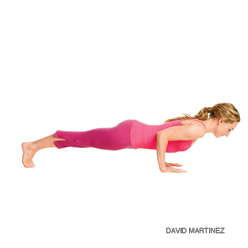
Yoga push-up
Older and wiser
Ego is the antithesis of what a yoga practice is supposed to be about. But that pastoral ideal — to “stay on your mat,” to focus solely on your own breath, to resist comparing body types and flexibility — is difficult to practice at a Type A studio like Core Power. And for a Type A practitioner like me.
Then I figured out that injury could heal me, not only the other way around.
When I returned to Core Power, I went to slower-moving, balance-focused classes that don’t include multiple repetitions of Chaturanga. I learned the 26 poses of hot yoga and sought out teachers who are closer to my age. And, just as yoga calls us to take its spiritual tenets with us off the mat, out into the world, I began to look at myself and others differently.
The Oldest Woman in Yoga quit mentally competing and comparing. If the loose skin shows on my lower belly, stretched twice — mightily — by nearly 10-pound baby boys, so be it. To paraphrase Gloria Steinem: “This is what 57 looks like.”
I ask instructors how to modify for my tight hips and weak left shoulder. I warmly greet the young women who clean the studios and bathrooms, and strike up conversations with other middle-aged women.
And, in an effort to focus less on being thin than being strong, I tried a TRX class at the SweatShop.
“I would love to look good in an Academy Awards ball gown, but that no longer is the highest thing on my list,” says Winegar, who founded the SweatShop in 1981, at the cusp of what would become a booming fitness movement. “Now, I want to get up without an achy back or stiff hands or feet that don’t work or a shoulder that doesn’t move.
“Women need different things at all stages of life.”
Lesson learned: I am working to accept my age rather than denying it. If enough of us come to celebrate the inevitable, society may see the wisdom that comes with wrinkles.
 The Middle Stages: Between Midlife and Old Age